
Mary Tong, BHSc, MD Candidate,1 Joseph M. Lam, MD, FRCSC,2
1McMaster University, Hamilton, ON.
2Clinical Associate Professor, Department of Pediatrics, Clinical Associate Professor, Department of Dermatology University of British Columbia, BC.
CLINICAL TOOLS
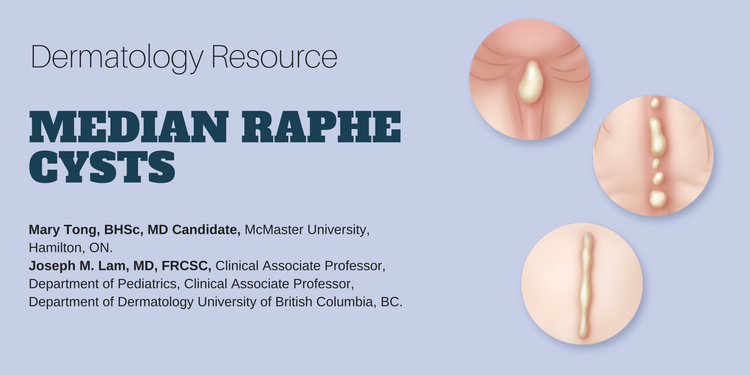
Abstract: Median raphe cysts are rare congenital lesions caused by a defect in embryological development of the male genitalia. They can present as solitary or multiple papules along the median raphe from urethral meatus to the anus. Although they are asymptomatic during childhood, they can cause problems later on as they increase in size. Surgical excision of the lesion is not necessary unless the patient becomes symptomatic.  |
| Key Words: median raphe cysts, congenital lesions, treatment, management. |


| Median raphe cysts are benign cysts that can be present at birth, or acquired due to trauma or infection in the genitalia area. |
| Histologically, the cysts can have pseudo stratified columnar, squamous cell, or glandular epithelium, or a mixture of these cells. |
| Although these cysts are asymptomatic during childhood, they should be monitored overtime because they may cause problems as they increase in size with time. |
| Because these are benign malformations, median raphe cysts do not require excision unless they cause problems such as pain, problems with urination or sexual activity, or for cosmetic reasons. |
| Median raphe cysts are benign lesions that may be caused be a defect in the embryological development of the male genitalia. |
| The differential diagnoses of median raphe cyst include glomus tumor, dermoid cyst, pilonidal cyst, epidermal inclusion cyst, urethral diverticulum, and steatocystoma. |
| Treatment for asymptomatic median raphe cyst is not necessary but surgical excision can be considered if the cyst is causing problems or for cosmetic reasons. |
| To have access to full article that these tools were developed for, please subscribe. The cost to subscribe is $80 USD per year and you will gain full access to all the premium content on www.healthplexus.net, an educational portal, that hosts 1000s of clinical reviews, case studies, educational visual aids and more as well as within the mobile app. |