
Editor's Note, Volume 10 Issue 6


D’Arcy Little, MD, CCFP, FCFP, FRCPC Medical Director, JCCC and HealthPlexus.NET

Briar Findlay1Joseph M. Lam, MD, FRCPC,2
1 Paediatric Resident, BC Children's Hospital, Vancouver, BC.
2Associate Clinical Professor, Department of Paediatrics, Associate Member, Department of Dermatology, University of British Columbia.
CLINICAL TOOLS
| Abstract: Many dermatoses occur in the pediatric population that can mimic atopic dermatitis based on their morphology or their propensity for triggering itch. This review will highlight some of the common skin conditions that can mimic atopic dermatitis, their typical response to topical corticosteroids and helpful features that can help distinguish these conditions from atopic dermatitis. |
| Key Words: atopic dermatitis mimickers, topical corticosteroids, chronic inflammatory skin disease, paediatrics. |

| Many dermatitic eruptions can mimic atopic dermatitis but features such as their typical response to topical corticosteroids can be a helpful distinguishing feature. |
| Some atopic dermatitis mimickers can worsen with topical corticosteroids and these include periorificial dermatitis and tinea corporis. |
| Some atopic dermatitis mimickers will only partially improve with topical corticosteroids alone and these include allergic contact dermatitis and molluscum dermatitis. |
| Other atopic dermatitis mimickers such as psoriasis and seborrheic dermatitis can respond to topical corticosteroids and the correct diagnosis can be made using other morphological or historical features. |
| AD is a prevalent, chronic and relapsing condition in infancy and childhood. |
| Morphology, distribution and age of onset can be important in distinguishing between AD and common mimickers. |
| Response to corticosteroids is not diagnostic for AD as many mimickers may have an initial or complete response to topical corticosteroids; however, corticosteroid usage in some mimickers of AD may lead to complications and unnecessary side effects of topical corticosteroids. |
| To have access to full article that these tools were developed for, please subscribe. The cost to subscribe is $80 USD per year and you will gain full access to all the premium content on www.healthplexus.net, an educational portal, that hosts 1000s of clinical reviews, case studies, educational visual aids and more as well as within the mobile app. |
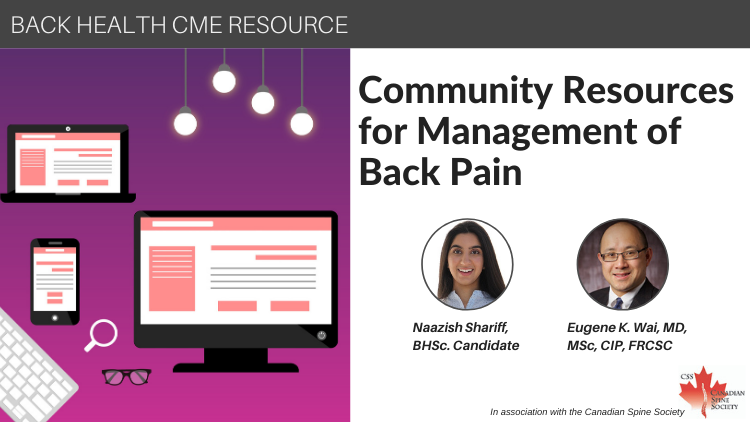
1Naazish Shariff, BHSc. Candidate, 2Eugene K. Wai, MD, MSc, CIP, FRCSC,
1Faculty of Health Science, University of Ottawa, Ottawa, ON. 2Head—University of Ottawa Combined Adult Spinal Surgery Program, Associate Professor—Division of Orthopaedic Surgery, University of Ottawa, Cross Appointment to School of Epidemiology and Public Health, Ottawa, ON.
CLINICAL TOOLS
| Abstract:Back pain is a community level health problem because of the high prevalence and burden on patients, health care and society. Many aspects of back management, such as exercise and psychosocial stress management, are suitable for a community model of care. Community models for back pain are in their infancy but lessons learned from other chronic diseases can be applied and will be discussed. This review will discuss existing evidence-based community programs, such as Exercise is Medicine® and the Stanford Model, that support exercise and self-management, and their relevance to low back pain. |
| Key Words: back pain, community model of care, self-management, exercise, lifestyle risk factors. |
Members of the College of Family Physicians of Canada may claim MAINPRO-M2 Credits for this unaccredited educational program.
www.cfpc.ca/Mainpro_M2
You can take quizzes without subscribing; however, your results will not be stored. Subscribers will have access to their quiz results for future reference.

| Many aspects of back management such as exercise and promotion of self-management are more suited for a community model of care. |
| Physicians and other health care providers are important catalysts for change and must support patient engagement. |
| Health care practitioners should identify resources within their community as well as develop their own local creative solutions. |
| Evidence-supported models for community involvement in managing chronic diseases are available. This article provides resources enabling practitioners to identify these programs in their community and tailor them for their back pain patients. |
| To have access to full article that these tools were developed for, please subscribe. The cost to subscribe is $80 USD per year and you will gain full access to all the premium content on www.healthplexus.net, an educational portal, that hosts 1000s of clinical reviews, case studies, educational visual aids and more as well as within the mobile app. |