
Editor's Note, Volume 8 Issue 5


D’Arcy Little, MD, CCFP, FRCPC Medical Director, JCCC and HealthPlexus.NET
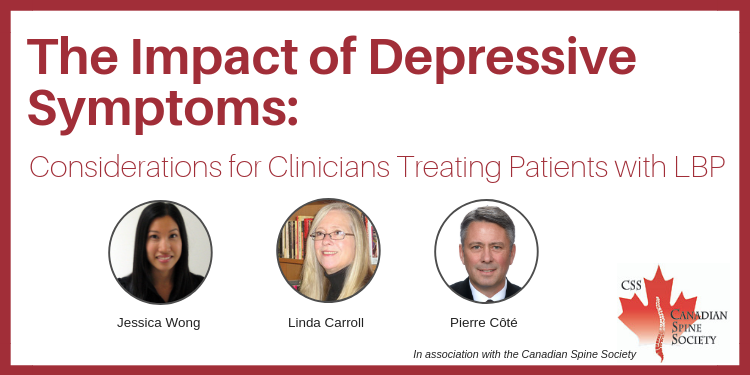
Jessica Wong, DC, MPH,1 Linda Carroll, PhD, 2 Pierre Côté, DC, PhD, 3
1 Research Associate, UOIT-CMCC Centre for Disability Prevention and Rehabilitation, University of Ontario Institute of Technology (UOIT) and Canadian Memorial Chiropractic College (CMCC).
2Professor Emeritus, School of Public Health, University of Alberta.
3 Professor and Canada Research Chair in Disability Prevention and Rehabilitation, Faculty of Health Sciences, University of Ontario Institute of Technology (UOIT); Director, UOIT-CMCC Centre for Disability Prevention and Rehabilitation, University of Ontario Institute of Technology (UOIT) and Canadian Memorial Chiropractic College (CMCC).
CLINICAL TOOLS
| Abstract: A considerable proportion of patients with low back pain (LBP) experience depressive symptoms. A clinical case is used to highlight potential steps that clinicians can take to help manage depressive symptoms in these patients: 1) Assess for depressive symptoms using a valid and reliable questionnaire; 2) Provide education, reassurance, and self-management strategies to initiate the program of care; 3) Adjust care plans if patients also present with depressive symptoms (e.g., ongoing support and education); and 4) Provide ongoing assessment of depressive symptoms, and consider referrals to a specialist or other health care providers (e.g., counselors, clinical psychologists, or psychiatrists) for further evaluation if symptoms are worsening. |
| Key Words: Low back pain, depressive symptoms, depression, depressive disorder. |
Members of the College of Family Physicians of Canada may claim MAINPRO-M2 Credits for this unaccredited educational program.
www.cfpc.ca/Mainpro_M2
You can take quizzes without subscribing; however, your results will not be stored. Subscribers will have access to their quiz results for future reference.

| A considerable proportion of patients with low back pain present with depressive symptoms |
| Depressive symptomatology includes depression that has not been formally diagnosed and symptoms that do not meet the criteria for depression |
| The presence of depression may indicate poorer recovery from low back pain |
| Patients experiencing low back pain and concomitant depressive symptoms may benefit from ongoing assessments, education, reassurance, and self-management strategies |
| Assess for depressive symptoms in patients with LBP using a valid and reliable questionnaire (e.g., Patient Health Questionnaire-9) |
| Provide education, reassurance, and self-management strategies to all patients with LBP to initiate the program of care |
| Adjust the care plan accordingly if patients also present with depressive symptoms, including additional support and education (e.g., addressing misconceptions, encouraging activity) on an ongoing basis |
| Provide ongoing assessment of depressive symptoms, and consider referrals for further evaluation if symptoms are worsening |
| To have access to full article that these tools were developed for, please subscribe. The cost to subscribe is $80 USD per year and you will gain full access to all the premium content on www.healthplexus.net, an educational portal, that hosts 1000s of clinical reviews, case studies, educational visual aids and more as well as within the mobile app. |
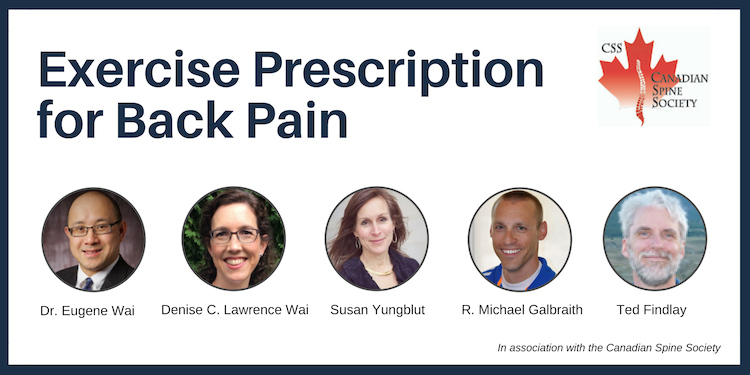
Eugene K. Wai, MD, MSc, CIP, FRCSC1 R. Michael Galbraith, DO, CCFP (SEM), Dip Sport Med2 Denise C. Lawrence Wai BScPT3 Susan Yungblut, PT, MBA4 Ted Findlay, DO, CCFP, FCFP5
1 is an orthopedic surgeon who specializes in the care of adult spinal disorders. He is also an Associate Professor in the Department of Surgery at the University of Ottawa. In addition he is the Research Chair for the Canadian Spine Society.
2Private practice Elite Sports Medicine in Lethbridge, AB.. Head Team Physician, Lethbridge Hurricanes (WHL). Clinical Lecturer, Dept of Family Medicine, University of Calgary School of Medicine.
3 is a Physical Therapist in Ottawa and a Research Assistant at The Ottawa Hospital.
4 Physiotherapist, Liquidgym, Ottawa; Nordic Walking Instructor and Urban Poling Master Trainer, OttawaNordicWalks; Past Director, Exercise is Medicine Canada
5 is a Clinical Assistant Professor in the Department of Medicine at the University of Calgary. He is also in a Private Family Medicine practice. In addition he is on Medical Staff at Alberta Health Services, Calgary Zone in Calgary, Alberta.
CLINICAL TOOLS
| Abstract: Exercise is one of the most effective and simplest evidence-based recommendations to manage acute and chronic back pain. This paper discusses the physiology and evidence to support exercise as effective treatment. We will provide guidance on how to assess and prescribe exercise and offer methods to educate and encourage physical activity for patients with back pain. |
| Key Words: Back Pain, Physical Activity, Exercise Prescription, Motivational Interviewing. |
Members of the College of Family Physicians of Canada may claim MAINPRO-M2 Credits for this unaccredited educational program.
www.cfpc.ca/Mainpro_M2
You can take quizzes without subscribing; however, your results will not be stored. Subscribers will have access to their quiz results for future reference.

| 1. Exercise is one of the most effective and simplest evidence-based recommendations to manage acute and chronic back pain. |
| 2. For chronic back pain the most important exercise is the one the patient will actually do. |
| 3. For acute back pain the exercise prescriptions should take into account the patient's directional preference of exercise (Pattern of Pain) and the patient's unique situation. |
| 4. Exercise Prescriptions should include the F.I.T.T. principle (Frequency, Intensity, Time and Type). |
| Simply asking the patient about exercise has been shown to be effective in improving health outcomes. Consistent messaging about the positive role of physical activity is important. |
| Most forms of physical activity are usually beneficial. The exercise prescription should take in to account what the patient is actually prepared to do. |
| Patients often require reassurance that pain associated with exercising does not lead to physical harm. |
| Motivational interviewing is a structured, empathetic method to engage resistant patients. |
| Walking is free. |
| To have access to full article that these tools were developed for, please subscribe. The cost to subscribe is $80 USD per year and you will gain full access to all the premium content on www.healthplexus.net, an educational portal, that hosts 1000s of clinical reviews, case studies, educational visual aids and more as well as within the mobile app. |
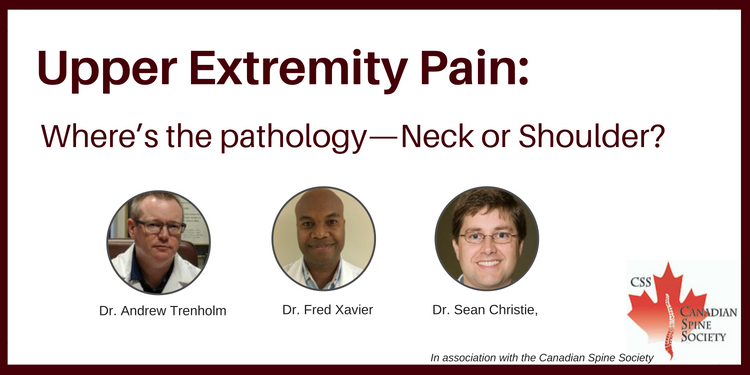
Andrew Trenholm, MD, MSc, FRCSC,1 Fred Xavier, MD, PhD,2 Sean Christie, MD, FRCSC,3
1 Associate Professor Orthopaedics (Upper Extremity and Trauma) Dalhousie University, Halifax, NS.
2Fellow, Combined Spine Program, Department of Surgery, Dalhousie University, Halifax, NS.
3 Associate Professor, Dalhousie University, Department of Surgery (Neurosurgery), Halifax, NS.
CLINICAL TOOLS
| Abstract: Neck and shoulder disorders are among the leading causes of pain and disability. History and physical examination are key components to clinical diagnosis and to determining whether the source of the arm pain is the neck or the shoulder. When consistent with the history, it is recommended to perform targeted provocative tests or manoeuvers. Several studies have shown that using a test item cluster improves diagnostic accuracy more than any single test item alone. Imaging, electrophysiological and laboratory studies are usually unnecessary unless there are clear clinical indications. |
| Key Words: Cervical radiculopathy, Neck pain, Shoulder pain, Clinical diagnosis, Provocative tests. |
Members of the College of Family Physicians of Canada may claim MAINPRO-M2 Credits for this unaccredited educational program.
www.cfpc.ca/Mainpro_M2
You can take quizzes without subscribing; however, your results will not be stored. Subscribers will have access to their quiz results for future reference.

| 1. Sinister pathology is rarely produces completely intermittent pain. |
| 2. Neck pain is frequently associated with psychosocial stress and heightened emotional response. |
| 3. The first step in taking the history is to establish the site of the dominant pain. |
| 4. A neurological examination should include tests for spinal cord involvement causing cervical myelopathy. |
| 5. Neck dominant pain can include pain felt in the face, upper back, top of the shoulder, anterior chest and headache. |
| The best way to differentiate between the neck and the shoulder as the source of upper limb pain is to assess the effect of movement in each area on the patient's typical pain. |
| The provocative tests should be chosen to confirm a suspected diagnosis. By themselves they are not a reliable guide to the specific pathology. |
| Neck and shoulder problems may coexist particularly in older patients and the examination of one should always include a screen of the other. |
| Radicular arm pain is more often caused by boney foraminal nerve root entrapment than by a new "soft" disc herniation. |
| To have access to full article that these tools were developed for, please subscribe. The cost to subscribe is $80 USD per year and you will gain full access to all the premium content on www.healthplexus.net, an educational portal, that hosts 1000s of clinical reviews, case studies, educational visual aids and more as well as within the mobile app. |