
Editor's Note, Volume 11 Issue 1


D’Arcy Little, MD, CCFP, FCFP, FRCPC Medical Director, JCCC and HealthPlexus.NET
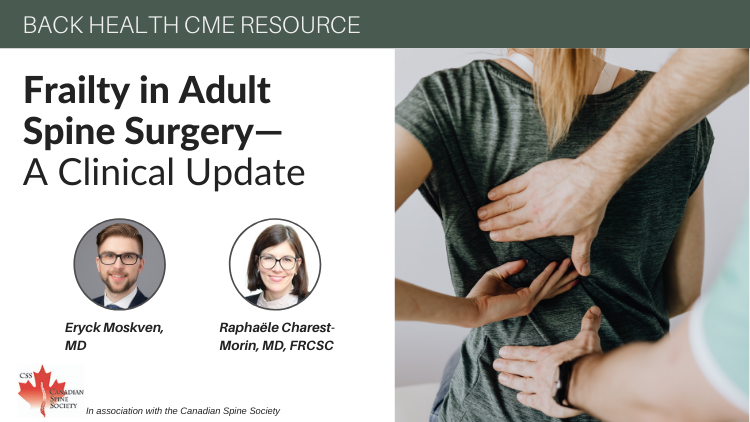
1Eryck Moskven, MD,2Raphaële Charest-Morin, MD, FRCSC,
1PGY 1, Department of Orthopaedics, Vancouver Spine Surgery Institute, University of British Columbia, Vancouver, BC. 2Clinical Assistant Professor, Combined Neurosurgical and Orthopaedic Spine Program,
Vancouver General Hospital, University of British Columbia, Vancouver, BC.
CLINICAL TOOLS
| Abstract: Purpose: Frailty is a state of increased vulnerability. This paper reviews the definitions and applicability of frailty tools and discusses the impact of frailty in patients with spinal disease. Recent Findings: Frailty is a significant risk factor for postoperative adverse-events (AEs), prolonged postoperative length of stay (LOS), adverse discharge disposition, and mortality following spine surgery. Cumulative deficit measures such as the mFI are appropriate risk stratification tools, while phenotypic measures are sensitive to capturing the relationship between spine disease and spine surgery on the frailty trajectory. Summary: Frailty in patients with spinal disorders is predictive of postoperative adverse outcomes. The role of spine surgery to reverse frailty requires investigation. |
| Key Words: frailty, spine surgery, adverse outcomes, geriatric. |
Members of the College of Family Physicians of Canada may claim MAINPRO-M2 Credits for this unaccredited educational program.
www.cfpc.ca/Mainpro_M2
You can take quizzes without subscribing; however, your results will not be stored. Subscribers will have access to their quiz results for future reference.

| Frailty is a state of decreased reserve and increased vulnerability associated with adverse health outcomes. |
| Clinical frailty measures derived from the cumulative deficit model of frailty such as the mFI are appropriate risk stratification tools for identifying patients at an increased risk of postoperative AEs following spine surgery. |
| Frailty tools with phenotypic constructs are the most sensitive measures in capturing the relationship between spinal pathology and surgical intervention on the frailty trajectory. |
| When assessing an elderly patient, the FRAIL acronym is a helpful guide to screen for frailty - F (fatigue), R (resistance/muscular weakness), A (ambulatory difficulty), I (illness and comorbidities), and L (unintentional loss of weight). |
| Access to a readily available clinical frailty assessment tool on a mobile device, such as the Clinical Frailty Scale (CFS), reduces the need for extensive chart review to calculate and determine frailty severity. |
| When assessing for surgical candidacy the clinician should evaluate the impact of spinal pathology on health-related quality of life, the magnitude of the proposed surgical intervention and the frailty status. |
| To have access to full article that these tools were developed for, please subscribe. The cost to subscribe is $80 USD per year and you will gain full access to all the premium content on www.healthplexus.net, an educational portal, that hosts 1000s of clinical reviews, case studies, educational visual aids and more as well as within the mobile app. |
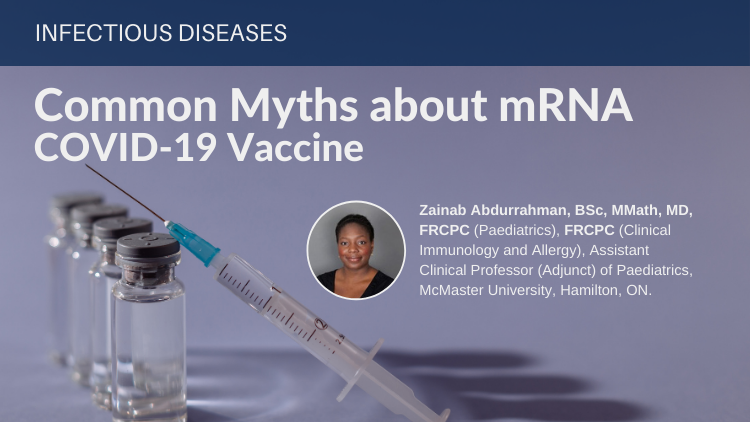
Zainab Abdurrahman, BSc, MMath, MD, FRCPC (Paediatrics), FRCPC (Clinical Immunology and Allergy)
Assistant Clinical Professor (Adjunct) of Paediatrics, McMaster University, Hamilton, ON.
CLINICAL TOOLS
| Abstract: There are many concerns the general population has over the new mRNA vaccines that have been produced and are now being distributed in countries around the world to help curb the spread of COVID-19. This review helps to debunk the myths around some of the more common concerns. |
| Key Words: COVID-19, vaccines, mRNA, trials, studies. |

| The mRNA vaccine is safe and effective for the prevention of COVID-19. |
| The two mRNA vaccines approved for use in Canada are the Pfizer-Biontech and the Moderna vaccine. |
| The Ministry of Health updated their guidelines indicating that the vaccine is still recommended for those with allergies. |
| It is important to discuss and dispel the myths that patients may have surrounding the mRNA vaccines. |
| The vaccine is safe and effective for the prevention of COVID-19. |
| Despite the safety and efficacy of the vaccine, patients who receive it should be reminded to continue wearing a mask and physically distance and follow public health guidelines. |
| To have access to full article that these tools were developed for, please subscribe. The cost to subscribe is $80 USD per year and you will gain full access to all the premium content on www.healthplexus.net, an educational portal, that hosts 1000s of clinical reviews, case studies, educational visual aids and more as well as within the mobile app. |
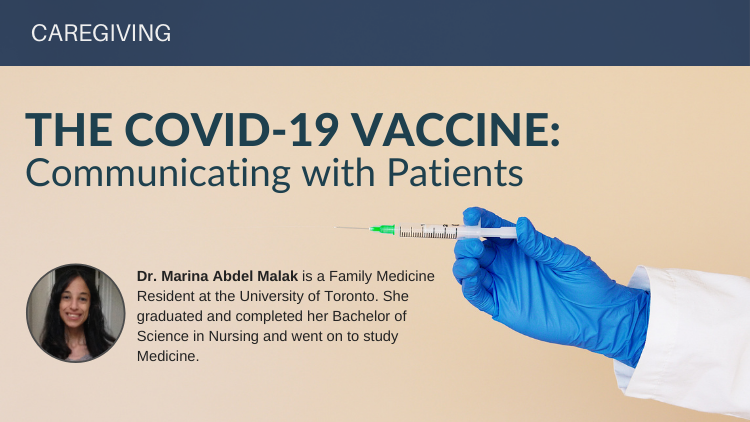
Dr. Marina Abdel Malak
is a Family Medicine Resident at the University of Toronto. She graduated and completed her Bachelor of Science in Nursing and went on to study Medicine. She has a passion for medical education, patient empowerment, and increasing awareness about the relationship between mental, emotional, and physical health.
CLINICAL TOOLS
| Abstract: The COVID-19 pandemic has challenged providers and patients in several ways. The news of a vaccine has sparked both hope and doubt among our communities. Healthcare providers are in optimal positions to educate patients about the COVID-19 vaccine, and to dispel myths. This article aims to provide quick facts about the vaccine, tips to navigate around vaccine hesitancy, and resources to share with patients. |
| Key Words: COVID-19, vaccine, pandemic, resilience. |

| The COVID-19 vaccine is available and indicated for most patients > 16 years old, in a 2-dose series (with 21 days between first and second dose) |
| There is a spectrum of 'vaccine hesitancy' among individuals. Tailoring conversations to patients is essential in helping to navigate discussions around receiving vaccines |
| Data shows that the COVID-19 vaccine is about 95% effective in preventing the virus, with side effects similar to 'routine' vaccines |
| It is the responsibility of healthcare providers to dispel myths about vaccines, and to empower patients to understand the importance of vaccination when indicated |
| To have access to full article that these tools were developed for, please subscribe. The cost to subscribe is $80 USD per year and you will gain full access to all the premium content on www.healthplexus.net, an educational portal, that hosts 1000s of clinical reviews, case studies, educational visual aids and more as well as within the mobile app. |