Caregiving

Disclaimer:  While every attempt is made to ensure that drug dosages provided within the text of this journal and the website are accurate, readers are urged to check drug package inserts before prescribing. Views and opinions in this publication and the website are not necessarily endorsed by or reflective of those of the publisher.

Dr. Marina Abdel Malak, MD, CCFP, BSc.N,

is a Family Physician in Mississauga, Ontario. She has served on several committees and groups, including The Primary Care Network and Collaborative Mental Health Network. She has a passion for medical education, patient empowerment, and increasing awareness about the relationship between mental, emotional, and physical health. Dr. Abdel Malak is highly involved in quality improvement initiatives, and her research interests include strategies to support physician wellness, patient self-management, and optimizing physician education.

CLINICAL TOOLS

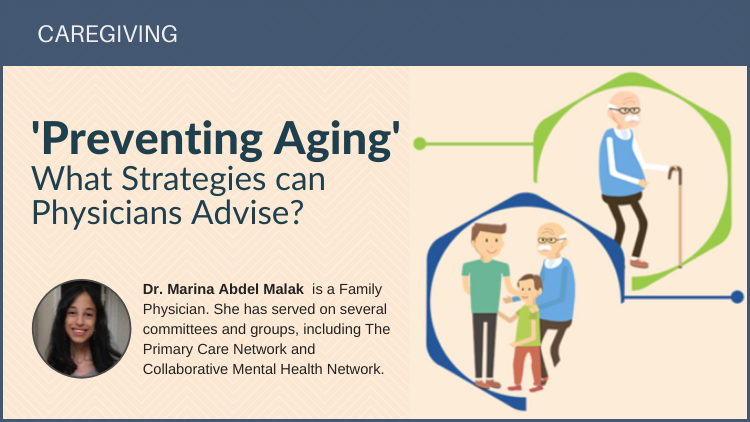
Abstract: The Canadian population continues to age, and therefore, promoting healthy aging is essential. Physicians play an important role in counselling patients on how they can optimize their health. Despite the range of societal myths and fads, the 4 pillars of health are the strategies that have been shown by evidence to promote healthy aging. In the clinical setting, it is critical for physicians to advise patients on these 4 pillars: a balanced diet, a range of physical activities, maintaining relationships, and utilizing the brain’s cognitive capacities all promote physical, mental, social, and emotional wellness. Although aging itself is unavoidable, these lifestyle behaviours can support patients in experiencing aging as a positive, fulfilling, and meaningful part of their lives.
Key Words: Health promotion, aging, nutrition, exercise, cognition, social engagement.
1) Although aging is unavoidable, patients can engage in lifestyle habits and behaviours that promote healthy aging and improve quality of life
2) Optimal nutritional intake and physical activity positively impact mental, emotional, and physical health throughout the lifespan
3) Engaging in social relationships, as well as cognitive stimulation, improves the self-esteem life-satisfaction of elderly patients
1) The four pillars of health that promote healthy aging throughout the lifespan are nutritional intake, physical activity, cognitive stimulation, and social engagement. Physicians need to counsel patients on strategies that address these four pillars
2) Chronic under and over-nutrition are both harmful to health. Physicians should therefore provide advice to patients on how to eat a balanced diet that provides essential vitamins, minerals, and macronutrients
3) Cognitive stimulation can involve activities such as word searches, memory games, playing a musical instrument, mazes, and more. Evidence supports that these activities promote neuroplasticity and can prevent the development of dementia
4) Attending groups and workshops provides social engagement opportunities for elderly patients, which allows them to contribute to the community, develop social skills, and maintain a sense of human connectedness
To have access to full article that these tools were developed for, please subscribe. The cost to subscribe is $80 USD per year and you will gain full access to all the premium content on www.healthplexus.net, an educational portal, that hosts 1000s of clinical reviews, case studies, educational visual aids and more as well as within the mobile app.
Disclaimer at the end of each page

Dr. Marina Abdel Malak

is a Family Medicine Resident at the University of Toronto. She graduated and completed her Bachelor of Science in Nursing and went on to study Medicine. She has a passion for medical education, patient empowerment, and increasing awareness about the relationship between mental, emotional, and physical health.

CLINICAL TOOLS

Abstract: The COVID-19 pandemic has challenged providers and patients in several ways. The news of a vaccine has sparked both hope and doubt among our communities. Healthcare providers are in optimal positions to educate patients about the COVID-19 vaccine, and to dispel myths. This article aims to provide quick facts about the vaccine, tips to navigate around vaccine hesitancy, and resources to share with patients.
Key Words: COVID-19, vaccine, pandemic, resilience.
The COVID-19 vaccine is available and indicated for most patients > 16 years old, in a 2-dose series (with 21 days between first and second dose)
There is a spectrum of 'vaccine hesitancy' among individuals. Tailoring conversations to patients is essential in helping to navigate discussions around receiving vaccines
Data shows that the COVID-19 vaccine is about 95% effective in preventing the virus, with side effects similar to 'routine' vaccines
It is the responsibility of healthcare providers to dispel myths about vaccines, and to empower patients to understand the importance of vaccination when indicated
To have access to full article that these tools were developed for, please subscribe. The cost to subscribe is $80 USD per year and you will gain full access to all the premium content on www.healthplexus.net, an educational portal, that hosts 1000s of clinical reviews, case studies, educational visual aids and more as well as within the mobile app.
Disclaimer at the end of each page

Dr. Marina Abdel Malak

is a Family Medicine Resident at the University of Toronto. She graduated and completed her Bachelor of Science in Nursing and went on to study Medicine. She has a passion for medical education, patient empowerment, and increasing awareness about the relationship between mental, emotional, and physical health.

CLINICAL TOOLS

Abstract: The COVID-19 pandemic is an unprecedented situation. Feelings of isolation, uncertainty, fatigue, and a loss of control have created stress among individuals across the world. Healthcare providers are in a position where they must balance their personal, familial, and work obligations during the pandemic. As frontline workers, healthcare providers are particularly vulnerable to the physical, mental, emotional, and social stressors encountered during crises. This can contribute to burn out, physical illnesses, and dissatisfaction. It is therefore essential that healthcare providers are supported in acknowledging and normalizing these feelings, and accessing resources to help them cope. To maintain social distancing and provide around-the-clock services, there are a variety of online resources available to support healthcare providers during this time. By utilizing various coping skills and seeking support, healthcare providers can protect their mental, emotional, physical, and social (MEPS) health during the COVID-19 situation.
Key Words: COVID-19, pandemic, wellness, physical health, resilience.
The COVID-19 pandemic has created a level of uncertainty, fear, and distress across the world. Feelings of isolation, anxiety, and stress are normal during this time.
Healthcare providers are, in particular, are faced with difficult decisions and situations in the COVID-19 crisis. Balancing personal, familial, and work obligations can be extremely challenging.
Mental, emotional, physical, and social health (MEPS) are equally important. As healthcare providers, we cannot take care of others if we do not care for ourselves first.
Various resources are available to help healthcare providers during the COVID-19 pandemic. Developing and utilizing a range of coping tools can promote MEPS health.
To have access to full article that these tools were developed for, please subscribe. The cost to subscribe is $80 USD per year and you will gain full access to all the premium content on www.healthplexus.net, an educational portal, that hosts 1000s of clinical reviews, case studies, educational visual aids and more as well as within the mobile app.
Disclaimer at the end of each page

Holly Clark, Holly Clark is a freelance writer and works as a content manager for various international brands. When Holly is not researching and writing she loves nothing more than heading out into the country for some downtime. Holly is currently writing for Be in Health at https://www.beinhealth.com/

Caring for someone with dementia is never easy. In fact, many people often ask for support from other individuals who are also taking care of dementia patients. The first thing you should do is make some modifications in your home. People with dementia often see the world as a new and confusing place. Things can be scary every day. Therefore, it helps to adjust the environment to suit their needs and make them feel as comfortable as possible. Here is a guide on how individuals can create a danger-free home for those with dementia.

Ask for Guidance from Local Aging Agency

Often, these professionals have experience in taking care of people with Alzheimer's or other diseases related to dementia. They can recommend certified aging experts to come inspect your house and advise accordingly on safety issues in your home. It, therefore, helps to give them a call before modifying your house.

Inspect Areas of Your House That May be Unsafe
Check out areas in your house that you suspect may compromise the safety of your loved one. And when doing that, it helps to inspect them from the patient's point of view. So you have to remember that this condition affects one's balance, cognitive abilities, memory as well as perception. According to Jane Byrne, Project Coordinator at FirstCare nursing home Wicklow, "Someone with this condition has a difficult time interpreting and remembering information as well as making sound decisions." It, therefore, helps to modify your house in a way that will give them an easy time. And when doing that, you also should be careful. Redecorating or redesigning your home and other significant changes can be unsettling. On the other hand, simple moves like furniture rearrangement can also be alarming. Therefore, be cautious and give them time to adjust.

Follow the AARP Checklist for Home Safety
For those who don't have any idea on where to start, having this list will be useful. It outlines all the safety measures caregivers should take in order to make a home danger-free for loved ones with dementia. This list will serve as a guide on how to create a safe environment. Some of the things homeowners are advised to do, include:
Decluttering the walkway of any substance. Even if there is ice, snow, or debris, individuals should make sure it is removed. It's essential that you move bikes, chalks, lawn ornaments, or jump ropes to other rooms.

Marking Step Edges Using Neon Glow in the Dark Tape

Providing sufficient lighting, both indoors and outdoors. Sometimes people with dementia may perceive shadows as demons or burglars. Placing bright outdoor lighting, therefore, helps reduce falls, fear, as well as anxiety.

Repairing uneven bricks or cracked pavements as they serve as tripping points.

Designate a Danger Zone
Dementia people forget how things are used quickly. They can even drink wiper juice or touch a hot grill with bare hands. Therefore, individuals should convert one room, either the garage or outdoor shed, into storing substances such as sharp knives, as well as cutters, bleach, washing products, paint, insecticides, and other substances that might be confused. It also helps to have a combination of locks on rooms that contain hazardous items.

Creating a safe home for seniors with dementia is about identifying areas in your house that may pose dangers and modifying them so that they're safe. It also helps that individuals do a pantry patrol regularly since patients may eat spoiled or moldy foods.

Disclaimer at the end of each page

Dr. Marina Abdel Malak

is a Family Medicine Resident at the University of Toronto. She graduated and completed her Bachelor of Science in Nursing and went on to study Medicine. She has a passion for medical education, patient empowerment, and increasing awareness about the relationship between mental, emotional, and physical health.

CLINICAL TOOLS

Abstract:Empowering patients to set health-directed goals can be a challenging process. The skilled clinician successfully supports patients in setting goals that are SMART (specific, measurable, achievable, realistic/relevant, and time-related). When goals are made in collaboration with patients, they are more likely to be long-lasting and impactful. This article will focus on how physicians can work with patients to identify, create, and work towards meaningful interventions that optimize health.
Key Words: motivation, behaviour changes, counselling, goals, treatment.

Members of the College of Family Physicians of Canada may claim MAINPRO-M2 Credits for this unaccredited educational program.

www.cfpc.ca/Mainpro_M2

You can take quizzes without subscribing; however, your results will not be stored. Subscribers will have access to their quiz results for future reference.

Goal-setting should be a partnership between physicians and patients
Asking patients what THEY want—and can—change in their lives/health is the first step to eliciting what behaviours can be targeted
After goals are set, it is important for physicians to reassess patients' progress by asking them if goals were met, and why or why not. When success occurs, patients should be congratulated on their achievements. If the goals were not met, physicians should seek to understand why this occurred, and work with patients to create new goals that are more realistic or achievable
Physicians should motivate patients to set goals that are SMART (specific, measurable, achievable, realistic/relevant, and time-related)
Patients are more likely to adhere to behaviours, habits, or interventions if they feel understood, supported, and empowered
Supporting patients in achieving goals that optimize health can have significant impacts on patient wellness, self-esteem, functioning; and strengthens the physician-patient relationship
To have access to full article that these tools were developed for, please subscribe. The cost to subscribe is $80 USD per year and you will gain full access to all the premium content on www.healthplexus.net, an educational portal, that hosts 1000s of clinical reviews, case studies, educational visual aids and more as well as within the mobile app.
Disclaimer at the end of each page

Treating Patients as Real People, Not a Collection of Symptoms

Author(s)
Deck
It’s understandable that physicians and nurses are primarily concerned with the medical conditions they’re responsible for treating.
Thumbnail Image
Teaser

Instead of asking a new patient, “How are you?” I recommend asking, “So who are you?”

When you enter a car showroom, a salesperson may identify you as a small-car buyer or a second-hand car buyer, or, if you're known to the dealership, perhaps as a solid every-three-year leaser. With a label in mind, the salesperson will approach you in a particular way.

Topic
Section

A Few Degrees of Separation

Author(s)
Deck
I have often talked about how important stories are when it comes to medical care.
Thumbnail Image
Teaser

Instead of asking a new patient, “How are you?” I recommend asking, “Who are you?”—meaning, “What is your story?”

I have often talked about how important stories are when it comes to medical care. We must, of course, use the best available medical knowledge to benefit our patients, but I believe it is also important to find the humanistic aspects of care and build on them, in order to foster human relationships.The importance of learning the patient’s personal story is key to achieving this goal.

Topic
Section

Dealing with Family Strife

Author(s)
Deck
Physicians usually become adept at choosing medications for the complaints and illnesses that patients bring to their attention.
Thumbnail Image
Teaser

One always hopes that as medical practitioners, we will be able to focus our attention on the medical issues faced by seniors…

One always hopes that as medical practitioners, we will be able to focus our attention on the medical issues faced by seniors and help families cope with the fears, disappointments and tragedies that are faced by loved ones in the midst of what are often life-altering illnesses.

Section

Offering patients more choices about end-of-life care

Author(s)
Deck
What I found surprising about the National Post article was that one would think after reading it that offering dying patients more choices in their end-of-life care was a novel idea...
Thumbnail Image
Teaser

Originally published in December 2012 on the Baycrest.org

What I found surprising about the National Post article was that one would think after reading it that offering dying patients more choices in their end-of-life care was a novel idea...

Originally published in December 2012 on the Baycrest.org

Section

Advances in Alzheimer's Disease Management

CHAPTER 7: Ethical and clinically humane end-of-life care for those living with dementia
by Michael Gordon


Editors:
Serge Gauthier, McGill University, Montreal, Quebec, Canada
Pedro Rosa-Neto, McGill University, Montreal, Quebec, Canada
Publisher: Future Medicine
Reviewed by: Michael Gordon, MD, MSc, FRCPC, FACP, FRCPEdin

It is always a pleasure to be able to discuss a new book to a receptive audience when I believe the book has something special to offer. When it comes to reviewing books outside the realm of medicine or the medical sciences, reviews often are reflective of the personal and aesthetic views of the reviewer. There are many books written for professional readers on the fringe of medical science that deal with non-clinical aspects of medicine and many that have translated important medical concepts to the lay audience and others in the form of memoirs and novels of the personal and historical type that add a great deal to the general wealth and richness of medicine and the associated medical sciences.

To undertake an academic text book is always a daunting task. Generally if experts and specialists in the field cannot write such a book without the help of others and currently the idea of editors securing experts to write the relevant chapters is a well-accepted methodology for achieving that goal. That being said it becomes the responsibility of the editors to make sure that those that they recruit to write the relevant chapters have the academically sound and clinically and research-based capability of doing so and on top of that have the writing skills to achieve their goal. Moreover, for the chapters to hang together in one strives to have some degree of congruence in the writing approaches and styles, while at the same time promoting the particular capabilities of the writers of each chapter. At the end it is hoped that the chapters hang together into a whole that attracts the reader and provides a perspective on the subject and each of its varied components that would be hard to achieve if the reader decided to explore each of the subject chapters separately without the benefit of them being collated, edited and reference into one easily accessible book.

I am therefore pleased and honoured to not only present the book to subscribers of HealthPlexus.net, Advances in Alzheimer’s Disease Management edited by Serge Gauthier and Pedro Rosa-Neto but to have been one of the contributors. At a time when the knowledge surrounding Alzheimer’s disease and other dementias is on the one hand expanding rapidly from the scientific perspective, for the practicing physician and patient living with dementia and their families, the challenges seems to be overwhelming. There seems to be a huge disconnect between the understanding and scientific progress of the causes in many domains of enquiry and the actual clinical impact that all this new knowledge currently has that physicians in the front lines of care can utilize clinically.

In medicine however, one never knows what key will be the one that opens the door we are all looking to enter. At any given time all we can do is to try and figure out using the best clues and evidence available to know what secrets lay behind that door. The readily accessible E-book format in which Advances in Alzheimer’s disease management is produced allows for a relatively low cost alternative to the usual costs of hard copy texts. The content of the book covers all the main challenging concepts and recommended or best-practices as they exists currently. Obviously in time, perhaps a very short time, some of these will change but for those in the field we all know that many of the concepts and practices have not changed in many years.

The table of contents includes the following subjects by the authors listed next to the chapter titles, with mine at the end. I have been given permission to reproduce my chapter, Ethical and clinically humane end-of-life care for those living with dementia on the HealthPlexus.net website so that subscribers can get a taste of the e-book itself.

1) Genetics of Alzheimer’s disease by Jayashree Viswanathan, Hilkka Soininen & Mikko Hiltunen;
2) Diagnosis of Alzheimer’s disease by Pedro Rosa-Neto, Jared Rowley, Antoine Leuzy, Sara Mohades, Monica Shin, Marina T Dauar and Serge Gauthier
3) Available symptomatic antidementia drugs by Marie-Pierre Thibodeau and Fadi Massoud
4) New drugs under development for Alzheimer’s disease by Lezanne Ooi, Kirubakaran Shanmugam, Mili Patel, Rachel Debono and Gerald Münch
5) Management of agitation and aggression: controversies and possible solutions by Clive Ballard and Anne Corbett
6) Guidelines for the diagnosis and treatment of Alzheimer’s disease by Serge Gauthier and Christopher JS Patterson
7) Ethical and clinically humane end-of-life care for those living with dementia by Michael Gordon

For those interested in ordering the book, this can be done through the following links:
The direct URL for the book is:
http://www.futuremedicine.com/doi/book/10.2217/9781780840840

For those who are interested in finding more information about the book/our e-book series, the email address is:
info@futuremedicine.com
For those who wish to place an order, the email is:
sales@futuremedicine.com