
Editor's Note, Volume 8 Issue 3


D’Arcy Little, MD, CCFP, FRCPC Medical Director, JCCC and HealthPlexus.NET
Dr. Aly Abdulla1 Adil Abdulla2 Neelam Charania3
1 is a family doctor with specialties in sports medicine, palliative care, and cosmetic medicine. He can be found on Twitter, LinkedIn and https://ihopeyoufindthishumerusblog.wordpress.com/
2 is a law student at the University of Toronto that has suffered 13 concussions.
3 is a Masters in Occupational Therapy from Boston University and involved in managing and rehabilitating patients with chronic concussion syndrome.
CLINICAL TOOLS
| Abstract: Concussion or minimal traumatic brain injury is a confusing medical condition that is more common than previously appreciated. At the Berlin congress in 2016, 3 key tools and 11 key processes have been developed to clarify this condition and ensure good outcomes. This article summarizes those recommendations in an easy to use format. |
| Key Words: Concussion, minimal traumatic brain injury (mTBI), symptoms, protocol. |


| Do the SCAT5 or cSCAT5 on everyone with a mTBI. |
| When thinking of concussion also consider cervical spine or neck injury and vestibular injury. Learn to differentiate them. Treat accordingly. |
| The patient should rest for 24–48 hours after the injury, then can be encouraged to become gradually and progressively more active while staying below their cognitive and physical symptom-ex-acerbation thresholds |
| Any patients having persistent concussive symptoms (> 14 days for an adult or > 30 days in a child) should be referred to a specialist in mTBI and prescribed active rehabilitation. |
| Have a high rate of suspicion for mTBI |
| Most mTBI are managed well with Remove from play, Re-evaluate in office using SCAT5, and Rest |
| Repeat clinical testing is de rigeur for Return to Play |
| Learn to manage symptoms like poor sleep, mood changes, and deconditioning while patients recover. |
| To have access to full article that these tools were developed for, please subscribe. The cost to subscribe is $80 USD per year and you will gain full access to all the premium content on www.healthplexus.net, an educational portal, that hosts 1000s of clinical reviews, case studies, educational visual aids and more as well as within the mobile app. |
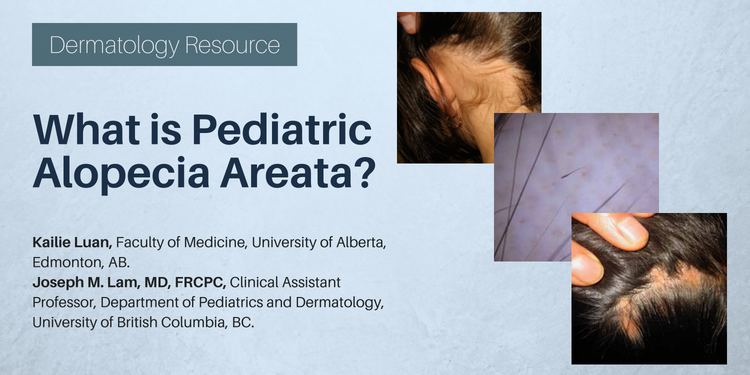
Kailie Luan,1 Joseph M. Lam, MD, FRCPC,2
1Faculty of Medicine, University of Alberta, Edmonton, AB.
2Clinical Assistant Professor, Department of Pediatrics and Dermatology, University of British Columbia, BC.
CLINICAL TOOLS
| Abstract: Alopecia areata is a chronic immune-mediated disorder that causes nonscarring hair loss. Although most commonly causing discrete hair loss on the scalp, the condition can affect any hair bearing area of the body and cause significant emotional and psychosocial distress. While intralesional glucocorticoids are often used as initial treatment for adults with the condition, therapeutic options for children are more limited with concerns of treatment tolerability and potential side effects. This article aims to provide an overview of alopecia areata with particular focus on managing this chronic condition in children. |
| Key Words: Alopecia areata, clinical presentation, diagnosis, management, pediatrics. |


| Alopecia areata is a chronic relapsing disorder characterized by non scarring hair loss that can affect any hair-bearing area of the body |
| While intralesional glucocorticoids are often used as initial treatment for adults, potent topical corticosteroids are effective as first line therapy in children due to better treatment tolerability |
| The diagnosis is generally made on clinical grounds with the majority of patients presenting with limited patchy disease affecting the scalp |
| In cases of inadequate response, topical minoxidil or immunotherapy are additional options, with systemic corticosteroids and immunosuppressive agents reserved for refractory cases, and IL-2 and JAK inhibitors as new emerging therapies for AA |
| Not all patients with alopecia areata require treatment as up to 50 percent of patients with limited alopecia areata will experience spontaneous regrowth of hair.4 |
| Due to the benign nature of alopecia areata, and spontaneous remission is common, watchful waiting is considered a reasonable option in cases of limited disease. |
| To have access to full article that these tools were developed for, please subscribe. The cost to subscribe is $80 USD per year and you will gain full access to all the premium content on www.healthplexus.net, an educational portal, that hosts 1000s of clinical reviews, case studies, educational visual aids and more as well as within the mobile app. |
Alexandra Stratton, MD, MSc, FRCSC,1 Dr. Darren Roffey, PhD,2 Dr. Erica Stone, MD, FRCPC,3 Mohamed M. El Koussy, BSc,4 Dr. Eugene Wai, MD,5
1Orthopaedic Spinal Surgeon, University of Ottawa Combined Adult Spinal Surgery Program, Division of Orthopaedic Surgery, The Ottawa Hospital, Ottawa, ON.
2University of Ottawa Spine Program, The Ottawa Hospital, Ottawa, ON, Clinical Epidemiology Program, Ottawa Hospital Research Institute, Ottawa, ON.
3Anesthesiology, PGY 6 Pain Medicine, The Ottawa Hospital, Ottawa, ON.
4Clinical Research Assistant, University of Ottawa Combined Adult Spinal Surgery Program, Division of Orthopaedic Surgery, The Ottawa Hospital, Ottawa, ON.
5is an orthopedic surgeon who specializes in the care of adult spinal disorders. He is also an Associate Professor in the Department of Surgery at the University of Ottawa. In addition he is the Research Chair for the Canadian Spine Society. Department of Orthopaedic Surgery, Centre Hospitalier Universitaire de Québec, Laval University, QC.
CLINICAL TOOLS
| Abstract: Opioids are drugs with pain relieving properties; however, there is evidence that opioids are no more effective than non-opioid medications in treating low back pain (LBP), and opioid use results in higher adverse events and worse surgical outcomes. First line treatment should emphasize non-pharmacological modalities including education, self-care strategies, and physical rehabilitation. Non-steroidal anti-inflammatory drugs (NSAIDs) are generally considered an appropriate introduction into pharmacological treatment when deemed necessary. Non-opioid adjunct medications can be considered for specific features related to LBP such as neuropathic leg pain. Primary care providers should exhaust first and second line treatments before considering low-dose opioids, and only then in consultation with evidence-based clinical practice guidelines. |
| Key Words: Pharmacological; low back pain; radiculopathy; opioids; analgesia. |
Members of the College of Family Physicians of Canada may claim MAINPRO-M2 Credits for this unaccredited educational program.
www.cfpc.ca/Mainpro_M2
You can take quizzes without subscribing; however, your results will not be stored. Subscribers will have access to their quiz results for future reference.

| 1. First line treatment for low back and radicular leg pain is non-pharmacological. |
| 2. Second line treatment includes NSAIDs (with or without proton pump inhibitor), and muscle relaxants (3 weeks maximum), gabapentinoids and antidepressants. |
| 3. Exhausting non-opioid analgesics includes trialing different medications within the same class and at different doses since many of these medications have wide therapeutic dose ranges. |
| A "start low and go slow" approach is recommended for initiating pharmacological treatments for low back and radicular leg pain, especially when using neuroleptics and antidepressants. |
| When treating low back pain with neuropathic leg pain, patients who fail a trial of pregabalin may tolerate gabapentin, or vice versa. |
| Antidepressants have a role in managing low back pain, particularly chronic, even in the absence of mood disorder. |
| To have access to full article that these tools were developed for, please subscribe. The cost to subscribe is $80 USD per year and you will gain full access to all the premium content on www.healthplexus.net, an educational portal, that hosts 1000s of clinical reviews, case studies, educational visual aids and more as well as within the mobile app. |