Sports Medicine

Disclaimer:  While every attempt is made to ensure that drug dosages provided within the text of this journal and the website are accurate, readers are urged to check drug package inserts before prescribing. Views and opinions in this publication and the website are not necessarily endorsed by or reflective of those of the publisher.

Dr. Alykhan Abdulla, BSC, MD, LMCC, CCFP, DipSportMed CASEM, FCFP, CTH (ISTM), CCPE, Masters Cert Phys Leader, ICD.D

Assistant Professor University of Ottawa Faculty of Medicine, Academic Clinical Professor University of Ottawa Faculty of Nursing Medical Director The Kingsway Health Centre, The Kingsway Travel Clinic, The Kingsway Cosmetic Clinic, Editor in Chief/Author Journal of Current Clinical Care SPORTS MEDICINE, Past Chair Section of General and Family Practice Ontario Medical Association, Bruyere Foundation

CLINICAL TOOLS

Abstract: Dementia is a threat to the aging population. Although dementia cannot be reversed there is evidence that physical exercise can improve activities of daily living, balance, quality of life, funtion, strength, and mental function through various parameters. This article will focus on aerobic training, resistance training, and flexibility training.
Key Words: dementia, exercise, aerobic training, resistance training, flexibility training, exercise prescription.
Approach to Exercise Prescription includes asking questions during a patient's routine visit.
1. Ask about a patient's level of physical fitness.
2. Review their activities, assessing intensity, duration, and frequency.
3. Develop a fitness goal.
Prescribing exercise to patients with dementia that includes focus on aerobic training, resistance training, and flexibility for the prevention of injuries will help reduce the symptoms of dementia and improve function.
To have access to full article that these tools were developed for, please subscribe. The cost to subscribe is $80 USD per year and you will gain full access to all the premium content on www.healthplexus.net, an educational portal, that hosts 1000s of clinical reviews, case studies, educational visual aids and more as well as within the mobile app.
Disclaimer at the end of each page
Dr. Alykhan Abdulla, BSC, MD, LMCC, CCFPC, DipSportMed CASEM, FCFCP, CTH (ISTM), CCPE, Masters Cert Phys Leader, ICD.D

Assistant Professor University of Ottawa Faculty of Medicine, Academic Clinical Professor University of Ottawa Faculty of Nursing Medical Director The Kingsway Health Centre, The Kingsway Travel Clinic, The Kingsway Cosmetic Clinic, Beechwood Medical Cosmetic Physio Pharmacy, Editor in Chief/Author Journal of Current Clinical Care SPORTS MEDICINE, Vice Chair Section of General and Family Practice Ontario Medical Association, Board Director Eastern Ontario Regional Lab Association, Bruyere Foundation

CLINICAL TOOLS

Abstract: A Repetitive strain injuries are a group of medical conditions that are caused by prolonged repetitive, awkward, or forceful movements that overstress particular muscles, nerves, tendons, or bones. It is most common in the forearms and hands, but can also affect the eyes, neck, shoulders, or back.
Key Words: repetitive strain injuries, good posture, typing technique, regular stretching.
The key to RSI is prevention and that includes the following items:
1. Good Posture: feet flat on the floor, knees at right angles, pelvis rocked forward, lower back slightly arched, upper back naturally rounded, shoulder arms and hands naturally relaxed at the side, head middle of shoulders.
2. Typing technique: wrists straight, let your hands float and your strokes light, and don't strain your fingers for the hard keys like CTRL or ALT.
3. Regular stretching: get up every 15-20 and stretch out your wrists, fingers, elbows, shoulders, neck and upper back.
Repetitive strain injuries are common and can be treated with good posture, proper typing techniques and regular stretching.
Setting up an ergonomic work station at home and taking regular breaks that include strengthening the hands and forearms.
Working with a physiotherapist and/or massage therapist can be helpful in conquering repetitive strain injuries.
To have access to full article that these tools were developed for, please subscribe. The cost to subscribe is $80 USD per year and you will gain full access to all the premium content on www.healthplexus.net, an educational portal, that hosts 1000s of clinical reviews, case studies, educational visual aids and more as well as within the mobile app.
Disclaimer at the end of each page

Dr. Alykhan Abdulla, BSC, MD, LMCC, CCFPC, DipSportMed CASEM, FCFCP, CTH (ISTM), CCPE, Masters Cert Phys Leader, ICD.D

Assistant Professor University of Ottawa Faculty of Medicine, Academic Clinical Professor University of Ottawa Faculty of Nursing Medical Director The Kingsway Health Centre, The Kingsway Travel Clinic, The Kingsway Cosmetic Clinic, Beechwood Medical Cosmetic Physio Pharmacy, Editor in Chief/Author Journal of Current Clinical Care SPORTS MEDICINE, Vice Chair Section of General and Family Practice Ontario Medical Association, Board Director Eastern Ontario Regional Lab Association, Bruyere Foundation

CLINICAL TOOLS

Abstract: A common term for an enlarged heart that is associated with repeated strenuous exercise is athletic heart syndrome (AHS). This article reviews AHS, other serious conditions that appear similar to AHS, and how to identify a young athlete at risk for sudden cardiac death.
Key Words: athletic heart syndrome, enlarged heart, strenuous exercise, sudden cardiac death.
The changes in heart structure and function seen in athletic heart syndrome would suggest illness if seen in non-athletes.
When abnormalities in heart structure or function are detected in an athlete, it is important to ensure the abnormalities are indeed due solely to exercise conditioning, and not to a cardiac disorder.
Consider a clinical history of drug abuse, the use of anabolic steroids, recent viral infections and very tall athletes with arachnodactily or an arm span greater than their height.
Clinically suspicious athletes need to go for further testing.
To have access to full article that these tools were developed for, please subscribe. The cost to subscribe is $80 USD per year and you will gain full access to all the premium content on www.healthplexus.net, an educational portal, that hosts 1000s of clinical reviews, case studies, educational visual aids and more as well as within the mobile app.
Disclaimer at the end of each page
Dr. Aly Abdulla, MD, CCFP, FCFP, DipSportMed CASEM, CTH, CCPE, McPL,

is a family doctor with specialties in sports medicine, palliative care, and cosmetic medicine. He can be found on Twitter, LinkedIn and https://ihopeyoufindthishumerusblog.wordpress.com/

CLINICAL TOOLS

Abstract: Knee injuries in female athletes is more common than in male athletes. There are many theories. Using these theories, prevention strategies are provided to ensure the incidence of such injuries decrease over time.
Key Words: knee injuries, athletes, prevention, exercise.
The incidence of significant knee injury among females is five times higher per player hour than for males.
Investigation shows that a large proportion of female knee injuries are non-contact.
Poor eating habits and eating disorders are more common in females so review this in prevention.
It is best to wear low heels to reduce weakening calf muscles and hamstrings.
Consider strength training to aerobic training at 50/50 and doing stretching after strength training.
Practice proper landing techniques with pliometrics, deceleration training and proprioceptive techniques.
To have access to full article that these tools were developed for, please subscribe. The cost to subscribe is $80 USD per year and you will gain full access to all the premium content on www.healthplexus.net, an educational portal, that hosts 1000s of clinical reviews, case studies, educational visual aids and more as well as within the mobile app.
Disclaimer at the end of each page

Dr. Robert Caratun, BSc, MSc,1
Dr. Aly Abdulla, MD, CCFP, FCFP, DipSportMed CASEM, CTH, CCPE, McPL,2

1is a graduating medical student from The University of Ottawa going into Family Medicine residency at The University of Calgary in June 2019. He has a background in coaching and creating custom mental skills programs for athletes.
2 is a family doctor with specialties in sports medicine, palliative care, and cosmetic medicine. He can be found on Twitter, LinkedIn and https://ihopeyoufindthishumerusblog.wordpress.com/

CLINICAL TOOLS

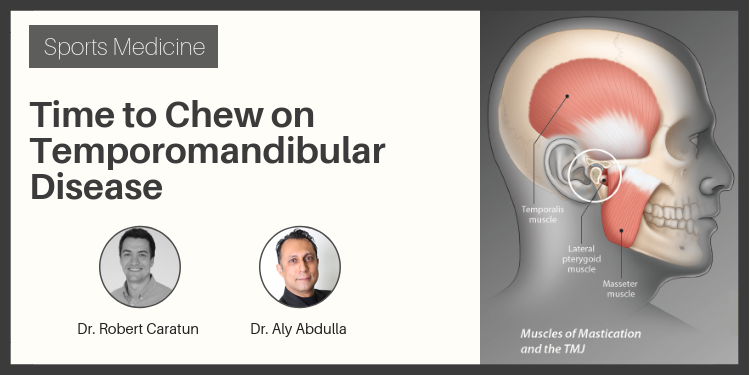
Abstract: Temporomandibular disorders (TMD) are one of the most common non tooth-related chronic orofacial pain conditions that involve the muscles of mastication and/or the temporomandibular joint (TMJ) and associated structures. This article reviews the etiology, diagnosis, and treatment of this chronic pain condition.
Key Words: chronic pain, temporomandibular disorders (TMD), temporomandibular joint (TMJ).
1. The etiology of TMD is multifactorial in nature
2. TMD is a clinical diagnosis. Clinicians should perform a complete history and physical with special focus on a dental and psychiatric history.
3. Imaging can be considered if history and physical are insufficient for diagnosis. Diagnostic injections can also be used to further guide clinicians.
4. For TMD treatment, supportive patient education should be prioritized (jaw rest, soft diet, passive stretching) in addition to conservative treatment measures (e.g. NSAIDs).
The most common presenting symptoms of TMD are facial pain, ear discomfort, headache and jaw discomfort/dysfunction.
Symptoms of TMD are typically associated with jaw movement and pain in the temple, masseter, or preauricular region. If there is no pain with jaw movement, consider an alternate diagnosis.
A large volume of patients report abnormal jaw sounds with no jaw pain or dysfunction. Do not treat adventitious jaw sounds; only pain or discomfort in TMD
Patent supportive measures and conservative treatment result in significant pain reduction for the majority of patients and should be the main focus of TMD treatment.
To have access to full article that these tools were developed for, please subscribe. The cost to subscribe is $80 USD per year and you will gain full access to all the premium content on www.healthplexus.net, an educational portal, that hosts 1000s of clinical reviews, case studies, educational visual aids and more as well as within the mobile app.
Disclaimer at the end of each page

Yoni Freedhoff, MD,

Family doc, Associate Professor at the University of Ottawa, Author of The Diet Fix, and founder of Ottawa's non-surgical Bariatric Medical Institute—a multi-disciplinary, ethical, evidence-based nutrition and weight management centre. Nowadays I'm more likely to stop drugs than start them. You can also find me on Twitter and Facebook.

CLINICAL TOOLS

Abstract: The reason why weights rise in the industrialized world remains unclear, but most agree that diet plays a crucial role. The endless list of fad diets from paleo to keto to low-carb has led to public mistrust and confusion. The results of a new study titled "Ultra-processed diets cause excess calorie intake and weight gain: A one-month inpatient randomized controlled trial of ad libitum food intake" strongly suggests that regardless of diet, ultra-processed foods should be avoided.
Key Words: diet, nutrition, ultra-processed foods, calorie intake, weight gain.
Helping patients understand the importance of limiting the consumption of ultra-processed foods may be the first step to a healthier lifestyle.
Suggest planning meals ahead of time and eating healthy fats (olive oils, avocado, nuts), grains, enough protein (fish, beans, nuts) and fresh fruit and vegetables.
Discuss how ultra-processed foods may well be a contributor to both weight and other diet related diseases.
Reducing or eliminating consumption of ultra-processed foods may be an effective strategy for obesity prevention and treatment, but doing so requires privilege, time, skill, and expense.
To have access to full article that these tools were developed for, please subscribe. The cost to subscribe is $80 USD per year and you will gain full access to all the premium content on www.healthplexus.net, an educational portal, that hosts 1000s of clinical reviews, case studies, educational visual aids and more as well as within the mobile app.
Disclaimer at the end of each page

Dr. Aly Abdulla, MD, CCFP, FCFP, DipSportMed CASEM, CTH, CCPE, McPL,1
Neelam Charania, BSc, MSc (OT),2

1 is a family doctor with specialties in sports medicine, palliative care, and cosmetic medicine. He can be found on Twitter, LinkedIn and https://ihopeyoufindthishumerusblog.wordpress.com/
2 has a Masters in Occupational Therapy from Boston University.

CLINICAL TOOLS

Abstract: Sedentarianism raises multiple health concerns. In an effort to provide safe options this article will include a short primer on types of exercises along with a step-by-step approach to exercise prescription in the adult population.
Key Words: exercise, sedentarianism, exercise prescription.
1. Exercise has been shown to improve both physical and mental well-being through the following mechanisms: improved body physique, reduced disability associated with arthritis, mproved balance and a reduction in falls, and improved psychological health.
2. Most physicians are aware of the two most common types of exercise training; aerobic/cardiovascular endurance training and muscular strength/resistance training. Other types of exercise are performed to improve flexibility, balance and coordination.
3. The exercise programme's duration should begin at about 10 minutes and progress to 20-30 minutes (it is possible to divide this into tenminute aliquots).
4. The latest research confirms that only one set per exercise or strength training is required to have the same benefit as multiple sets
5. The most important caveat is not to progress if pain, discomfort, or interposing illness is encountered. Sometimes a holding pattern or regression is required
1. The Canadian Society for Exercise Physiology (CSEP)* through Health Canada has developed the Physical Activity Readiness Questionnaire (PAR-Q) which can easily identify adults for whom physical activity might be inappropriate or those who should have a more thorough medical work-up prior to starting an exercise programme.
2. Every attempt should be commended, and any indiscretion should not be belaboured. The patient should be veered back to his goals without guilt.
3. I ask each patient to record their heart rate upon waking and their post-exercise heart rate. This is the beginning of their exercise log, which will include the type of exercise, duration, intensity, and frequency. Patients should be be encouraged to bring it to each appointment. This serves two purposes— ONE, it helps familiarize the patient with his or her level of exertion and progress, and TWO, it helps, within the actual exercise regimen, to target appropriate intensity levels.
4. The simplified calculation for determining MHR is MHR = (220-age). Intially target 40-60% MHR over 1-2 months, then improve to 70-75% MHR over 6months, then maintain.
To have access to full article that these tools were developed for, please subscribe. The cost to subscribe is $80 USD per year and you will gain full access to all the premium content on www.healthplexus.net, an educational portal, that hosts 1000s of clinical reviews, case studies, educational visual aids and more as well as within the mobile app.
Disclaimer at the end of each page

Dr. Aly Abdulla, MD, CCFP, FCFP, DipSportMed CASEM, CTH, CCPE, McPL,1
Neelam Charania, BSc, MSc (OT),2

1 is a family doctor with specialties in sports medicine, palliative care, and cosmetic medicine. He can be found on Twitter, LinkedIn and https://ihopeyoufindthishumerusblog.wordpress.com/
2 has a Masters in Occupational Therapy from Boston University and involved in managing and rehabilitating patients with chronic osteoarthritis and disability.

CLINICAL TOOLS

Abstract: Osteoarthritis is most common form of arthritis. It is also very disabling. Fortunately, there is a long list of medical therapies including education, OTC meds, strengthening, braces, prescribed medications, standard and non-standard intra-articular therapies and some new experimental therapies. This article focuses on well known and well proven therapies like cortisone and hyaluronic acid injections into large joints like knees and hips. Large meta-analysis shows improvement in pain, physical function and stiffness in a simple well tolerated procedure with minimal side effects.
Key Words: osteoarthritis, arthritis, knee, hip, joint injections, steroid, hyaluronic acid.
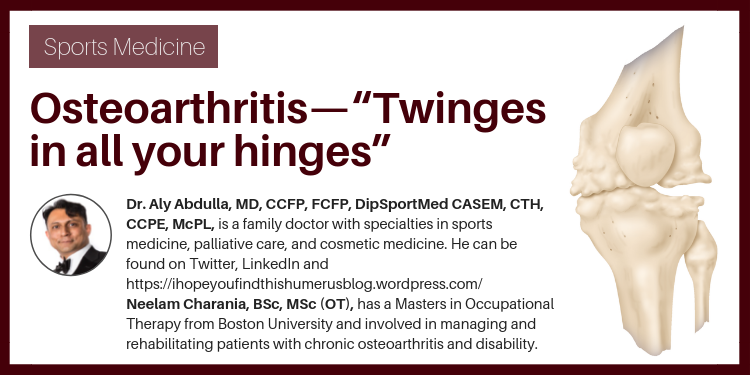
OA symptoms include joint pain, morning stiffness <30min, reduced ROM, and possibly swelling.
The most common joints are knees, hips, fingers, thumbs, big toes and lumbar spine.
The key pathophysiology in OA is destruction of cartilage and bone formation, which reduces function and causes pain.
Simple x-rays are diagnostic. There is no need for advanced imaging like CT or MRI for OA.
A combination of therapy is key to successfully managing this condition.
If morning stiffness >30 minutes, stiffness and pain increases with rest, joint warmth or erythema, or three or more joints, you should think of inflammatory, septic, or crystal arthritis RATHER than osteoarthritis.
Don't forget about weight loss, bracing, topical agents, or non conventional medications like duloxetine or tramadol in osteoarthritis.
There is no maximum amount of cortisone injections in a joint but it is mainly used for stiffness, swelling and pain.
Hyaluronic acid intra articular injections manage symptoms of pain, stiffness, range of motion, and physical function. The best formulations are high MW and cross-linked because they last longer.
New experimental therapies like PRP, MSC, and ACI have limited evidence and are costly.
To have access to full article that these tools were developed for, please subscribe. The cost to subscribe is $80 USD per year and you will gain full access to all the premium content on www.healthplexus.net, an educational portal, that hosts 1000s of clinical reviews, case studies, educational visual aids and more as well as within the mobile app.
Disclaimer at the end of each page