
Editor's Note, Volume 8 Issue 4


D’Arcy Little, MD, CCFP, FRCPC Medical Director, JCCC and HealthPlexus.NET

Madison O.L. Rays, Sharon Chung, PhD, Maya Capua, MD, Colin M. Shapiro, MBBCh, PhD, FRCPC,
Youthdale Child and Adolescent Sleep Centre and Youthdale Treatment Centres, Toronto, ON.
CLINICAL TOOLS
| Abstract: Obstructive sleep apnea (OSA) is a disorder in which patients stop breathing repeatedly during sleep, and it is linked to a number of serious medical consequences. However, most patients with OSA remain undiagnosed. The consequences of OSA are particularly severe in children. Adenotonsillar hypertrophy (AT) is a major factor in the etiology of Obstructive Sleep Apnea (OSA) in children. Physicians should consider snoring, pauses in breathing while asleep, restless sleep, bizarre sleeping positions, paradoxical chest movements, cyanosis, bedwetting, hyperactivity, and disruptive behaviour in school as possible indications of untreated OSA in children. The presentation of OSA in children differs substantially from that in adults. For example, hyperactivity is often a primary symptom in children but is not a symptom typically found in adults. |
| Key Words: obstructive sleep apnea (OSA), children, adenotonsillar hypertrophy (AT), medical consequences. |
| The presentation of OSA in children is significantly different than that in adults; hyperactivity can be a primary symptom in children but is not typically found in adults. |
| Adenotonsillar hypertrophy is an indicator of undiagnosed OSA in children and merits a sleep study. |
| Untreated OSA in children can lead to medical and psychiatric issues. |
| Adenotonsillectomy, a common treatment for OSA in children with large tonsils, not only reduces or eliminates the OSA, but in most cases improves the associated behavioral problems. |
| Evidence-based medicine supports the need for children with adenotonsillar hypertrophy to be referred to a sleep specialist to be screened for OSA regardless of the degree of tonsillar enlargement. |
| The I'm Sleepy questionnaire allows doctors to quickly and easily identify children with a high risk of having OSA. |
| To have access to full article that these tools were developed for, please subscribe. The cost to subscribe is $80 USD per year and you will gain full access to all the premium content on www.healthplexus.net, an educational portal, that hosts 1000s of clinical reviews, case studies, educational visual aids and more as well as within the mobile app. |
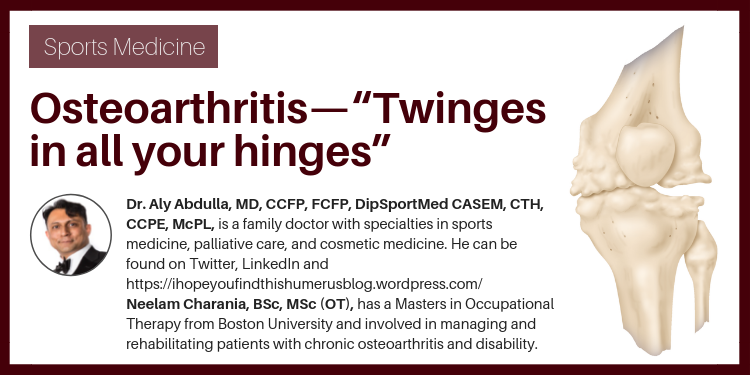
Dr. Aly Abdulla, MD, CCFP, FCFP, DipSportMed CASEM, CTH, CCPE, McPL,1 Neelam Charania, BSc, MSc (OT),2
1 is a family doctor with specialties in sports medicine, palliative care, and cosmetic medicine. He can be found on Twitter, LinkedIn and https://ihopeyoufindthishumerusblog.wordpress.com/
2 has a Masters in Occupational Therapy from Boston University and involved in managing and rehabilitating patients with chronic osteoarthritis and disability.
CLINICAL TOOLS
| Abstract: Osteoarthritis is most common form of arthritis. It is also very disabling. Fortunately, there is a long list of medical therapies including education, OTC meds, strengthening, braces, prescribed medications, standard and non-standard intra-articular therapies and some new experimental therapies. This article focuses on well known and well proven therapies like cortisone and hyaluronic acid injections into large joints like knees and hips. Large meta-analysis shows improvement in pain, physical function and stiffness in a simple well tolerated procedure with minimal side effects. |
| Key Words: osteoarthritis, arthritis, knee, hip, joint injections, steroid, hyaluronic acid. |


| OA symptoms include joint pain, morning stiffness <30min, reduced ROM, and possibly swelling. |
| The most common joints are knees, hips, fingers, thumbs, big toes and lumbar spine. |
| The key pathophysiology in OA is destruction of cartilage and bone formation, which reduces function and causes pain. |
| Simple x-rays are diagnostic. There is no need for advanced imaging like CT or MRI for OA. |
| A combination of therapy is key to successfully managing this condition. |
| If morning stiffness >30 minutes, stiffness and pain increases with rest, joint warmth or erythema, or three or more joints, you should think of inflammatory, septic, or crystal arthritis RATHER than osteoarthritis. |
| Don't forget about weight loss, bracing, topical agents, or non conventional medications like duloxetine or tramadol in osteoarthritis. |
| There is no maximum amount of cortisone injections in a joint but it is mainly used for stiffness, swelling and pain. |
| Hyaluronic acid intra articular injections manage symptoms of pain, stiffness, range of motion, and physical function. The best formulations are high MW and cross-linked because they last longer. |
| New experimental therapies like PRP, MSC, and ACI have limited evidence and are costly. |
| To have access to full article that these tools were developed for, please subscribe. The cost to subscribe is $80 USD per year and you will gain full access to all the premium content on www.healthplexus.net, an educational portal, that hosts 1000s of clinical reviews, case studies, educational visual aids and more as well as within the mobile app. |
Dr. Julia Alleyne, BHSc(PT), MD, CCFP, Dip. Sport Med MScCH,1 Pierre Côté DC, PhD,2 Dr. Hamilton Hall, MD, FRCSC,3
1 is a Family Physician practising Sport and Exercise Medicine at the Toronto Rehabilitation Institute, University Health Network. She is appointed at the University of Toronto, Department of Family and Community Medicine as an Associate Clinical Professor.
2Canada Research Chair in Disability Prevention and Rehabilitation; Associate Professor, Faculty of Health Sciences, University of Ontario Institute of Technology (UOIT); Director, UOIT-CMCC Centre for the Study of Disability Prevention and Rehabilitation.
3 is a Professor in the Department of Surgery at the University of Toronto. He is the Medical Director, CBI Health Group and Executive Director of the Canadian Spine Society in Toronto, Ontario.
CLINICAL TOOLS
| Abstract: Neck pain is a common presentation in primary care with an estimated one-year incidence ranging from 10.4-21.3% and a 25-50% recurrent rate.1 Guidelines have not included a specific approach to assessment although treatment recommendations have advised non-pharmacological and pharmacological management for optimal results. The CORE Neck Tool was designed as a comprehensive, user-friendly approach to clinical decision making for primary care providers assessing patients with neck pain. The key components of the tool include a high yield history, physical examination and a management matrix providing evidence-based recommendations for acute and chronic neck dominant and arm dominant pain patterns. Criteria is clearly described for investigations and referral management and patient key messages are embedded in the tool. This tool has been incorporated into the Ontario Quality Based Spine Pathway and is endorsed by the Ontario College of Family Physicians and the Nurse Practitioners Association of Ontario. A clinical case will be used to demonstrate the application of the tool to practice and instruct the reader on the key features. |
| Key Words: Spinal lesion, tumour, imaging characteristics, primary bone tumours. |
Members of the College of Family Physicians of Canada may claim MAINPRO-M2 Credits for this unaccredited educational program.
www.cfpc.ca/Mainpro_M2
You can take quizzes without subscribing; however, your results will not be stored. Subscribers will have access to their quiz results for future reference.

| 1. Most neck pain is benign mechanical pain and serious pathology is uncommon. |
| 2. Always assess the patient's headache symptoms first before proceeding with the neck assessment. |
| 3. Cervical imaging is only required in patients with persistent arm dominant pain, positive neurological findings or a history of significant trauma.12 |
| 4. Neck pain is considered chronic if persisting greater than three months. |
| 5. Exercise, education and postural advice are the best evidence-based treatment. |
| If the patient presents with shoulder dominant pain, do a complete shoulder examination versus if the patient presents with neck dominant pain, only a shoulder screen assessing range is necessary. |
| Palpation of the cervical nodes is a quick and necessary component of the neck examination to ensure that a red flag is not present. |
| Cervical myelopathy signs may include difficulty with hand fine motor tasks, tingling and/or numbness in the upper extremities and changes in gait steadiness and coordination. |
| Do not make the concurrent diagnosis of bilateral carpal tunnel syndrome, until cervical cord pathology has been excluded. |
| To have access to full article that these tools were developed for, please subscribe. The cost to subscribe is $80 USD per year and you will gain full access to all the premium content on www.healthplexus.net, an educational portal, that hosts 1000s of clinical reviews, case studies, educational visual aids and more as well as within the mobile app. |