
Editor's Note, Volume 9 Issue 6


D’Arcy Little, MD, CCFP, FCFP, FRCPC Medical Director, JCCC and HealthPlexus.NET
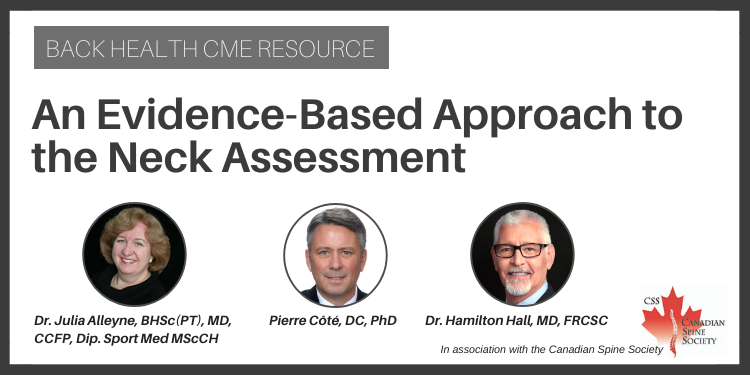
Dr. Julia Alleyne, BHSc(PT), MD, CCFP, Dip. Sport Med MScCH1 Pierre Côté, DC, PhD2 Dr. Hamilton Hall, MD, FRCSC3
1is a Family Physician practising Sport and Exercise Medicine at the Toronto Rehabilitation Institute, University Health Network. She is appointed at the University of Toronto, Department of Family and Community Medicine as an Associate Clinical Professor. 2Professor and Canada Research Chair in Disability Prevention and Rehabilitation, Faculty of Health Sciences, University of Ontario Institute of Technology (UOIT); Director, UOIT-CMCC Centre for Disability Prevention and Rehabilitation, University of Ontario Institute of Technology (UOIT) and Canadian Memorial Chiropractic College (CMCC). 3 is a Professor in the Department of Surgery at the University of Toronto. He is the Medical Director, CBI Health Group and Executive Director of the Canadian Spine Society in Toronto, Ontario.
CLINICAL TOOLS
| Abstract:Neck pain is a common musculoskeletal condition that frequently resolves spontaneously or with conservative treatment and only occasionally requires surgical intervention. The purpose of the neck examination is to determine if the etiology is neurological or mechanical pain, which determines treatment planning, and then to rule out red flags. There is good evidence that on examination clinicians cannot reliably differentiate specific anatomical structures but they should still perform a focused clinical examination to locate typical pain on movement and establish the neurological status. Base treatment on exercise, activity management and pain control. |
| Key Words: neck, examination, treatment, differential diagnosis. |
Members of the College of Family Physicians of Canada may claim MAINPRO-M2 Credits for this unaccredited educational program.
www.cfpc.ca/Mainpro_M2
You can take quizzes without subscribing; however, your results will not be stored. Subscribers will have access to their quiz results for future reference.


| If your patient is presenting with symptoms of systemic disease, deteriorating neurological status or focal severe pain, initiate further investigations and or referral. |
| Once red flags have been ruled out, neck pain will fall into two categories: neurological or mechanical pain. |
Range of Motion testing should be done in 3 specific planes; flexion-extension, lateral flexion and rotation. Moving the neck in circles does not provide useful clinical information.

|
 |
| To have access to full article that these tools were developed for, please subscribe. The cost to subscribe is $80 USD per year and you will gain full access to all the premium content on www.healthplexus.net, an educational portal, that hosts 1000s of clinical reviews, case studies, educational visual aids and more as well as within the mobile app. |
Dr. Zahra Bardai BSc MD CCFP (COE) MHSc FCFP 200hRYT,
Lecturer, Department of Family and Community Medicine, University of Toronto, Staff Physician, Brock CHC Primary Health Care Program, Cannington ON.
CLINICAL TOOLS
| Abstract: Stories have the capacity to move us by evoking strong powerful emotions and unlocking potent insights. The narratives that convey the lived experience in medicine bring a sense of meaning and compassion to the science of the discipline. This article is an introduction in a series that depicts stories in medicine and the influence they have on patient care, medical education and physician well being. |
| Key Words: narratives, patient care, medical education, physician well being. |
| The art and science of medicine as seen through a narrative based lens is interwoven in the telling and retelling of the patient and provider's experience. |
| Narrative based medicine involves honing skills of listening, exploring, deciphering and reflecting in order to understand and improve the humanitarian practice of medicine. |
| The practice of narrative medicine involves bearing witness and holding space through attentive mindful listening during a clinical encounter. |
| To have access to full article that these tools were developed for, please subscribe. The cost to subscribe is $80 USD per year and you will gain full access to all the premium content on www.healthplexus.net, an educational portal, that hosts 1000s of clinical reviews, case studies, educational visual aids and more as well as within the mobile app. |
Dr. Marina Abdel Malak
is a Family Medicine Resident at the University of Toronto. She graduated and completed her Bachelor of Science in Nursing and went on to study Medicine. She has a passion for medical education, patient empowerment, and increasing awareness about the relationship between mental, emotional, and physical health.
CLINICAL TOOLS
| Abstract:Empowering patients to set health-directed goals can be a challenging process. The skilled clinician successfully supports patients in setting goals that are SMART (specific, measurable, achievable, realistic/relevant, and time-related). When goals are made in collaboration with patients, they are more likely to be long-lasting and impactful. This article will focus on how physicians can work with patients to identify, create, and work towards meaningful interventions that optimize health. |
| Key Words: motivation, behaviour changes, counselling, goals, treatment. |
Members of the College of Family Physicians of Canada may claim MAINPRO-M2 Credits for this unaccredited educational program.
www.cfpc.ca/Mainpro_M2
You can take quizzes without subscribing; however, your results will not be stored. Subscribers will have access to their quiz results for future reference.

| Goal-setting should be a partnership between physicians and patients |
| Asking patients what THEY want—and can—change in their lives/health is the first step to eliciting what behaviours can be targeted |
| After goals are set, it is important for physicians to reassess patients' progress by asking them if goals were met, and why or why not. When success occurs, patients should be congratulated on their achievements. If the goals were not met, physicians should seek to understand why this occurred, and work with patients to create new goals that are more realistic or achievable |
| Physicians should motivate patients to set goals that are SMART (specific, measurable, achievable, realistic/relevant, and time-related) |
| Patients are more likely to adhere to behaviours, habits, or interventions if they feel understood, supported, and empowered |
| Supporting patients in achieving goals that optimize health can have significant impacts on patient wellness, self-esteem, functioning; and strengthens the physician-patient relationship |
| To have access to full article that these tools were developed for, please subscribe. The cost to subscribe is $80 USD per year and you will gain full access to all the premium content on www.healthplexus.net, an educational portal, that hosts 1000s of clinical reviews, case studies, educational visual aids and more as well as within the mobile app. |