Disclaimer:  While every attempt is made to ensure that drug dosages provided within the text of this journal and the website are accurate, readers are urged to check drug package inserts before prescribing. Views and opinions in this publication and the website are not necessarily endorsed by or reflective of those of the publisher.

1Naazish Shariff, BHSc. Candidate, 2Eugene K. Wai, MD, MSc, CIP, FRCSC,

1Faculty of Health Science, University of Ottawa, Ottawa, ON. 2Head—University of Ottawa Combined Adult Spinal Surgery Program, Associate Professor—Division of Orthopaedic Surgery, University of Ottawa, Cross Appointment to School of Epidemiology and Public Health, Ottawa, ON.

CLINICAL TOOLS

Abstract:Back pain is a community level health problem because of the high prevalence and burden on patients, health care and society. Many aspects of back management, such as exercise and psychosocial stress management, are suitable for a community model of care. Community models for back pain are in their infancy but lessons learned from other chronic diseases can be applied and will be discussed. This review will discuss existing evidence-based community programs, such as Exercise is Medicine® and the Stanford Model, that support exercise and self-management, and their relevance to low back pain.
Key Words: back pain, community model of care, self-management, exercise, lifestyle risk factors.

Members of the College of Family Physicians of Canada may claim MAINPRO-M2 Credits for this unaccredited educational program.

www.cfpc.ca/Mainpro_M2

You can take quizzes without subscribing; however, your results will not be stored. Subscribers will have access to their quiz results for future reference.

Many aspects of back management such as exercise and promotion of self-management are more suited for a community model of care.
Physicians and other health care providers are important catalysts for change and must support patient engagement.
Health care practitioners should identify resources within their community as well as develop their own local creative solutions.
Evidence-supported models for community involvement in managing chronic diseases are available. This article provides resources enabling practitioners to identify these programs in their community and tailor them for their back pain patients.
To have access to full article that these tools were developed for, please subscribe. The cost to subscribe is $80 USD per year and you will gain full access to all the premium content on www.healthplexus.net, an educational portal, that hosts 1000s of clinical reviews, case studies, educational visual aids and more as well as within the mobile app.
Disclaimer at the end of each page

Editor's Note, Volume 10 Issue 5

D’Arcy Little, MD, CCFP, FCFP, FRCPC Medical Director, JCCC and HealthPlexus.NET

Disclaimer at the end of each page

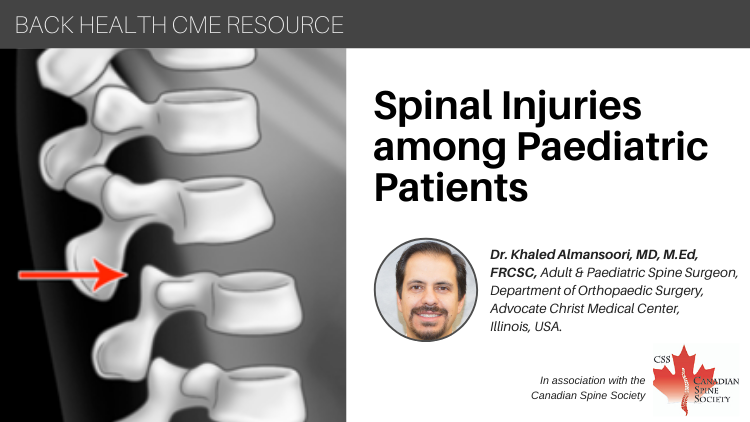
Dr. Khaled Almansoori, MD, M.Ed, FRCSC,

Adult & Paediatric Spine Surgeon, Department of Orthopaedic Surgery, Advocate Christ Medical Center, Illinois, USA.

CLINICAL TOOLS

Abstract:Due to the distinctive anatomic and biomechanical features of the growing paediatric spine, children are susceptible to unique patterns of spinal injuries. Although clinical examination can help guide management, physicians are often required to rely on advanced imaging. Imaging interpretation can be challenging when considering that abnormal parameters among adults, are often within normal physiological limits in children. In general, spinal injuries in children younger than nine years of age are often managed non-operatively, while adolescents are typically managed by adult treatment principles. With the exception of neurologic injuries, most paediatric spinal injuries demonstrate good to excellent prognosis and outcomes.
Key Words: fracture, injury, spine, paediatric, children.

Members of the College of Family Physicians of Canada may claim MAINPRO-M2 Credits for this unaccredited educational program.

www.cfpc.ca/Mainpro_M2

You can take quizzes without subscribing; however, your results will not be stored. Subscribers will have access to their quiz results for future reference.

Due to the unique properties of the growing spine, including greater elasticity, osseous plasticity, presence of growth centers, relatively strong ligaments, and greater joint mobility, paediatric patients are susceptible to unique fracture patterns and injuries.
There are absolute contraindications regarding return to play decisions.
Children under 13 years of age with vertebral body compression fractures can progressively restore their vertebral height until skeletal maturity.
The vast majority of spine injuries among children under nine years of age, even when relatively unstable, can be managed non-operatively.
Pre-adolescent patients with complete spinal cord injuries are at high risk for developing progressive scoliosis and have not been shown to demonstrate any better neurological outcomes when compared to adults.
The cervical spine is the commonest area of spine injuries with the C1-3 vertebral levels being more commonly seen in children under eight years of age.
A standard immobilization board should not be used for children under eight years of age without an occipital recess or 2-3cm of padding to elevate their body relatively to their head.
Adult radiographic spinal parameters are often unreliable in children and severe neurologic injuries can be sustained in spite of normal imaging results.
Clinical examination is fairly unreliable for identifying spinal column injuries among pre-school patients and it is often necessary to rely on advanced imaging.
To have access to full article that these tools were developed for, please subscribe. The cost to subscribe is $80 USD per year and you will gain full access to all the premium content on www.healthplexus.net, an educational portal, that hosts 1000s of clinical reviews, case studies, educational visual aids and more as well as within the mobile app.
Disclaimer at the end of each page

Members of the College of Family Physicians of Canada may claim one non-certified credit per hour for this non-certified educational program.

Mainpro+® Overview

Dr. Pradeep Shenoy, MD, FRCS, FACS, DLO,1
Marah Mansour2

1ENT & Neck Surgeon, Campbellton Regional Hospital, Campbellton, New Brunswick, Canada.
2Faculty of Medicine, Tartous University, Tartous, Syrian Arab Republic.

CLINICAL TOOLS

Abstract:Acute Epiglottitis is a potentially life threatening infection of the supraglottic structures, epiglottis and aryepiglottic folds causing fatal airway obstruction. Historically described in adults before the 1960s and after the 1960s in the paediatric group causing more mortality and morbidity until the introduction of the H. influenza type B vaccine in 1993. Since then the incidence was described again more in the adult group.6 Prompt diagnosis and treatment will save the patients if failed mortality is as high as 80% in children and 20% in adults.2
Key Words: Epiglottis, H. Influenza Type B, Aspergillus, Kliebsiella, Candida, Fibroptic laryngoscopy, Humidified oxygen therapy, orotracheal intubation, naso-tracheal intubation, tracheostomy thumb sign.
Epiglottits is an acute emergency in ENT practice as mortality is high in children at about 80% and 20% in adults.
Before the 1960s epiglottitis was not seen in the paediatric group.
Since the invention of H. influenza type B vaccine the numbers in the paediatric group has declined though in adults it remains the same as there are other bacteria and fungus involved in immune compromised patients .
Acute epiglottitis is potentially life threatening both in children and adults. Prompt diagnosis with clinical examination complimented with radiographic investigation depending on the severity of cases and early treatment could save the patient
To have access to full article that these tools were developed for, please subscribe. The cost to subscribe is $80 USD per year and you will gain full access to all the premium content on www.healthplexus.net, an educational portal, that hosts 1000s of clinical reviews, case studies, educational visual aids and more as well as within the mobile app.
Disclaimer at the end of each page

Editor's Note, Volume 10 Issue 4

D’Arcy Little, MD, CCFP, FCFP, FRCPC Medical Director, JCCC and HealthPlexus.NET

Disclaimer at the end of each page