Articles

Disclaimer:  While every attempt is made to ensure that drug dosages provided within the text of this journal and the website are accurate, readers are urged to check drug package inserts before prescribing. Views and opinions in this publication and the website are not necessarily endorsed by or reflective of those of the publisher.

Clone of Incontinence among Older Adults

David R. Staskin, MD, Department of Urology, New York Presbyterian Hospital, Weill-Cornell Medical College, New York, NY, USA.
Edward Zoltan, MD, Division of Urology, Department of Surgery, Hospital of the University of Pennsylvania, Philadelphia, PA, USA.
Alan J. Wein, MD, Division of Urology, Department of Surgery, Hospital of the University of Pennsylvania, Philadelphia, PA, USA.

Older adults have a high prevalence of urinary incontinence. Among the older adult population, many nonurinary pathological, anatomical, physiological, and pharmacological factors may serve as comorbidities in the development of incontinence. The treating physician must appreciate potentially reversible pathologies. Older adults frequently are prescribed several drugs; therefore, it is important to consider drug-drug metabolic interactions. Age-associated changes may affect pharmacological actions of the drug. Antimuscarinic therapy has been proven efficacious and represents the first line of pharmacologic therapy for overactive bladder (OAB). The selection of an antimuscarinic agent for the management of an older individual presenting with OAB is limited by the natural condition of the aging body and by the side effects associated with antimuscarinics as a class and the specific agents themselves.
Key words: urinary incontinence, antimuscarinics, older adult, frail older adult, geriatrics.
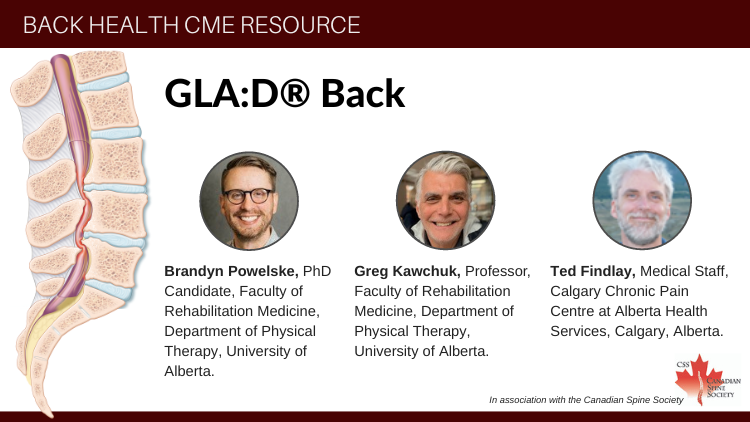
Brandyn Powelske, PhD Candidate, 1 Greg Kawchuk, 2 Ted Findlay,3

1 Faculty of Rehabilitation Medicine, Department of Physical Therapy, University of Alberta.
2 Professor, Faculty of Rehabilitation Medicine, Department of Physical Therapy, University of Alberta.
3Medical Staff, Calgary Chronic Pain Centre at Alberta Health Services, Calgary. Alberta.

CLINICAL TOOLS

Abstract: While low back pain is one of the most common clinical conditions seen in a family physician's office, there remains a lack of low or no cost initial treatment options that are concordant with recognized best practice guidelines. As a result, many patients are offered investigations and treatments that have limited value and/or significant risks but are readily available through publicly funded provincial health care systems. GLA:D® Back builds upon the successful GLA:D model (initially developed for hip and knee osteoarthritis patients) by using the same established methodology to deliver a patient education and targeted rehabilitation program for low back pain.
Key Words: low back pain; best practice; guidelines; education; rehabilitation.

Members of the College of Family Physicians of Canada may claim MAINPRO-M2 Credits for this unaccredited educational program.

www.cfpc.ca/Mainpro_M2

You can take quizzes without subscribing; however, your results will not be stored. Subscribers will have access to their quiz results for future reference.

1. Low Back Pain remains one of the most seen conditions in a family medical practice, and chronic low back pain the leading cause of ongoing disability
2. There are significant patient financial and access barriers to treatment modalities most consistently recommended in practice guidelines: education and activity/rehabilitation-based therapies.
3. GLA:D Back presents a validated option that can help close the gap between recommended treatments for low back pain and access through a primary care practice.
4. GLA:D Back is an extension of the well-recognized and widely used GLA:D program for hip and knee osteoarthritis.
In the absence of clinical "Red Flags", avoid ordering unnecessary imaging when the results are not needed for investigating an established clinical diagnosis or to initiate a therapeutic procedure.
When considering pharmacotherapeutic options, remember that the Institute for Safe Medical Practices (Canada Institute for Safe Medication Practices Canada notes that opioids should generally be avoided in the treatment of low back pain, headache and fibromyalgia.
The Covid-19 Pandemic has taught us that many group based education and rehabilitation-based programs can be effectively delivered in a virtual format.
To have access to full article that these tools were developed for, please subscribe. The cost to subscribe is $80 USD per year and you will gain full access to all the premium content on www.healthplexus.net, an educational portal, that hosts 1000s of clinical reviews, case studies, educational visual aids and more as well as within the mobile app.

Erika Leck, MD, PGY 5,1, Sean D Christie, MD, FRCSC, 2,

1 Department of Surgery (Neurosurgery) Dalhousie University.
2 Vice-Chair and Director of Research Professor, Division of Neurosurgery , Department of Surgery (Neurosurgery), Healthy Populations Institute Flagship Project Co-Lead, Creating Sustainable Health Systems in a Climate Crisis, Dalhousie University.

CLINICAL TOOLS

Abstract: The global population is ageing, and with that there is a concomitant increase in spinal pain and mobility complaints, most related to degenerative changes. It is important to consider how the markers of aging and, specifically, frailty, can overlap with symptoms of spine disease. Although non-operative management should be the initial response, spine surgery in older adults is safe and should be considered as part of a holistic approach for patients with persistent neuropathic pain.
Key Words: Spine Surgery, Elderly, Older Adults, Frailty, Imaging, Spinal Degeneration.

Members of the College of Family Physicians of Canada may claim MAINPRO-M2 Credits for this unaccredited educational program.

www.cfpc.ca/Mainpro_M2

You can take quizzes without subscribing; however, your results will not be stored. Subscribers will have access to their quiz results for future reference.

1. It is essential to remember that, while degeneration is inevitable, the appearance of symptoms is not and treatment decisions must be based on the clinical presentation, not the images.
2. Our ageing population will lead to an increase in the frequency of spine-related complaints.
3. It is important to consider how the markers of aging and frailty overlap with symptoms of spine disease.
4. The conservative approaches should always be pursued prior to consideration of surgical options.
5. When required, spine surgery in older patients is safe and efficacious, but should involve a healthcare team able to appropriately assess and support the patient and their loved ones.
1. Biological age does not necessarily equate to chronological age.
2. Radiological “abnormalities” become more common with age, but are frequently asymptomatic, order tests that direct care.
3. Combination, non-opioid, pharmacological strategies, with a ‘start low and go slow’ approach are preferred.
4. Tools such as the Clinical Frailty Scale can be helpful in predicting risk and clinical decision making.
To have access to full article that these tools were developed for, please subscribe. The cost to subscribe is $80 USD per year and you will gain full access to all the premium content on www.healthplexus.net, an educational portal, that hosts 1000s of clinical reviews, case studies, educational visual aids and more as well as within the mobile app.

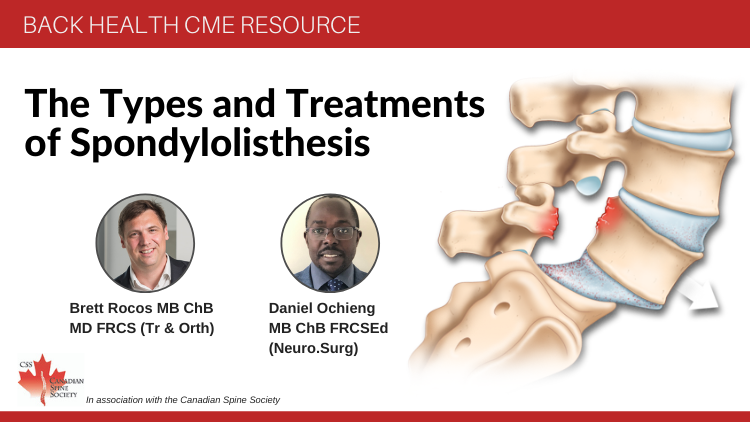
Brett Rocos MB ChB MD FRCS (Tr & Orth),1, Daniel Ochieng MB ChB FRCSEd (Neuro.Surg),2,

1 Consultant Spine Surgeon, Department of Spine Surgery, Barts Health NHS Trust, London, UK.
2Complex Spine Fellow, Department of Spine Surgery, Barts Health NHS Trust, London, UK.

CLINICAL TOOLS

Abstract: Spondylolisthesis is a common finding in the adult patient but seldom requires surgical intervention. Up to 18% of the population show spondylolisthesis on spinal imaging with the vast majority requiring little or no treatment. This review explores the aetiology of spondylolisthesis, alongside key findings in the history and examination that should prompt referral, as well as presenting the evidence supporting surgical treatment. Spondylolisthesis affects patients at nearly every stage of life and understanding why and how to manage this common problem will aid in counselling patients and making the right referrals.
Key Words: Spondylolisthesis, spondylosis, back pain, radicular pain, neurogenic claudication, spinal stenosis.

Members of the College of Family Physicians of Canada may claim MAINPRO-M2 Credits for this unaccredited educational program.

www.cfpc.ca/Mainpro_M2

You can take quizzes without subscribing; however, your results will not be stored. Subscribers will have access to their quiz results for future reference.

• Spondylolisthesis affects 18% of adults.
• Surgical treatment for spondylolisthesis is rarely required.
• Risk factors depend on the patient's age and include specific athletic activities, trauma and degenerative changes to the posterior elements.
• Examination findings can be normal.
• Surgical options include repair, decompression, and stabilisation of affected segments.
• Spondylolisthesis is a common incidental finding.
• Not every spondylolisthesis needs treatment.
• Uncontrolled pain is a valid reason for referral.
• Analgesia, physiotherapy, and injection therapy manage most cases successfully.
To have access to full article that these tools were developed for, please subscribe. The cost to subscribe is $80 USD per year and you will gain full access to all the premium content on www.healthplexus.net, an educational portal, that hosts 1000s of clinical reviews, case studies, educational visual aids and more as well as within the mobile app.

Patrick Thornley, MD, MSc, FRCSC,1, Christopher S. Bailey, MD, MSc, FRCSC,2,

1 London Health Science Centre Combined Neurosurgical and Orthopaedic Spine Program, Schulich School of Medicine, Western University, Ontario, Canada.
2 London Health Science Centre Combined Neurosurgical and Orthopaedic Spine Program, Schulich School of Medicine, Western University, Ontario, Canada.

CLINICAL TOOLS

Abstract: Lumbar intervertebral disc herniations (IVH) carry a high lifetime prevalence and are the most common cause of sciatica. The vast majority of symptomatic lumbar IVH improve with conservative management though adjuncts such as physiotherapy and epidural steroid injections may play a role in short-term symptom relief. For patients with unresponsive lumbar IVH, discectomy reliably improves symptoms more rapidly than continued conservative care, though there is inconsistent evidence that clinical differences between operative and conservative care are no different at one-year after symptom onset.
Key Words: lumbar radiculopathy, intervertebral disc herniation; lumbar intervertebral disc herniation; lumbar disc herniation; sciatica.

Members of the College of Family Physicians of Canada may claim MAINPRO-M2 Credits for this unaccredited educational program.

www.cfpc.ca/Mainpro_M2

You can take quizzes without subscribing; however, your results will not be stored. Subscribers will have access to their quiz results for future reference.

1. The natural history of lumbar intervertebral disc herniations causing lumbar radiculopathy is favourable with conservative care in the vast majority of patients.
2. Advanced imaging for patients with lumbar radiculopathy is indicated only in the setting of “red flag” neurologic symptoms or a concerning clinical history for infection, neoplastic or traumatic etiology or the absence of symptom improvement after six-weeks of conservative care.
3. Long-term follow-up demonstrates most patients with lumbar intervertebral disc herniation causing lumbar radiculopathy achieve comparable clinical improvement with surgery or conservative management, with surgery leading to earlier symptom resolution.
4. The high-quality evidence for surgery is weak given the high cross over rate but observational studies show a benefit of surgery after failed non-operative care.
1. The diagnosis is made on the patient’s history including leg dominant pain and confirmed by the physical examination.
2. A combination of a detailed motor and sensory neurologic examination, including supine straight leg raise in addition to cross leg straight leg raise, increases the clinical sensitivity and specificity of a diagnostic examination for lumbar radiculopathy.
3. Analgesics should be used to manage function and not just to reduce pain, taking into account response to the specific analgesic on an individual basis including the known side effect profiles.
4. Microdiscectomy surgery for patients with refractory lumbar radiculopathy lasting greater than four months can lead to a significant reduction in leg pain compared to continued conservative management.
To have access to full article that these tools were developed for, please subscribe. The cost to subscribe is $80 USD per year and you will gain full access to all the premium content on www.healthplexus.net, an educational portal, that hosts 1000s of clinical reviews, case studies, educational visual aids and more as well as within the mobile app.

Brett Rocos MB ChB MD FRCS (Tr & Orth),1, Daniel Ochieng MB ChB FRCSEd (Neuro.Surg),2,

1 Consultant Spine Surgeon, Department of Spine Surgery, Barts Health NHS Trust, London, UK.
2Complex Spine Fellow, Department of Spine Surgery, Barts Health NHS Trust, London, UK.

CLINICAL TOOLS

Abstract: Spondylolisthesis is a common finding in the adult patient but seldom requires surgical intervention. Up to 18% of the population show spondylolisthesis on spinal imaging with the vast majority requiring little or no treatment. This review explores the aetiology of spondylolisthesis, alongside key findings in the history and examination that should prompt referral, as well as presenting the evidence supporting surgical treatment. Spondylolisthesis affects patients at nearly every stage of life and understanding why and how to manage this common problem will aid in counselling patients and making the right referrals.
Key Words: Spondylolisthesis, spondylosis, back pain, radicular pain, neurogenic claudication, spinal stenosis.

Members of the College of Family Physicians of Canada may claim MAINPRO-M2 Credits for this unaccredited educational program.

www.cfpc.ca/Mainpro_M2

You can take quizzes without subscribing; however, your results will not be stored. Subscribers will have access to their quiz results for future reference.

• Spondylolisthesis affects 18% of adults.
• Surgical treatment for spondylolisthesis is rarely required.
• Risk factors depend on the patient's age and include specific athletic activities, trauma and degenerative changes to the posterior elements.
• Examination findings can be normal.
• Surgical options include repair, decompression, and stabilisation of affected segments.
• Spondylolisthesis is a common incidental finding.
• Not every spondylolisthesis needs treatment.
• Uncontrolled pain is a valid reason for referral.
• Analgesia, physiotherapy, and injection therapy manage most cases successfully.
To have access to full article that these tools were developed for, please subscribe. The cost to subscribe is $80 USD per year and you will gain full access to all the premium content on www.healthplexus.net, an educational portal, that hosts 1000s of clinical reviews, case studies, educational visual aids and more as well as within the mobile app.

Michael Gordon, MD, MSc, FRCPC,

Emeritus Professor of Medicine, University of Toronto, Toronto, ON.

CLINICAL TOOLS

Abstract: The evolution of medicine is quite remarkable and astounding. Modern medicine is successfully treating or providing long-term control of conditions which in the not-so-distant past were lethal or resulted in permanent disability. The strong emphasis on evidence-based medicine in today's medical profession has led to a more organized approach toward evaluating the safety and efficacy of new medical treatments. Despite attempts to meet the complex needs of an ever-aging population, an almost cynical or inherent distrust of physicians in general and their medical claims is being increasingly noted. For many physicians this has led to an uncomfortable sense of professional frustration as doubt is cast on themselves or the medical profession in general when the expectations and goals of patients or their families are not achieved. The causes of this apparent malady of contemporary medicine are myriad and may be explored from various perspectives, depending on the particular issue. To understand better the issues and challenges involved, today's medical practitioner needs to be aware of the complex mix of organizational, professional, ethical, and at times anthropological perspectives contributing to this dissonance between medical professionals and the public. Improving our insight into the forces at work in this dissonance will help medical professionals improve medical services to the public and contribute to the preservation of medicine's admirable historical legacy.
Key Words: Anti-vaccination movement, conspiracy theories, evidence-based medicine, medical quackery, trust in physicians.
Evidence-based medicine asks questions, finds and appraises the relevant data, and harnesses that information for everyday clinical practice. Evidence-based medicine follows four steps:
• Formulate a clear clinical question from a patient’s problem
• Search the literature for relevant clinical articles
• Evaluate (critically appraise) the evidence for its validity and usefulness
• Implement useful findings in clinical practice.
The growing mistrust undermines the patient-doctor relationship, as well as the public’s perspective of health care professionals and the system in general.
If the medical dissonance is left unresolved, the future of health care will become increasingly onerous for those wishing to enter its professions, ultimately impacting those in need of medical services.
To have access to full article that these tools were developed for, please subscribe. The cost to subscribe is $80 USD per year and you will gain full access to all the premium content on www.healthplexus.net, an educational portal, that hosts 1000s of clinical reviews, case studies, educational visual aids and more as well as within the mobile app.

Conner Joseph Clay1, José M. Orenday-Barraza, MD2, María José Cavagnaro MD2, Leah Hillier MD CCFP (SEM)3, Leeann Qubain1, Eric John Crawford MD MSc(c) FRCSC4, Brandon Hirsch MD5, Ali A. Baaj MD2, Robert A. Ravinsky MDCM MPH FRCSC5

1 University of Arizona College of Medicine – Phoenix, Phoenix, AZ.
2Department of Neurosurgery, University of Arizona College of Medicine – Phoenix, Phoenix, AZ.
3Department of Family Medicine & Community Medicine, Banner University Medical Center Phoenix, University of Arizona College of Medicine – Phoenix, Phoenix, AZ.
4Division of Orthopaedic Surgery, Department of Surgery, University of Toronto, Toronto, ON, Canada.
5Department of Orthopaedic Surgery, University of Arizona College of Medicine – Phoenix, Phoenix, AZ.

CLINICAL TOOLS

Abstract: Low back pain (LBP) is one of the most common presenting complaints in the primary care setting with significant economic implications and impairment of quality of life. Effective treatment of LBP can frequently be delivered in the primary care setting. Knowledge of common pain generators and recognition of pain patterns based on the history and physical exam helps guide the treatment of LBP without the need for excessive resource utilization. The majority of patients presenting with LBP can be confidently managed with targeted conservative management; when this fails further investigation may be warranted. Part 2 of this review focuses on imaging and diagnosis of LBP, as well as a detailed review of treatment modalities.
Key Words: low back pain, imaging, diagnostic interventions, treatment.

Members of the College of Family Physicians of Canada may claim MAINPRO-M2 Credits for this unaccredited educational program.

www.cfpc.ca/Mainpro_M2

You can take quizzes without subscribing; however, your results will not be stored. Subscribers will have access to their quiz results for future reference.

Patients presenting with lumbar-related complaints, in the absence of red flags or neurological deficits, can safely undergo a course of conservative treatment prior to ordering imaging studies.
Nonsurgical treatment modalities that can be attempted in patients with LBP include oral medications, topical medications, passive modalities, active physical therapy and cognitive interventions.
Diagnostic interventions such as selective nerve root blocks, diagnostic facet joint injections, medial branch blocks and provocative discography can be useful in confirming that a particular anatomical structure is a clinically relevant pain generator.
Surgery, in the absence of red flags or neurological deficits, should only be considered after the patient fails a thorough course of conservative treatment.
Images of the spine are not necessary to initiate management of mechanical low back pain; they may even be counterproductive.
When required, initial radiological evaluation of the lumbar spine involves upright plain radiographs. Further investigation may include use of MRI or CT myelography.
Diagnostic interventions can aid in establishing the dominant pain-generating anatomical structure but are not required if the patient is improving as anticipated.
To have access to full article that these tools were developed for, please subscribe. The cost to subscribe is $80 USD per year and you will gain full access to all the premium content on www.healthplexus.net, an educational portal, that hosts 1000s of clinical reviews, case studies, educational visual aids and more as well as within the mobile app.

Conner Joseph Clay1, José M. Orenday-Barraza, MD2, María José Cavagnaro MD2, Leah Hillier MD CCFP (SEM)3, Leeann Qubain1, Eric John Crawford MD MSc(c) FRCSC4, Brandon Hirsch MD5, Ali A. Baaj MD2, Robert A. Ravinsky MDCM MPH FRCSC5

1 University of Arizona College of Medicine – Phoenix, Phoenix, AZ.
2Department of Neurosurgery, University of Arizona College of Medicine – Phoenix, Phoenix, AZ.
3Department of Family Medicine & Community Medicine, Banner University Medical Center Phoenix, University of Arizona College of Medicine – Phoenix, Phoenix, AZ.
4Division of Orthopaedic Surgery, Department of Surgery, University of Toronto, Toronto, ON, Canada.
5Department of Orthopaedic Surgery, University of Arizona College of Medicine – Phoenix, Phoenix, AZ.

CLINICAL TOOLS

Abstract: Low back pain (LBP) is one of the most common presenting complaints in the primary care setting, with significant economic implications and impairment of quality of life. Effective treatment of low back pain can frequently be delivered in the primary care setting. Knowledge of common pain generators, and recognition of pain patterns based on the history and physical exam helps guide the treatment of LBP without the need for excessive resource utilization. The majority of patients presenting with LBP can be confidently treated with targeted conservative management, frequently obviating the need for advanced imaging and diagnostic investigations.
Key Words: low back pain, mechanical low back pain, lumbar pain, degenerative disease, clinical evaluation, triage.

Members of the College of Family Physicians of Canada may claim MAINPRO-M2 Credits for this unaccredited educational program.

www.cfpc.ca/Mainpro_M2

You can take quizzes without subscribing; however, your results will not be stored. Subscribers will have access to their quiz results for future reference.

The lumbar spine is designed to be both strong and flexible, but disruption or degeneration of the supporting structures of the spine can result in low back pain without major pathology.
Low back pain can be characterized into one of four pain patterns using a focused history supported by a relevant physical exam.
Lumbar spine MRI is indicated if accompanying Red Flag symptoms, such as recent systemic illness, high suspicion for tumour, or progressive/severe neurological symptoms/signs are present with the back pain.
The presence of "red flag" signs and symptoms must be carefully interpreted as a group and not individually.
Most adults will experience LBP sometime during their life.
Knowledge of common pain generators, and recognition of pain patterns based on the history and physical exam help guide treatment without the need for excessive resource utilization.
The goal of triaging LBP is to determine which cases arise from sinister pathology, and which cases can be safely managed conservatively.
Diagnostic investigations and specialist referral are warranted only when there is suspicion of a specific disease process that would be managed differently than mechanical LBP.
When clearly identified, the four LBP pain patterns should be treated in the primary care setting before undergoing advanced imaging.
To have access to full article that these tools were developed for, please subscribe. The cost to subscribe is $80 USD per year and you will gain full access to all the premium content on www.healthplexus.net, an educational portal, that hosts 1000s of clinical reviews, case studies, educational visual aids and more as well as within the mobile app.
Disclaimer at the end of each page

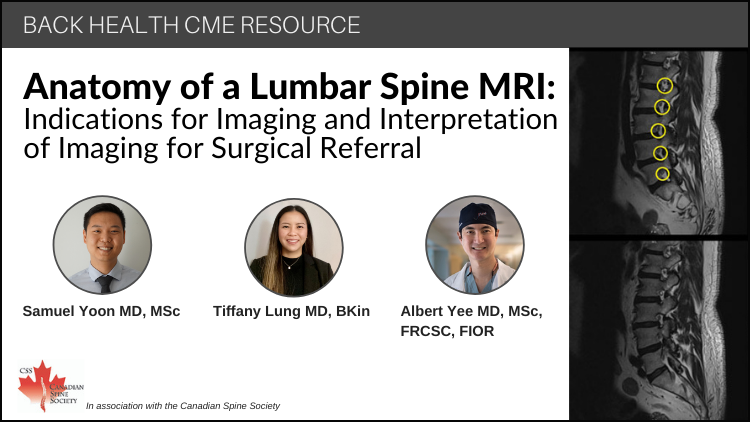
1Samuel Yoon MD, MSc, 2Tiffany Lung MD, BKin, 3 Albert Yee MD, MSc, FRCSC, FIOR,

1Division of Orthopaedic Surgery, University of Toronto, Toronto, Ontario, Canada.2Division of Orthopaedic Surgery, University of Toronto, Toronto, Ontario, Canada. 3 Professor of Surgery, Department of Surgery, University of Toronto, Marvin Tile Chair Division Chief of Orthopaedic Surgery, Division of Spine Surgery, Sunnybrook Health Sciences Centre, Toronto, Ontario, Canada.

CLINICAL TOOLS

Abstract: Despite guidelines from multiple medical organizations including Choosing Wisely Canada, routine screening for low back pain symptoms with advanced imaging modalities such as Magnetic Resonance Imaging (MRI) persists. While sensitive, the high prevalence of asymptomatic or non-correlative degenerative findings limits their usefulness for routine screening. Given the constraints on Canadian healthcare resources this is a cause for significant concern. Lumbar MRI examinations should be ordered only with clear clinical indications and never for simple triage. Suitable indications include patients with symptoms of Cauda Equina Syndrome, suspected spinal malignancies, vertebral infections, or a progressive neurologic deficit correlating to a dermatomal and/or myotomal distribution.
Key Words: Appropriateness in diagnostic imaging, lumbar MRI, low back pain, surgical indications.

Members of the College of Family Physicians of Canada may claim MAINPRO-M2 Credits for this unaccredited educational program.

www.cfpc.ca/Mainpro_M2

You can take quizzes without subscribing; however, your results will not be stored. Subscribers will have access to their quiz results for future reference.

Lumbar spine MRI is not a useful screening tool as incidental degenerative findings are extremely common.
Routine lumbar MRI usage to investigate low back pain is inappropriate and can cause harm to patients through wasted time and resources, as well as possible nocebo effects.
Lumbar spine MRI is indicated if accompanying Red Flag symptoms, such as recent systemic illness, high suspicion for tumour, or progressive/severe neurological symptoms/signs are present with the back pain.
Elective referrals to spine surgical specialists should confirm that the patient's clinical spinal condition aligns with advanced imaging findings.
The majority of patients with low back pain will improve with conservative management modalities.
Understanding clinical patterns of lumbar related axial pain and lower extremity referred neurologic symptoms is a more useful guide for determining whether or not patients are surgical candidates than obtaining images of structural change.
Patients suspected of having Cauda Equina Syndrome or exhibiting rapid progressive neurological decline in a dermatomal/myotomal distribution should be referred immediately for surgical evaluation.
To have access to full article that these tools were developed for, please subscribe. The cost to subscribe is $80 USD per year and you will gain full access to all the premium content on www.healthplexus.net, an educational portal, that hosts 1000s of clinical reviews, case studies, educational visual aids and more as well as within the mobile app.
Disclaimer at the end of each page