Law and Ethics

Disclaimer:  While every attempt is made to ensure that drug dosages provided within the text of this journal and the website are accurate, readers are urged to check drug package inserts before prescribing. Views and opinions in this publication and the website are not necessarily endorsed by or reflective of those of the publisher.

Michael Gordon, MD, MSc, FRCPC,

Emeritus Professor of Medicine, University of Toronto, Toronto, ON.

CLINICAL TOOLS

Abstract: The evolution of medicine is quite remarkable and astounding. Modern medicine is successfully treating or providing long-term control of conditions which in the not-so-distant past were lethal or resulted in permanent disability. The strong emphasis on evidence-based medicine in today's medical profession has led to a more organized approach toward evaluating the safety and efficacy of new medical treatments. Despite attempts to meet the complex needs of an ever-aging population, an almost cynical or inherent distrust of physicians in general and their medical claims is being increasingly noted. For many physicians this has led to an uncomfortable sense of professional frustration as doubt is cast on themselves or the medical profession in general when the expectations and goals of patients or their families are not achieved. The causes of this apparent malady of contemporary medicine are myriad and may be explored from various perspectives, depending on the particular issue. To understand better the issues and challenges involved, today's medical practitioner needs to be aware of the complex mix of organizational, professional, ethical, and at times anthropological perspectives contributing to this dissonance between medical professionals and the public. Improving our insight into the forces at work in this dissonance will help medical professionals improve medical services to the public and contribute to the preservation of medicine's admirable historical legacy.
Key Words: Anti-vaccination movement, conspiracy theories, evidence-based medicine, medical quackery, trust in physicians.
Evidence-based medicine asks questions, finds and appraises the relevant data, and harnesses that information for everyday clinical practice. Evidence-based medicine follows four steps:
• Formulate a clear clinical question from a patient’s problem
• Search the literature for relevant clinical articles
• Evaluate (critically appraise) the evidence for its validity and usefulness
• Implement useful findings in clinical practice.
The growing mistrust undermines the patient-doctor relationship, as well as the public’s perspective of health care professionals and the system in general.
If the medical dissonance is left unresolved, the future of health care will become increasingly onerous for those wishing to enter its professions, ultimately impacting those in need of medical services.
To have access to full article that these tools were developed for, please subscribe. The cost to subscribe is $80 USD per year and you will gain full access to all the premium content on www.healthplexus.net, an educational portal, that hosts 1000s of clinical reviews, case studies, educational visual aids and more as well as within the mobile app.

Planning for the Future: Expected and Unexpected

Author(s)
Deck
For those of us who are planners, it seems perfectly natural to anticipate the possibilities of the future...
Thumbnail Image
Teaser

My late father, an engineer whose expertise was motor vehicles, drummed into me the importance of timely oil changes—which I do to this day: it is an almost obsession with me.

For those of us who are planners, it seems perfectly natural to anticipate the possibilities of the future and try to take steps to either avoid bad outcomes or implement steps to mitigate deleterious outcomes. My late father, an engineer whose expertise was motor vehicles, drummed into me the importance of timely oil changes—which I do to this day: it is an almost obsession with me.

Section

The Need to Feed—A Powerful Force

Author(s)
Deck
The mothers of all living species appear to have a biologically determined need to feed their young.
Thumbnail Image
Teaser

Food is clearly one of the essentials of life. Most people in the more developed world consider food as much for its culinary delights and aesthetics than for its nourishment attributes.

Why Families Should Consider Forgoing CPR

Author(s)
Deck
Physicians usually become adept at choosing medications for the complaints and illnesses that patients bring to their attention.
Thumbnail Image
Teaser

It happens a few times a month: I get a request for a meeting with a family struggling…

It happens a few times a month: I get a request for a meeting with a family struggling whether or not to provide a do not resuscitate (DNR) order for a frail and aged family member. Often the patient has dementia, and, therefore, the decision falls to the formal substitute decision maker (SDM), in keeping with the Health Care Consent Act in Ontario (and comparable legislation elsewhere).

Section
Keyword

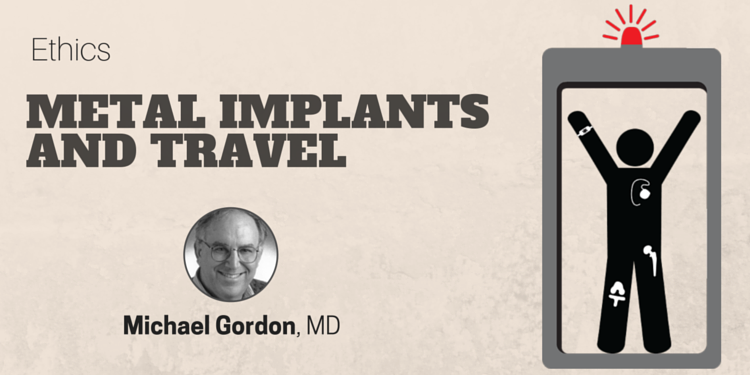
Metal Implants and Travel

Author(s)
Deck
It is the age of the bionic person…
Thumbnail Image
Teaser

Many older patients of mine have metal implants in their limbs following some form of reconstructive surgery…

Many older patients of mine have metal implants in their limbs following some form of reconstructive surgery. It is the age of the bionic person.

With so many "snowbirds" and with security metal detectors almost everywhere, there is often an expressed concern about whether having a metal implant in the hip or knee might delay you or lead to problems when you pass through airport or cruise security metal detectors.

Section

Where's the Beef?

Author(s)
Deck
I was sitting in a coffee shop next to table with 5 older women…
Thumbnail Image
Teaser

I could hear one of them say to the group, “I am cutting bacon out of my diet—but I do love it once in a while”…

I was sitting in a coffee shop next to table with 5 older women. I could hear one of them say to the group, "I am cutting bacon out of my diet—but I do love it once in a while".

Section

Make sure your Substitute Decision-Maker Understand the Rules of Engagement

Author(s)
Deck
Ihave heard it many times, “ I am the POA"…
Thumbnail Image
Teaser

I have heard it many times, “ I am the POA" (wrong use of the term—what they mean is the SDM-Substitute-Decision-Maker or as is often used in the United States Proxy: the POA is in fact the document outlining the substance of the decisions that are being referred to).

I have heard it many times, “ I am the POA (wrong use of the term—what they mean is the Substitute-Decision-Maker (SDM) or as is often used in the United States Proxy: the POA is in fact the document outlining the substance of the decisions that are being referred to).

Section

Any Reason to not Enjoy Sex if you are in a Nursing Home?

Author(s)
Deck
A while back there was a headline in the New York Times about a well-known retired politician…
Thumbnail Image
Teaser

A while back there was a headline in the New York Times about a well-known retired politician who was charged with rape for allegedly having sexual relations with his wife.

A while back there was a headline in the New York Times about a well-known retired politician who was charged with rape for allegedly having sexual relations with his wife. This would of course not have been a story were it not for the fact that his wife was at the time of the alleged event living in a nursing home and experiencing cognitive impairment to a significant degree.

Section

Why a Section on Ethics?

Author(s)
Deck
At the time of my medical training, the term medical ethics was hardly used when discussing complex issues related to patients and families.
Thumbnail Image
Teaser

For most of us in practice in the 1960’s when I attended and completed medical school, the main source and inspiration for medical ethics was Hippocrates…

At the time of my medical training, the term medical ethics was hardly used when discussing complex issues related to patients and families.

Section

Discussions with your Doctor about your Future Wishes

Author(s)
Deck
There are days in my clinic where I seem to be having the same conversation over and over…
Thumbnail Image
Teaser

There are days in my clinic where I seem to be having the same conversation over and over—but with a different patient and different family.

There are days in my clinic where I seem to be having the same conversation over and over—but with a different patient and different family. I have often thought that a model of care I once heard a presentation about might be worth doing—having the equivalent of a group therapy, but with a number of my patients and their families to discuss the common problems in aging and cognitive function.

Section