
Current Concepts in the Surgical Treatment of the Degenerative Spine
Year
2016
Number
4
Image Number
1
Image Galleries
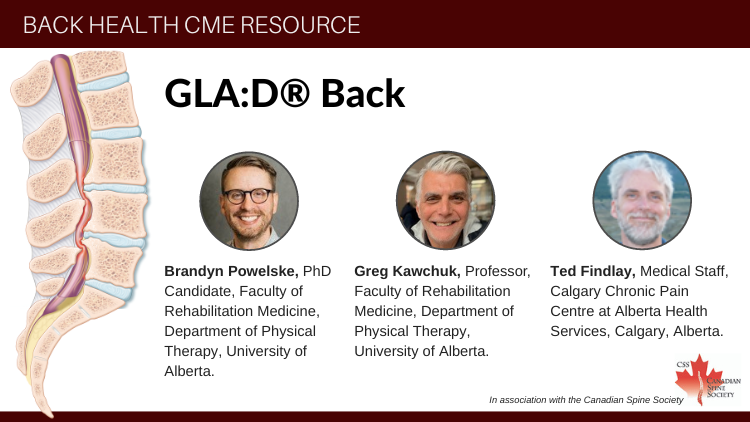
Brandyn Powelske, PhD Candidate, 1 Greg Kawchuk, 2 Ted Findlay,3
1 Faculty of Rehabilitation Medicine, Department of Physical Therapy, University of Alberta.
2 Professor, Faculty of Rehabilitation Medicine, Department of Physical Therapy, University of Alberta.
3Medical Staff, Calgary Chronic Pain Centre at Alberta Health Services, Calgary. Alberta.
| Abstract: While low back pain is one of the most common clinical conditions seen in a family physician's office, there remains a lack of low or no cost initial treatment options that are concordant with recognized best practice guidelines. As a result, many patients are offered investigations and treatments that have limited value and/or significant risks but are readily available through publicly funded provincial health care systems. GLA:D® Back builds upon the successful GLA:D model (initially developed for hip and knee osteoarthritis patients) by using the same established methodology to deliver a patient education and targeted rehabilitation program for low back pain. |
| Key Words: low back pain; best practice; guidelines; education; rehabilitation. |
Members of the College of Family Physicians of Canada may claim MAINPRO-M2 Credits for this unaccredited educational program.
www.cfpc.ca/Mainpro_M2
You can take quizzes without subscribing; however, your results will not be stored. Subscribers will have access to their quiz results for future reference.
| 1. Low Back Pain remains one of the most seen conditions in a family medical practice, and chronic low back pain the leading cause of ongoing disability |
| 2. There are significant patient financial and access barriers to treatment modalities most consistently recommended in practice guidelines: education and activity/rehabilitation-based therapies. |
| 3. GLA:D Back presents a validated option that can help close the gap between recommended treatments for low back pain and access through a primary care practice. |
| 4. GLA:D Back is an extension of the well-recognized and widely used GLA:D program for hip and knee osteoarthritis. |
| In the absence of clinical "Red Flags", avoid ordering unnecessary imaging when the results are not needed for investigating an established clinical diagnosis or to initiate a therapeutic procedure. |
| When considering pharmacotherapeutic options, remember that the Institute for Safe Medical Practices (Canada Institute for Safe Medication Practices Canada notes that opioids should generally be avoided in the treatment of low back pain, headache and fibromyalgia. |
| The Covid-19 Pandemic has taught us that many group based education and rehabilitation-based programs can be effectively delivered in a virtual format. |
| To have access to full article that these tools were developed for, please subscribe. The cost to subscribe is $80 USD per year and you will gain full access to all the premium content on www.healthplexus.net, an educational portal, that hosts 1000s of clinical reviews, case studies, educational visual aids and more as well as within the mobile app. |
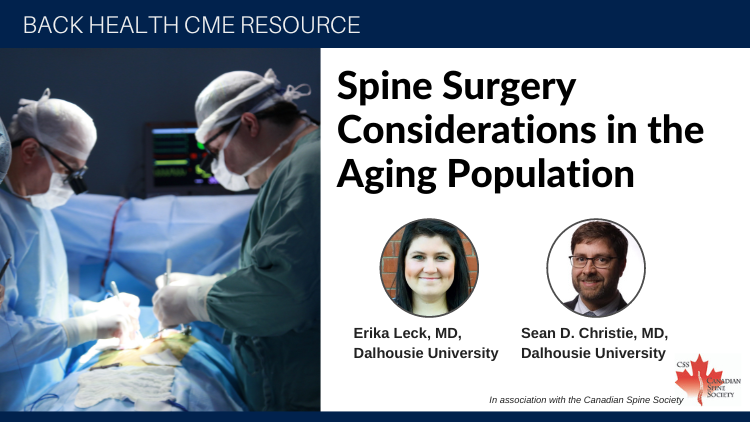
Erika Leck, MD, PGY 5,1, Sean D Christie, MD, FRCSC, 2,
1 Department of Surgery (Neurosurgery) Dalhousie University.
2 Vice-Chair and Director of Research Professor, Division of Neurosurgery , Department of Surgery (Neurosurgery), Healthy Populations Institute Flagship Project Co-Lead, Creating Sustainable Health Systems in a Climate Crisis, Dalhousie University.
| Abstract: The global population is ageing, and with that there is a concomitant increase in spinal pain and mobility complaints, most related to degenerative changes. It is important to consider how the markers of aging and, specifically, frailty, can overlap with symptoms of spine disease. Although non-operative management should be the initial response, spine surgery in older adults is safe and should be considered as part of a holistic approach for patients with persistent neuropathic pain. |
| Key Words: Spine Surgery, Elderly, Older Adults, Frailty, Imaging, Spinal Degeneration. |
Members of the College of Family Physicians of Canada may claim MAINPRO-M2 Credits for this unaccredited educational program.
www.cfpc.ca/Mainpro_M2
You can take quizzes without subscribing; however, your results will not be stored. Subscribers will have access to their quiz results for future reference.
| 1. It is essential to remember that, while degeneration is inevitable, the appearance of symptoms is not and treatment decisions must be based on the clinical presentation, not the images. |
| 2. Our ageing population will lead to an increase in the frequency of spine-related complaints. |
| 3. It is important to consider how the markers of aging and frailty overlap with symptoms of spine disease. |
| 4. The conservative approaches should always be pursued prior to consideration of surgical options. |
| 5. When required, spine surgery in older patients is safe and efficacious, but should involve a healthcare team able to appropriately assess and support the patient and their loved ones. |
| 1. Biological age does not necessarily equate to chronological age. |
| 2. Radiological “abnormalities” become more common with age, but are frequently asymptomatic, order tests that direct care. |
| 3. Combination, non-opioid, pharmacological strategies, with a ‘start low and go slow’ approach are preferred. |
| 4. Tools such as the Clinical Frailty Scale can be helpful in predicting risk and clinical decision making. |
| To have access to full article that these tools were developed for, please subscribe. The cost to subscribe is $80 USD per year and you will gain full access to all the premium content on www.healthplexus.net, an educational portal, that hosts 1000s of clinical reviews, case studies, educational visual aids and more as well as within the mobile app. |
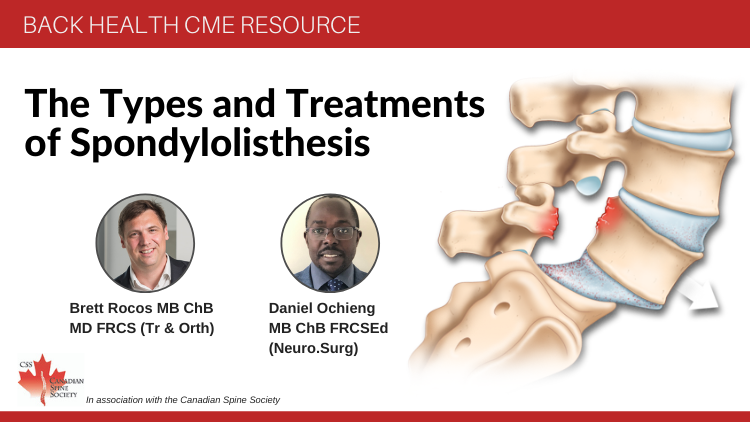
Brett Rocos MB ChB MD FRCS (Tr & Orth),1, Daniel Ochieng MB ChB FRCSEd (Neuro.Surg),2,
1 Consultant Spine Surgeon, Department of Spine Surgery, Barts Health NHS Trust, London, UK.
2Complex Spine Fellow, Department of Spine Surgery, Barts Health NHS Trust, London, UK.
| Abstract: Spondylolisthesis is a common finding in the adult patient but seldom requires surgical intervention. Up to 18% of the population show spondylolisthesis on spinal imaging with the vast majority requiring little or no treatment. This review explores the aetiology of spondylolisthesis, alongside key findings in the history and examination that should prompt referral, as well as presenting the evidence supporting surgical treatment. Spondylolisthesis affects patients at nearly every stage of life and understanding why and how to manage this common problem will aid in counselling patients and making the right referrals. |
| Key Words: Spondylolisthesis, spondylosis, back pain, radicular pain, neurogenic claudication, spinal stenosis. |
Members of the College of Family Physicians of Canada may claim MAINPRO-M2 Credits for this unaccredited educational program.
www.cfpc.ca/Mainpro_M2
You can take quizzes without subscribing; however, your results will not be stored. Subscribers will have access to their quiz results for future reference.
| • Spondylolisthesis affects 18% of adults. |
| • Surgical treatment for spondylolisthesis is rarely required. |
| • Risk factors depend on the patient's age and include specific athletic activities, trauma and degenerative changes to the posterior elements. |
| • Examination findings can be normal. |
| • Surgical options include repair, decompression, and stabilisation of affected segments. |
| • Spondylolisthesis is a common incidental finding. |
| • Not every spondylolisthesis needs treatment. |
| • Uncontrolled pain is a valid reason for referral. |
| • Analgesia, physiotherapy, and injection therapy manage most cases successfully. |
| To have access to full article that these tools were developed for, please subscribe. The cost to subscribe is $80 USD per year and you will gain full access to all the premium content on www.healthplexus.net, an educational portal, that hosts 1000s of clinical reviews, case studies, educational visual aids and more as well as within the mobile app. |


