Back Health

Disclaimer:  While every attempt is made to ensure that drug dosages provided within the text of this journal and the website are accurate, readers are urged to check drug package inserts before prescribing. Views and opinions in this publication and the website are not necessarily endorsed by or reflective of those of the publisher.

Patrick Thornley, MD, MSc, FRCSC,1, Christopher S. Bailey, MD, MSc, FRCSC,2,

1 London Health Science Centre Combined Neurosurgical and Orthopaedic Spine Program, Schulich School of Medicine, Western University, Ontario, Canada.
2 London Health Science Centre Combined Neurosurgical and Orthopaedic Spine Program, Schulich School of Medicine, Western University, Ontario, Canada.

CLINICAL TOOLS

Abstract: Lumbar intervertebral disc herniations (IVH) carry a high lifetime prevalence and are the most common cause of sciatica. The vast majority of symptomatic lumbar IVH improve with conservative management though adjuncts such as physiotherapy and epidural steroid injections may play a role in short-term symptom relief. For patients with unresponsive lumbar IVH, discectomy reliably improves symptoms more rapidly than continued conservative care, though there is inconsistent evidence that clinical differences between operative and conservative care are no different at one-year after symptom onset.
Key Words: lumbar radiculopathy, intervertebral disc herniation; lumbar intervertebral disc herniation; lumbar disc herniation; sciatica.

Members of the College of Family Physicians of Canada may claim MAINPRO-M2 Credits for this unaccredited educational program.

www.cfpc.ca/Mainpro_M2

You can take quizzes without subscribing; however, your results will not be stored. Subscribers will have access to their quiz results for future reference.

1. The natural history of lumbar intervertebral disc herniations causing lumbar radiculopathy is favourable with conservative care in the vast majority of patients.
2. Advanced imaging for patients with lumbar radiculopathy is indicated only in the setting of “red flag” neurologic symptoms or a concerning clinical history for infection, neoplastic or traumatic etiology or the absence of symptom improvement after six-weeks of conservative care.
3. Long-term follow-up demonstrates most patients with lumbar intervertebral disc herniation causing lumbar radiculopathy achieve comparable clinical improvement with surgery or conservative management, with surgery leading to earlier symptom resolution.
4. The high-quality evidence for surgery is weak given the high cross over rate but observational studies show a benefit of surgery after failed non-operative care.
1. The diagnosis is made on the patient’s history including leg dominant pain and confirmed by the physical examination.
2. A combination of a detailed motor and sensory neurologic examination, including supine straight leg raise in addition to cross leg straight leg raise, increases the clinical sensitivity and specificity of a diagnostic examination for lumbar radiculopathy.
3. Analgesics should be used to manage function and not just to reduce pain, taking into account response to the specific analgesic on an individual basis including the known side effect profiles.
4. Microdiscectomy surgery for patients with refractory lumbar radiculopathy lasting greater than four months can lead to a significant reduction in leg pain compared to continued conservative management.
To have access to full article that these tools were developed for, please subscribe. The cost to subscribe is $80 USD per year and you will gain full access to all the premium content on www.healthplexus.net, an educational portal, that hosts 1000s of clinical reviews, case studies, educational visual aids and more as well as within the mobile app.

Brett Rocos MB ChB MD FRCS (Tr & Orth),1, Daniel Ochieng MB ChB FRCSEd (Neuro.Surg),2,

1 Consultant Spine Surgeon, Department of Spine Surgery, Barts Health NHS Trust, London, UK.
2Complex Spine Fellow, Department of Spine Surgery, Barts Health NHS Trust, London, UK.

CLINICAL TOOLS

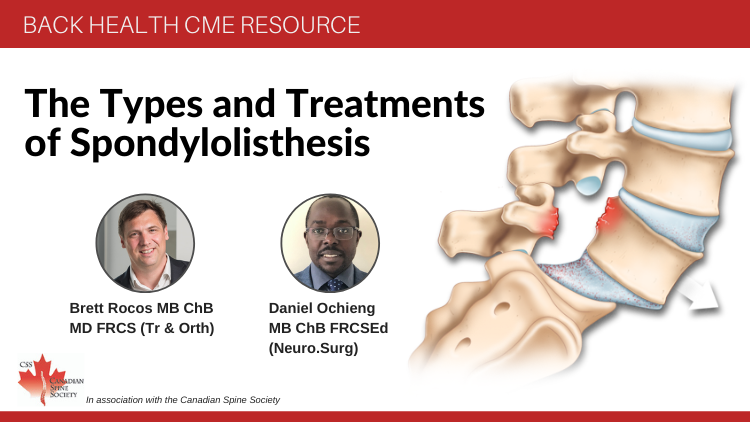
Abstract: Spondylolisthesis is a common finding in the adult patient but seldom requires surgical intervention. Up to 18% of the population show spondylolisthesis on spinal imaging with the vast majority requiring little or no treatment. This review explores the aetiology of spondylolisthesis, alongside key findings in the history and examination that should prompt referral, as well as presenting the evidence supporting surgical treatment. Spondylolisthesis affects patients at nearly every stage of life and understanding why and how to manage this common problem will aid in counselling patients and making the right referrals.
Key Words: Spondylolisthesis, spondylosis, back pain, radicular pain, neurogenic claudication, spinal stenosis.

Members of the College of Family Physicians of Canada may claim MAINPRO-M2 Credits for this unaccredited educational program.

www.cfpc.ca/Mainpro_M2

You can take quizzes without subscribing; however, your results will not be stored. Subscribers will have access to their quiz results for future reference.

• Spondylolisthesis affects 18% of adults.
• Surgical treatment for spondylolisthesis is rarely required.
• Risk factors depend on the patient's age and include specific athletic activities, trauma and degenerative changes to the posterior elements.
• Examination findings can be normal.
• Surgical options include repair, decompression, and stabilisation of affected segments.
• Spondylolisthesis is a common incidental finding.
• Not every spondylolisthesis needs treatment.
• Uncontrolled pain is a valid reason for referral.
• Analgesia, physiotherapy, and injection therapy manage most cases successfully.
To have access to full article that these tools were developed for, please subscribe. The cost to subscribe is $80 USD per year and you will gain full access to all the premium content on www.healthplexus.net, an educational portal, that hosts 1000s of clinical reviews, case studies, educational visual aids and more as well as within the mobile app.

Conner Joseph Clay1, José M. Orenday-Barraza, MD2, María José Cavagnaro MD2, Leah Hillier MD CCFP (SEM)3, Leeann Qubain1, Eric John Crawford MD MSc(c) FRCSC4, Brandon Hirsch MD5, Ali A. Baaj MD2, Robert A. Ravinsky MDCM MPH FRCSC5

1 University of Arizona College of Medicine – Phoenix, Phoenix, AZ.
2Department of Neurosurgery, University of Arizona College of Medicine – Phoenix, Phoenix, AZ.
3Department of Family Medicine & Community Medicine, Banner University Medical Center Phoenix, University of Arizona College of Medicine – Phoenix, Phoenix, AZ.
4Division of Orthopaedic Surgery, Department of Surgery, University of Toronto, Toronto, ON, Canada.
5Department of Orthopaedic Surgery, University of Arizona College of Medicine – Phoenix, Phoenix, AZ.

CLINICAL TOOLS

Abstract: Low back pain (LBP) is one of the most common presenting complaints in the primary care setting with significant economic implications and impairment of quality of life. Effective treatment of LBP can frequently be delivered in the primary care setting. Knowledge of common pain generators and recognition of pain patterns based on the history and physical exam helps guide the treatment of LBP without the need for excessive resource utilization. The majority of patients presenting with LBP can be confidently managed with targeted conservative management; when this fails further investigation may be warranted. Part 2 of this review focuses on imaging and diagnosis of LBP, as well as a detailed review of treatment modalities.
Key Words: low back pain, imaging, diagnostic interventions, treatment.

Members of the College of Family Physicians of Canada may claim MAINPRO-M2 Credits for this unaccredited educational program.

www.cfpc.ca/Mainpro_M2

You can take quizzes without subscribing; however, your results will not be stored. Subscribers will have access to their quiz results for future reference.

Patients presenting with lumbar-related complaints, in the absence of red flags or neurological deficits, can safely undergo a course of conservative treatment prior to ordering imaging studies.
Nonsurgical treatment modalities that can be attempted in patients with LBP include oral medications, topical medications, passive modalities, active physical therapy and cognitive interventions.
Diagnostic interventions such as selective nerve root blocks, diagnostic facet joint injections, medial branch blocks and provocative discography can be useful in confirming that a particular anatomical structure is a clinically relevant pain generator.
Surgery, in the absence of red flags or neurological deficits, should only be considered after the patient fails a thorough course of conservative treatment.
Images of the spine are not necessary to initiate management of mechanical low back pain; they may even be counterproductive.
When required, initial radiological evaluation of the lumbar spine involves upright plain radiographs. Further investigation may include use of MRI or CT myelography.
Diagnostic interventions can aid in establishing the dominant pain-generating anatomical structure but are not required if the patient is improving as anticipated.
To have access to full article that these tools were developed for, please subscribe. The cost to subscribe is $80 USD per year and you will gain full access to all the premium content on www.healthplexus.net, an educational portal, that hosts 1000s of clinical reviews, case studies, educational visual aids and more as well as within the mobile app.

Conner Joseph Clay1, José M. Orenday-Barraza, MD2, María José Cavagnaro MD2, Leah Hillier MD CCFP (SEM)3, Leeann Qubain1, Eric John Crawford MD MSc(c) FRCSC4, Brandon Hirsch MD5, Ali A. Baaj MD2, Robert A. Ravinsky MDCM MPH FRCSC5

1 University of Arizona College of Medicine – Phoenix, Phoenix, AZ.
2Department of Neurosurgery, University of Arizona College of Medicine – Phoenix, Phoenix, AZ.
3Department of Family Medicine & Community Medicine, Banner University Medical Center Phoenix, University of Arizona College of Medicine – Phoenix, Phoenix, AZ.
4Division of Orthopaedic Surgery, Department of Surgery, University of Toronto, Toronto, ON, Canada.
5Department of Orthopaedic Surgery, University of Arizona College of Medicine – Phoenix, Phoenix, AZ.

CLINICAL TOOLS

Abstract: Low back pain (LBP) is one of the most common presenting complaints in the primary care setting, with significant economic implications and impairment of quality of life. Effective treatment of low back pain can frequently be delivered in the primary care setting. Knowledge of common pain generators, and recognition of pain patterns based on the history and physical exam helps guide the treatment of LBP without the need for excessive resource utilization. The majority of patients presenting with LBP can be confidently treated with targeted conservative management, frequently obviating the need for advanced imaging and diagnostic investigations.
Key Words: low back pain, mechanical low back pain, lumbar pain, degenerative disease, clinical evaluation, triage.

Members of the College of Family Physicians of Canada may claim MAINPRO-M2 Credits for this unaccredited educational program.

www.cfpc.ca/Mainpro_M2

You can take quizzes without subscribing; however, your results will not be stored. Subscribers will have access to their quiz results for future reference.

The lumbar spine is designed to be both strong and flexible, but disruption or degeneration of the supporting structures of the spine can result in low back pain without major pathology.
Low back pain can be characterized into one of four pain patterns using a focused history supported by a relevant physical exam.
Lumbar spine MRI is indicated if accompanying Red Flag symptoms, such as recent systemic illness, high suspicion for tumour, or progressive/severe neurological symptoms/signs are present with the back pain.
The presence of "red flag" signs and symptoms must be carefully interpreted as a group and not individually.
Most adults will experience LBP sometime during their life.
Knowledge of common pain generators, and recognition of pain patterns based on the history and physical exam help guide treatment without the need for excessive resource utilization.
The goal of triaging LBP is to determine which cases arise from sinister pathology, and which cases can be safely managed conservatively.
Diagnostic investigations and specialist referral are warranted only when there is suspicion of a specific disease process that would be managed differently than mechanical LBP.
When clearly identified, the four LBP pain patterns should be treated in the primary care setting before undergoing advanced imaging.
To have access to full article that these tools were developed for, please subscribe. The cost to subscribe is $80 USD per year and you will gain full access to all the premium content on www.healthplexus.net, an educational portal, that hosts 1000s of clinical reviews, case studies, educational visual aids and more as well as within the mobile app.
Disclaimer at the end of each page

1Samuel Yoon MD, MSc, 2Tiffany Lung MD, BKin, 3 Albert Yee MD, MSc, FRCSC, FIOR,

1Division of Orthopaedic Surgery, University of Toronto, Toronto, Ontario, Canada.2Division of Orthopaedic Surgery, University of Toronto, Toronto, Ontario, Canada. 3 Professor of Surgery, Department of Surgery, University of Toronto, Marvin Tile Chair Division Chief of Orthopaedic Surgery, Division of Spine Surgery, Sunnybrook Health Sciences Centre, Toronto, Ontario, Canada.

CLINICAL TOOLS

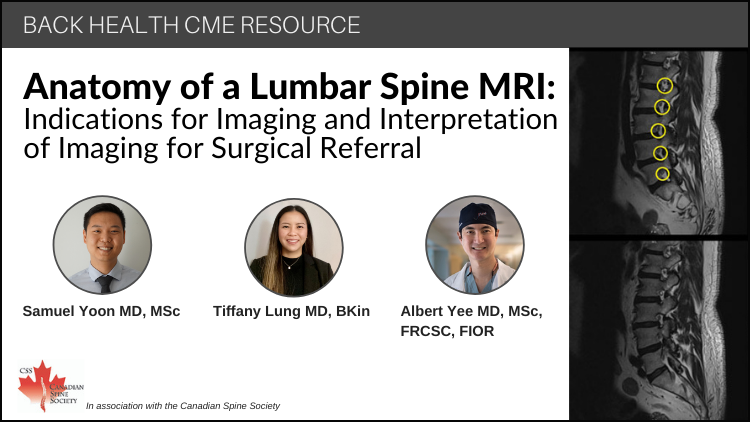
Abstract: Despite guidelines from multiple medical organizations including Choosing Wisely Canada, routine screening for low back pain symptoms with advanced imaging modalities such as Magnetic Resonance Imaging (MRI) persists. While sensitive, the high prevalence of asymptomatic or non-correlative degenerative findings limits their usefulness for routine screening. Given the constraints on Canadian healthcare resources this is a cause for significant concern. Lumbar MRI examinations should be ordered only with clear clinical indications and never for simple triage. Suitable indications include patients with symptoms of Cauda Equina Syndrome, suspected spinal malignancies, vertebral infections, or a progressive neurologic deficit correlating to a dermatomal and/or myotomal distribution.
Key Words: Appropriateness in diagnostic imaging, lumbar MRI, low back pain, surgical indications.

Members of the College of Family Physicians of Canada may claim MAINPRO-M2 Credits for this unaccredited educational program.

www.cfpc.ca/Mainpro_M2

You can take quizzes without subscribing; however, your results will not be stored. Subscribers will have access to their quiz results for future reference.

Lumbar spine MRI is not a useful screening tool as incidental degenerative findings are extremely common.
Routine lumbar MRI usage to investigate low back pain is inappropriate and can cause harm to patients through wasted time and resources, as well as possible nocebo effects.
Lumbar spine MRI is indicated if accompanying Red Flag symptoms, such as recent systemic illness, high suspicion for tumour, or progressive/severe neurological symptoms/signs are present with the back pain.
Elective referrals to spine surgical specialists should confirm that the patient's clinical spinal condition aligns with advanced imaging findings.
The majority of patients with low back pain will improve with conservative management modalities.
Understanding clinical patterns of lumbar related axial pain and lower extremity referred neurologic symptoms is a more useful guide for determining whether or not patients are surgical candidates than obtaining images of structural change.
Patients suspected of having Cauda Equina Syndrome or exhibiting rapid progressive neurological decline in a dermatomal/myotomal distribution should be referred immediately for surgical evaluation.
To have access to full article that these tools were developed for, please subscribe. The cost to subscribe is $80 USD per year and you will gain full access to all the premium content on www.healthplexus.net, an educational portal, that hosts 1000s of clinical reviews, case studies, educational visual aids and more as well as within the mobile app.
Disclaimer at the end of each page

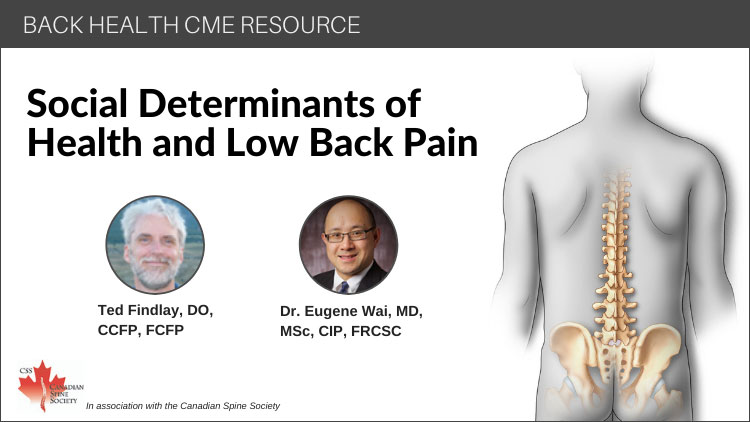
1Ted Findlay, DO, CCFP, FCFP, 2Dr. Eugene Wai, MD, MSc, CIP, FRCSC,

1Medical Staff, Calgary Chronic Pain Centre at Alberta Health Services, Calgary, Alberta. 2Associate Professor, University of Ottawa Division of Orthopaedic Surgery, Cross Appointment to School of Epidemiology and Public Health, Ottawa, ON.

CLINICAL TOOLS

Abstract: It has long been recognized that, following an intervention, two patients with very similar or even identical pathophysiology can have dramatically different outcomes. There is increasing recognition of the role and importance of the social determinants of health as a factor in explaining these differences. This article reviews a number of recent studies that explain the impact of these social determinants, specifically in chronic pain and low back pain. It includes commonly used screening tools and advice for interventions.
Key Words: Social determinants of health, chronic pain, low back pain, screening, social prescription.

Members of the College of Family Physicians of Canada may claim MAINPRO-M2 Credits for this unaccredited educational program.

www.cfpc.ca/Mainpro_M2

You can take quizzes without subscribing; however, your results will not be stored. Subscribers will have access to their quiz results for future reference.

1. According the World Health Organization, the impact of the social determinants of health on health and illness may outweigh that of health care or lifestyle choices.
2. The social determinants of health identified as being of the most importance specifically for low back pain include education and job position.
3. Most communities across Canada will include a number of resources that can be readily accessed as part of a "Social Prescription".
1. Incorporating social work support at an early stage may have the potential to improve treatment compliance and outcomes for those low back pain patients who have notable challenges related to the social determinants of health.
2. Well validated and easily utilized screening tools already exist for the routine screening of social determinants of health.
3. Sleep disorders are shown to affect nearly half of all people reporting chronic pain, with a bidirectional relationship.
Proper patient selection and pre-operative optimization of all modifiable factors improve outcomes and decrease the possibility of FBSS.
To have access to full article that these tools were developed for, please subscribe. The cost to subscribe is $80 USD per year and you will gain full access to all the premium content on www.healthplexus.net, an educational portal, that hosts 1000s of clinical reviews, case studies, educational visual aids and more as well as within the mobile app.
Disclaimer at the end of each page

1Zhi Wang BSc, MSc MD FRCSC, 2Ali Ghoul MD, 3Jesse Shen MD, PhD Candidate, 4Amer Sebaaly MSc, MD,

1Associate Professor, Montreal University (CHUM), Montreal, Quebec. 2PGY 3 Orthopaedic Resident, Saint Joseph University, Beirut Lebanon. 3PGY 5 Montreal University, Montreal Quebec. 4Orthopedic Lecturer, Saint Joseph University, Beirut, Lebanon.

CLINICAL TOOLS

Abstract: “Lumbar spinal pain of unknown origin, either persisting despite surgical intervention or appearing after surgical intervention for spinal pain, originating in the same topographical location” is a description widely used to describe Failed Back Surgery Syndrome (FBSS). In reality, the syndrome is more often a mismatch between the patient’s expectations and the surgical results. This review will describe the possible causes and presentation of FBSS and highlight the role of the multidisciplinary team approach in its management involving non-operative and surgical interventions. The most important objective is correct patient selection for surgery before the first operation.
Key Words: Failed Back Surgery Syndrome, multi-disciplinary approach, spine surgery, low back pain, patient expectations.

Members of the College of Family Physicians of Canada may claim MAINPRO-M2 Credits for this unaccredited educational program.

www.cfpc.ca/Mainpro_M2

You can take quizzes without subscribing; however, your results will not be stored. Subscribers will have access to their quiz results for future reference.

1. Fusing even a short segment of the spine can have significant, possibly deleterious effects, on the complex spinal functions.
2. The Failed Back Syndrome is often a mismatch between the patient's expectations and the final result rather than a failure of surgical technique.
3. The poor result may be the result of preoperative, intraoperative or postoperative factors. All three areas must be assessed.
4. Correct patient selection is as important or even more important than the surgical approach.
The incidence of Failed Back Surgery Syndrome ranges from 10-40% after a major spinal operation.
Setting the preoperative expectations with a full discussion between the patient, referring physician and operating surgeon plays a key role.
There are three periods – pre-operative, intra-operative, post-operative–in which FBSS can arise.
Proper patient selection and pre-operative optimization of all modifiable factors improve outcomes and decrease the possibility of FBSS.
To have access to full article that these tools were developed for, please subscribe. The cost to subscribe is $80 USD per year and you will gain full access to all the premium content on www.healthplexus.net, an educational portal, that hosts 1000s of clinical reviews, case studies, educational visual aids and more as well as within the mobile app.
Disclaimer at the end of each page

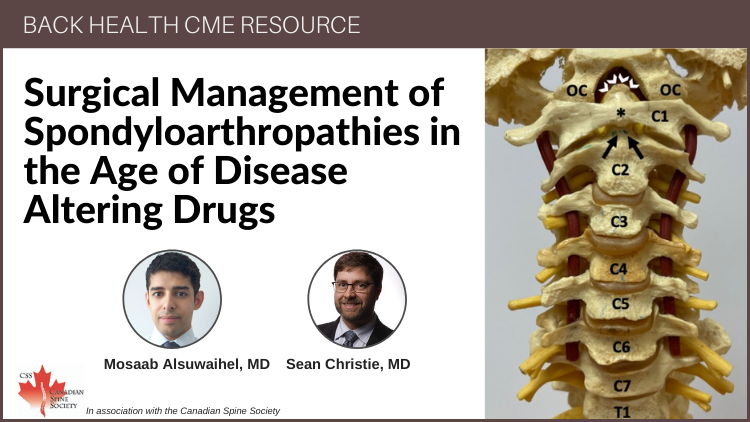
1Mosaab Alsuwaihel, MD, 2Sean Christie, MD,

1PGY4 Dalhousie Neurosurgery Program, Dalhousie University, Halifax, NS. 2Professor, Department of Surgery (Neurosurgery), Faculty of Medicine, Vice-Chair and Director of Research , Division of Neurosurgery, Dalhousie University.

CLINICAL TOOLS

Abstract: Inflammatory spondyloarthropathies produce synovitis of the spinal joints in rheumatoid arthritis (RA), or enthesitis in ankylosing spondylitis (AS). In RA, progressive disease leads to synovial destruction, ligamentous laxity, pannus formation and deformity. In AS progressive enthesitis results in ascending ossification, kyphotic deformity and rigidity which increase the risk of fracture. Although pain is the common presentation, spinal cord compression can produce neurological deficits. Although the need for surgery has decreased with the advent of new disease altering drugs, there remains a number of indications when surgical consultation remains important.
Key Words: Spondyloarthropathy and spondyloarthritis, Synovium and synovitis, Enthesis and enthesitis, Pannus.

Members of the College of Family Physicians of Canada may claim MAINPRO-M2 Credits for this unaccredited educational program.

www.cfpc.ca/Mainpro_M2

You can take quizzes without subscribing; however, your results will not be stored. Subscribers will have access to their quiz results for future reference.

1. Inflammatory arthritis from multiple etiologies may affect the spine with different patterns and pathophysiology.
2. Rheumatoid arthritis is a disease of synovial inflammation and in advanced disease leads to synovitis within the atlanto-dental articulation and the facet joints of the spine.
3. If left untreated atlantoaxial subluxation, cranial settling and pannus formation may lead to spinal cord and lower medullary compression.
4. Seronegative arthropathies leads to an enthesitis of the spine, usually starting in the sacroiliac spine and ascending with progressive ossification.
5. As a consequence of pathological alteration of the spine biomechanics, trauma in the setting of ankylosing spondylitis leads to different fracture patterns with a high chance of instability even after minimal trauma.
1. Early and adequate treatment of rheumatoid arthritis can prevent advanced atlanto-axial disease, deformity and neurological injury.
2. Even minimal trauma to the spine in a patient with ankylosing spondylitis has a high risk of instability and neurological injury; detailed imaging is always warranted.
3. With the advent of modern disease modifying agents for the treatment of spondyloarthropathies, the requisite for surgery has decreased but there remain important indications.
To have access to full article that these tools were developed for, please subscribe. The cost to subscribe is $80 USD per year and you will gain full access to all the premium content on www.healthplexus.net, an educational portal, that hosts 1000s of clinical reviews, case studies, educational visual aids and more as well as within the mobile app.
Disclaimer at the end of each page

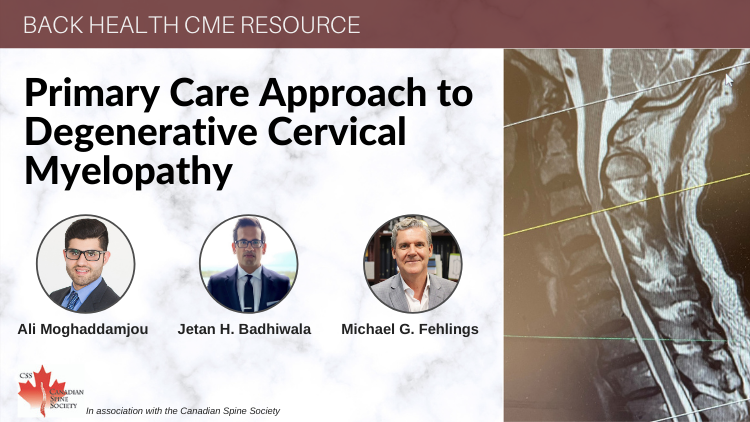
1Ali Moghaddamjou, MD,2Jetan H. Badhiwala, MD,3Michael G. Fehlings. MD, Phd, FRCSC, FACS,

1Division of Neurosurgery, Department of Surgery, University of Toronto, Spinal Program, Toronto Western Hospital, University Health Network, Toronto, Ontario, Canada. 2Division of Neurosurgery, Department of Surgery, University of Toronto, Spinal Program, Toronto Western Hospital, University Health Network, Toronto, Ontario, Canada. 3Division of Neurosurgery, Department of Surgery, University of Toronto, Spinal Program, Toronto Western Hospital, University Health Network, Toronto, Ontario, Canada.

CLINICAL TOOLS

Abstract: Degenerative cervical myelopathy is an umbrella term describing all degenerative conditions that present with cervical myelopathy due to compression of the spinal cord. The role of primary care physicians (PCPs) in early identification is vital as delayed diagnosis can lead to irreversible neurological impairment. Patients often present with subtle neurological deficits associated with neck or upper extremity pain. Screening for upper motor neuron signs, gait disturbances, fine motor abnormalities and bowel bladder symptoms is critical. Currently, surgical decompression is the treatment of choice but with future advancements in non-operative treatments, PCPs are expected to play a larger role in treatment plans.
Key Words: degenerative cervical myelopathy, primary care, cervical spondylotic myelopathy, degenerative disc disease.

Members of the College of Family Physicians of Canada may claim MAINPRO-M2 Credits for this unaccredited educational program.

www.cfpc.ca/Mainpro_M2

You can take quizzes without subscribing; however, your results will not be stored. Subscribers will have access to their quiz results for future reference.

PCPs play a vital role in the management of DCM as a delayed diagnosis can lead to irreversible neurological impairment.
A heightened level of awareness with a comprehensive history and a focused physical examination are essential.
With advancements in biomarkers and emerging neuroprotective and regenerative agents, we can expect an increased role in the primary care medical management of DCM patients soon.
The approach to DCM management is multidisciplinary and generally will involve PCPs, spinal surgeon, physiotherapist, pain specialist, and neurologist.
Patients with query bilateral carpal tunnel syndrome should be assessed for DCM.
Patients with moderate to severe DCM or unequivocal progression of mild DCM require surgical treatment while there exists clinical equipoise between structured non-operative therapies and surgical decompression for mild non-progressive cases of DCM.
Clinically monitor patients with mild DCM frequently and carefully for subtle signs of neurological progression
To have access to full article that these tools were developed for, please subscribe. The cost to subscribe is $80 USD per year and you will gain full access to all the premium content on www.healthplexus.net, an educational portal, that hosts 1000s of clinical reviews, case studies, educational visual aids and more as well as within the mobile app.
Disclaimer at the end of each page

1Eryck Moskven, MD,2Raphaële Charest-Morin, MD, FRCSC,

1PGY 1, Department of Orthopaedics, Vancouver Spine Surgery Institute, University of British Columbia, Vancouver, BC. 2Clinical Assistant Professor, Combined Neurosurgical and Orthopaedic Spine Program, Vancouver General Hospital, University of British Columbia, Vancouver, BC.

CLINICAL TOOLS

Abstract: Purpose: Frailty is a state of increased vulnerability. This paper reviews the definitions and applicability of frailty tools and discusses the impact of frailty in patients with spinal disease.
Recent Findings: Frailty is a significant risk factor for postoperative adverse-events (AEs), prolonged postoperative length of stay (LOS), adverse discharge disposition, and mortality following spine surgery. Cumulative deficit measures such as the mFI are appropriate risk stratification tools, while phenotypic measures are sensitive to capturing the relationship between spine disease and spine surgery on the frailty trajectory.
Summary: Frailty in patients with spinal disorders is predictive of postoperative adverse outcomes. The role of spine surgery to reverse frailty requires investigation.
Key Words: frailty, spine surgery, adverse outcomes, geriatric.

Members of the College of Family Physicians of Canada may claim MAINPRO-M2 Credits for this unaccredited educational program.

www.cfpc.ca/Mainpro_M2

You can take quizzes without subscribing; however, your results will not be stored. Subscribers will have access to their quiz results for future reference.

Frailty is a state of decreased reserve and increased vulnerability associated with adverse health outcomes.
Clinical frailty measures derived from the cumulative deficit model of frailty such as the mFI are appropriate risk stratification tools for identifying patients at an increased risk of postoperative AEs following spine surgery.
Frailty tools with phenotypic constructs are the most sensitive measures in capturing the relationship between spinal pathology and surgical intervention on the frailty trajectory.
When assessing an elderly patient, the FRAIL acronym is a helpful guide to screen for frailty - F (fatigue), R (resistance/muscular weakness), A (ambulatory difficulty), I (illness and comorbidities), and L (unintentional loss of weight).
Access to a readily available clinical frailty assessment tool on a mobile device, such as the Clinical Frailty Scale (CFS), reduces the need for extensive chart review to calculate and determine frailty severity.
When assessing for surgical candidacy the clinician should evaluate the impact of spinal pathology on health-related quality of life, the magnitude of the proposed surgical intervention and the frailty status.
To have access to full article that these tools were developed for, please subscribe. The cost to subscribe is $80 USD per year and you will gain full access to all the premium content on www.healthplexus.net, an educational portal, that hosts 1000s of clinical reviews, case studies, educational visual aids and more as well as within the mobile app.
Disclaimer at the end of each page