
Dermatology

Disclaimer:  While every attempt is made to ensure that drug dosages provided within the text of this journal and the website are accurate, readers are urged to check drug package inserts before prescribing. Views and opinions in this publication and the website are not necessarily endorsed by or reflective of those of the publisher.

About Psoriasis

WHAT IS PSORIASIS?

Psoriasis is a common but chronic skin condition that causes inflammation and scaling (red elevated patches and flaking silvery scales). The patches can be itchy or sore, causing discomfort and pain. Psoriasis causes skin cells to rise to the surface and shed at a very rapid rate. On average, people with psoriasis shed their skin cells every 3 to 4 days, while people without the condition have a turnover rate of about every 30 days.1,2,3,4
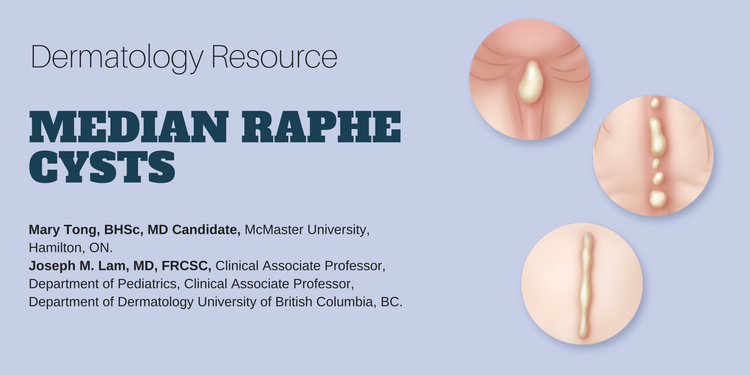
Mary Tong, BHSc, MD Candidate,1 Joseph M. Lam, MD, FRCSC,2

1McMaster University, Hamilton, ON.
2Clinical Associate Professor, Department of Pediatrics, Clinical Associate Professor, Department of Dermatology University of British Columbia, BC.

CLINICAL TOOLS

Abstract: Median raphe cysts are rare congenital lesions caused by a defect in embryological development of the male genitalia. They can present as solitary or multiple papules along the median raphe from urethral meatus to the anus. Although they are asymptomatic during childhood, they can cause problems later on as they increase in size. Surgical excision of the lesion is not necessary unless the patient becomes symptomatic.
Key Words: median raphe cysts, congenital lesions, treatment, management.
Median raphe cysts are benign cysts that can be present at birth, or acquired due to trauma or infection in the genitalia area.
Histologically, the cysts can have pseudo stratified columnar, squamous cell, or glandular epithelium, or a mixture of these cells.
Although these cysts are asymptomatic during childhood, they should be monitored overtime because they may cause problems as they increase in size with time.
Because these are benign malformations, median raphe cysts do not require excision unless they cause problems such as pain, problems with urination or sexual activity, or for cosmetic reasons.
Median raphe cysts are benign lesions that may be caused be a defect in the embryological development of the male genitalia.
The differential diagnoses of median raphe cyst include glomus tumor, dermoid cyst, pilonidal cyst, epidermal inclusion cyst, urethral diverticulum, and steatocystoma.
Treatment for asymptomatic median raphe cyst is not necessary but surgical excision can be considered if the cyst is causing problems or for cosmetic reasons.
To have access to full article that these tools were developed for, please subscribe. The cost to subscribe is $80 USD per year and you will gain full access to all the premium content on www.healthplexus.net, an educational portal, that hosts 1000s of clinical reviews, case studies, educational visual aids and more as well as within the mobile app.

About Rosacea

WHAT IS ROSACEA?

Rosacea is a common, chronic skin condition that causes redness of the face. It often presents as a mild redness or blushing that, over time, lasts for longer durations and becomes more pronounced. Rosacea can also produce enlarged, visible blood vessels and small red bumps on the facial skin. Before diagnosis, it can be mistaken for acne, an allergic reaction, or other skin conditions.1,2,3

Frequently Asked Questions about Psoriasis

WHAT IS PSORIASIS?

Psoriasis is a common but chronic skin condition that causes inflammation and scaling (red elevated patches and flaking silvery scales). The patches can be itchy or sore, causing discomfort and pain. Psoriasis causes skin cells to rise to the surface and shed at a very rapid rate. On average, people with psoriasis shed their skin cells every 3 to 4 days, while people without the condition have a turnover rate of about every 30 days.1,2,3,4

Frequently Asked Questions about Rosacea

WHAT IS ROSACEA?

Rosacea is a chronic skin condition that mainly affects the skin on the face (cheeks, nose, chin, and forehead).1

Living with Rosacea

CARING FOR YOUR SKIN

Use sunscreen daily with an SPF 30 or higher with broad-spectrum (UVA and UVB) protection. Sunscreen should be labelled: non-oily, fragrance-free, alcohol-free, and meant for sensitive skin.1

The Role of Nutraceuticals in Atopic Dermatitis

Jacky Lo, MD,1 Joseph M. Lam, MD, FRCSC,2

1 is a resident in the Family Medicine Residency at the University of British Columbia. He was previously a registered dietitian at the College of Dietitians in BC.
2is a pediatric dermatologist and a clinical assistant professor in the Departments of Pediatrics and Dermatology at the University of British Columbia.

CLINICAL TOOLS

Abstract: Atopic dermatitis (AD) is a chronic relapsing and remitting dermatosis with no definitive cure. Because treatment often remains challenging, the use of nutraceuticals has been gaining popularity as an alternative therapy.
Key Words: Nutraceuticals, atopic dermatitis, prevention, treatment.
The use of prebiotics in formula fed infants may reduce the incidence of AD up until two years of life.
The use of prenatal and/or postnatal probiotics, especially with Lactobacillus rhamnosus and Bifidobacterium, has been shown to reduce the incidence of AD. However, the evidence for its long-term effects appears to be inconsistent.
There is conflicting evidence regarding the use of vitamin D alone and zinc in the treatment of AD.
Routine supplementation of vitamin E alone and selenium does not appear to be beneficial in the treatment of AD.
While the use of fish oil has not been shown to have any statistically significant benefit in the treatment of AD, its use has been associated with improved quality of life, reduction in area affected in a pooled analysis of two studies and pruritus in one study.
Education plays an important in the management of AD and emphasis should be made to explore patients' reasons for turning to alternative therapies.
To have access to full article that these tools were developed for, please subscribe. The cost to subscribe is $80 USD per year and you will gain full access to all the premium content on www.healthplexus.net, an educational portal, that hosts 1000s of clinical reviews, case studies, educational visual aids and more as well as within the mobile app.

Cutaneous Features of Neurofibromatosis

Sang-Eun Kim , BSc, MSc,1 Joseph M. Lam, MD, FRCPC,2

1Faulty of Medicine, University of British Columbia, BC.
2Assistant Clinical Professor, Department of Paediatrics, Associate Member, Department of Dermatology, University of British Columbia, BC.

CLINICAL TOOLS

Abstract: Neurofibromatosis type 1 (NF1) is a multisystem genetic disorder that is characterized by café-au-lait spots, axillary or inguinal freckles, cutaneous neurofibromas, and skeletal dysplasias. Currently, there are no curative therapies for NF1 but medical therapies, including systemic sirolimus, have opened the door for significant medical advances in the treatment of NF1. Management of NF1 has been focused on routine examinations looking out for potential complications of NF1. However, many patients with NF1 are missed and may not be diagnosed early. The following review article will provide an overview of select common and uncommon cutaneous features of NF1 to help the practitioner recognize, diagnose and treat patients with NF1.
Key Words: Neurofibromatosis type 1, café-au-lait spots, axillary freckles, inguinal freckles, cutaneous neurofibromas.
Clinical diagnosis of NF1 requires the presence of at least 2 out of the 7 criteria.
Not all patients with café-au-lait spots will have NF1.
Axillary and inguinal freckling are the most specific criteria for NF1.
Three different types of cutaneous neurofibromas are dermal, subcutaneous, and plexiform neurofibromas (PNs). PNs can become malignant.
Juvenile xanthogranuloma and nevus anemicus are uncommon associated cutaneous features of NF1.
NF1 is a genetic disorder and there is no cure.
Patients should be routinely monitored for rare complications and annual exam should include BP measurement, skin and bone abnormality assessment, visual acuity checks, and ophthalmological evaluations.
Not all Cafe-au-lait spots require specialist referral however early recognition and prompt referral is essential.
To have access to full article that these tools were developed for, please subscribe. The cost to subscribe is $80 USD per year and you will gain full access to all the premium content on www.healthplexus.net, an educational portal, that hosts 1000s of clinical reviews, case studies, educational visual aids and more as well as within the mobile app.

A Scaly Periorbital Rash in a Preschool-aged Boy

Jennifer Smitten, MD, FRCPC,1 Joseph M Lam, MD, FRCPC,2

1BC Children's Hospital, University of British Columbia, BC.
2Assistant Clinical Professor, Department of Paediatrics, Associate Member, Department of Dermatology, University of British Columbia, BC.

CLINICAL TOOLS

Abstract: A healthy 4-year-old boy presented with an 8-month history of a pruritic scaly eruption around his right eye associated with several small pearly papules on the face. A clinical diagnosis of an eczematous id reaction to molluscum contagiosum was made. While up to 40% of cases of molluscum contagiosum may have an associated eczematous dermatitis, these are often under-recognized or misdiagnosed.
Key Words: Pediatrics, Dermatology, Dermatitis, Molluscum, Eczema, Id reaction, Viral exanthem, Hypersensitivity.
Eczematous id reactions to molluscum contagiosum (MC) in children are common, occurring in up to 40% of cases of MC.
Id reactions to MC can be challenging to diagnose, as they may occur at sites distant from the MC lesions.
Id reactions can be caused by a variety of infectious and noninfectious dermatoses.
Asymptomatic id reactions do not require pharmacologic treatment and a watchful waiting approach is reasonable.
1. Id reactions can be caused by a variety of infectious and noninfectious dermatoses, including allergic contact dermatitis to nickel, scabies infestation, tinea infection and molluscum infection.
2. In a unilateral eczematous dermatitis, consider molluscum dermatitis, especially in a child with no personal or family history of atopy.
3. Treatment of symptomatic id reactions may help to reduce spread of MC via autoinoculation from scratching.
To have access to full article that these tools were developed for, please subscribe. The cost to subscribe is $80 USD per year and you will gain full access to all the premium content on www.healthplexus.net, an educational portal, that hosts 1000s of clinical reviews, case studies, educational visual aids and more as well as within the mobile app.