Gender & Health

Disclaimer:  While every attempt is made to ensure that drug dosages provided within the text of this journal and the website are accurate, readers are urged to check drug package inserts before prescribing. Views and opinions in this publication and the website are not necessarily endorsed by or reflective of those of the publisher.

Benign Prostatic Hyperplasia—Medical and Surgical Treatment Options

Dean S. Elterman, MD, MSc, FRCSC,1 Udi Blankstein, MD,2

1Attending Urologic Surgeon, Toronto Western Hospital, University Health Network, Assistant Professor, Division of Urology, Department of Surgery, University of Toronto, Toronto, ON.
2Department of Urology, McMaster University, Hamilton, ON.

CLINICAL TOOLS

Abstract: Benign prostatic hyperplasia (BPH) affects the aging male. Treatment options vary widely. Some men will elect to conservatively monitor their symptoms and make alterations to their lifestyle choices. Pharmacotherapy options exist as well, and include alpha-blockers, 5-alpha reductase inhibitors and phosphodiesterase-5 inhibitors. Lastly, surgical options are also a viable treatment option, with many types at the disposal of the caregiver. Technological advancements have changed, and will continue to change the field in the near future. This review outlines the important aspects of this common affliction.
Key Words:Benign prostatic hyperplasia, management, treatment, referral.

Members of the College of Family Physicians of Canada may claim MAINPRO-M2 Credits for this unaccredited educational program.

www.cfpc.ca/Mainpro_M2

You can take quizzes without subscribing; however, your results will not be stored. Subscribers will have access to their quiz results for future reference.

There is a spectrum of bother ranging from mild nuisance to significant decrease in quality of life – this is largely associated with how the patient perceives the problem.
Physical exam and medical history are imperative in the initial assessment of BPH.
Conservative measures and lifestyle changes should be the first line treatment choice.
Surgical intervention should be attempted after failure of medical therapy to alleviate symptoms and prevent kidney injury or infection.
Ensure that there are no other causes that may cause LUTS such as various medications, and other comorbidities.
When considering more invasive intervention, ensure that the surgical team knows the patient's anticoagulation status.
To have access to full article that these tools were developed for, please subscribe. The cost to subscribe is $80 USD per year and you will gain full access to all the premium content on www.healthplexus.net, an educational portal, that hosts 1000s of clinical reviews, case studies, educational visual aids and more as well as within the mobile app.

Dr. Dean S. Elterman, MD, MSc, FRCSC,1 Harkiran K. Sagoo, BSc(Hons),2

1Attending Urologic Surgeon, Toronto Western Hospital, University Health Network, Assistant Professor, Division of Urology, Department of Surgery, University of Toronto, Toronto, ON.
24th Year Medical Student at GKT School of Medicine, King's College London, U.K.

CLINICAL TOOLS

Abstract: Sacral Neuromodulation (SNM) is a FDA-approved minimally invasive surgical therapy offered as a third-line treatment for refractory overactive bladder (OAB). Studies report improvements in continence, mean number of voids/day, quality of life, depression and sexual function in patients receiving SNM compared to medical therapy, with treatment success sustained long-term and with few adverse events. SNM is recommended by CUA and AUA guidelines in the treatment of OAB in carefully selected patients.
Key Words:Neuromodulation, Neurostimulation, Overactive, Bladder, Incontinence.

Members of the College of Family Physicians of Canada may claim MAINPRO-M2 Credits for this unaccredited educational program.

www.cfpc.ca/Mainpro_M2

You can take quizzes without subscribing; however, your results will not be stored. Subscribers will have access to their quiz results for future reference.

Sacral neuromodulation should be offered as third-line treatment for patients with overactive bladder symptoms refractory to conservative/behavioural and/or pharmacological treatment.
Sacral neuromodulation is a minimally invasive procedure that may be offered to carefully selected patients with severe refractory overactive bladder that are willing to undergo a surgical procedure.
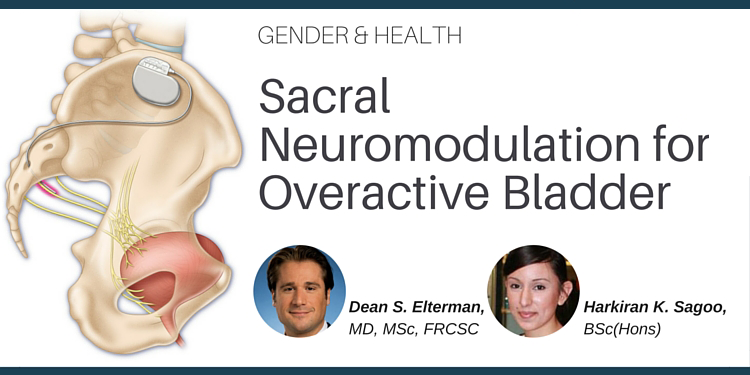
Sacral neuromodulation activates inhibitory sympathetic neurons using low-amplitude electrical stimulation of S3 afferent nerve roots to prevent detrusor contraction.
A prospective, randomized multi-center trial (level 1 evidence) reported improvements in incontinence, mean number of voids/day, quality of life, depression and sexual function in patients receiving sacral neuromodulation compared to standard medical treatment.
Adverse events/complications associated with SNM use include: pain at the implantation site, lead migration, wound-related complications, bowel dysfunction, infection, and generator problems.
Sacral neuromodulation is a FDA-approved minimally-invasive surgical therapy used as third-line treatment of overactive bladder symptoms/refractory overactive bladder. It is carried out in two stages, the first (evaluation) stage involves insertion of a temporary generator to assess clinical efficacy, and the second stage involves insertion of a permanent neuromodulator implant in patients that have demonstrated >50% improvement in symptoms during the evaluation stage.
Evidence from randomized, controlled trials, prospective multicenter, prospective single-center and retrospective studies demonstrates clinical efficacy of SNM in reducing symptoms of overactive bladder in these patients and therefore SNM is recommended by CUA and AUA guidelines in the treatment of overactive bladder in carefully-selected patients, as the risks of the procedure outweigh the burdens of the overactive bladder syndrome.
To have access to full article that these tools were developed for, please subscribe. The cost to subscribe is $80 USD per year and you will gain full access to all the premium content on www.healthplexus.net, an educational portal, that hosts 1000s of clinical reviews, case studies, educational visual aids and more as well as within the mobile app.