
Editor's Note, Volume 5 Issue 1

D’Arcy Little, MD, CCFP, FRCPC
Medical Director, JCCC and HealthPlexus.NET

D’Arcy Little, MD, CCFP, FRCPC
Medical Director, JCCC and HealthPlexus.NET
Neil Pugashetti,1 Shabbir M.H. Alibhai,3 Stanley A. Yap,1,2
1Department of Urology, University of California, Davis, Sacramento, CA.
2Division of Urology, Department of Surgery, VA Northern California Health Care System, Sacramento, CA, USA.
3Department of Medicine, University of Toronto, Toronto, Ontario, Canada.
| Abstract: Non-muscle-invasive bladder cancer (NMIBC) represents the large majority of newly diagnosed bladder tumors and represents a significant burden to both patients and the healthcare system. Although the initial standard treatment for all non-muscle-invasive tumors is surgical resection, there exist a wide variety of both surgical and medical treatment modalities based upon the tumor's specific stage and grade. Ensuring a proper diagnosis is key, and management should be tailored to the individual in order to reduce cancer recurrence and prevent progression of disease. |
| Key Words: Bladder cancer, non-muscle-invasive, diagnosis, treatment. |
Members of the College of Family Physicians of Canada may claim MAINPRO-M2 Credits for this unaccredited educational program.
www.cfpc.ca/Mainpro_M2You can take quizzes without subscribing; however, your results will not be stored. Subscribers will have access to their quiz results for future reference.
| Non-muscle-invasive bladder cancer consists of papillary tumors (Ta), tumors invading the submucosal lamina propria (T1), and flat lesions known as carcinoma in situ (CIS). |
| Proper management is key given the significant risk of tumor recurrence or progression to muscle-invasive disease. |
| Many treatment modalities exist including transurethral resection, intravesical chemotherapy, intravesical immunotherapy, and radical cystectomy; treatment choice depends on a variety of factors including tumor stage and grade. |
| The gold standard for the complete work-up of hematuria is office cystoscopy and imaging of the upper urinary tract. |
| Initial standard treatment of non-muscle-invasive bladder tumors is TURBT; at the time of resection, sampling of muscle surrounding the lesion is important to accurately assess depth of invasion. |
| To have access to full article that these tools were developed for, please subscribe. The cost to subscribe is $80 USD per year and you will gain full access to all the premium content on www.healthplexus.net, an educational portal, that hosts 1000s of clinical reviews, case studies, educational visual aids and more as well as within the mobile app. |
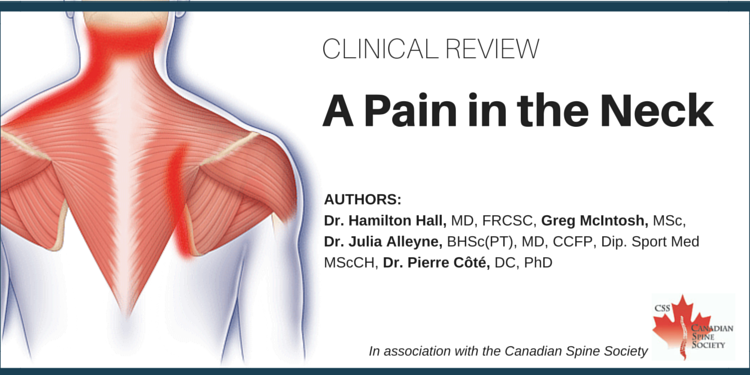
Dr. Hamilton Hall, MD, FRCSC,1 Greg McIntosh, MSc,2 Dr. Julia Alleyne, BHSc(PT), MD, CCFP, Dip. Sport Med MScCH,3 Dr. Pierre Côté, DC, PhD,4
1Professor, Department of Surgery, University of Toronto. Medical Director,
CBI Health Group, Executive Director of the Canadian Spine Society, Toronto, ON.
2Masters in Epidemiology, University of Toronto, Faculty of Medicine. Director of
Clinical Research for CBI Health Group and research consultant to the Canadian Spine
Society.
3Family Physician practising Sport and Exercise Medicine, Toronto Rehabilitation
Institute, University Health Network. Appointed at the University of Toronto, Department of
Family and Community Medicine, Associate Clinical Professor.
4Canada Research Chair in Disability Prevention and Rehabilitation; Associate
Professor, Faculty of Health Sciences, University of Ontario Institute of Technology (UOIT);
Director, UOIT-CMCC Centre for the Study of Disability Prevention and
Rehabilitation.
| Abstract: Neck pain is common and disabling. Associated with poor posture, sedentary work and stress it is long lasting and recurrent. Most neck pain is mechanical from the structural elements within the cervical spine and can be referred to a number of remote locations. Radicular arm dominant pain is infrequent. Neck pain is diagnosed on history and confirmed with the physical examination. Routine imaging is inappropriate and the Canadian C-spine rules are recommended. Management focuses on education, range of movement exercises with associated postural improvement and strengthening exercises; neck braces should not be used. |
| Key Words: cervical spine, neck pain, Canadian C-spine rules, range of movement, exercise. |
Members of the College of Family Physicians of Canada may claim MAINPRO-M2 Credits for this unaccredited educational program.
www.cfpc.ca/Mainpro_M2You can take quizzes without subscribing; however, your results will not be stored. Subscribers will have access to their quiz results for future reference.
| Most neck pain is benign mechanical pain and serious pathology is uncommon. |
| Neck pain is longer lasting and more disabling than generally recognized. |
| Referred neck pain can be felt on top the shoulders, between the shoulder blades, along the jaw, in the front of the chest and as a headache. |
| Nerve root involvement is unusual but when it occurs typically affects C5, C6 or C7. |
| Routine imaging is unproductive. |
| Management is based on education, range of movement exercises and strengthening. |
| A careful history to locate the site of the dominant symptoms and a physical examination to assess posture and rule out radiculopathy will identify common mechanical neck pain. |
| The need for an x-ray should be based on the Canadian C spine rules. |
| Improving mechanical neck pain starts with educating the patient about the favourable prognosis and increasing the range of neck movement: a cervical collar is contraindicated. |
| To have access to full article that these tools were developed for, please subscribe. The cost to subscribe is $80 USD per year and you will gain full access to all the premium content on www.healthplexus.net, an educational portal, that hosts 1000s of clinical reviews, case studies, educational visual aids and more as well as within the mobile app. |
Francesca Cheung, MD CCFP,1 Jeffrey Law and Lindsey Chow, 2
1Family physician with a focused practice designation in dermatology. She received the Diploma in Practical Dermatology from the Department of Dermatology at Cardiff University in Wales, UK. She is practising at the Lynde Institute for Dermatology in Markham, Ontario and works closely with Dr. Charles Lynde, MD FRCPC, an experienced dermatologist. In addition to providing direct patient care, she acts as a sub-investigator in multiple clinical studies involving psoriasis, onychomycosis, and acne.
2Third year medical students from the University of Western Ontario.
| Abstract: Kaposi's sarcoma (KS) is an angioproliferative tumour that requires infection by Human Herpesvirus 8 (HHV-8). It most commonly affects elderly men of Mediterranean/Eastern European backgrounds and HIV-infected patients. KS presents clinically as lesions on the skin, but may also arise in the gastrointestinal tract, lungs, and lymph nodes. There is no definitive cure for KS; therapeutic goals are to decrease the size of the lesions, prevent progression and improve function. Management depends on the type of KS, extent of disease and overall health of the patient. Observation is acceptable if the patient is asymptomatic; HAART is often sufficient to control lesions in HIV-infected patients. Cryotherapy and local excision can be used to treat solitary symptomatic lesions. Radiation therapy can be used for advanced and extended KS and in those patients for whom surgery is contraindicated. Intra-lesional injection of interferon alpha-2a or chemotherapeutic agents like vincristine have been reported to be effective in treating nodular KS lesions, but may be associated with inflammation and discomfort. Systemic chemotherapy such as pegylated liposomal doxorubicin is indicated when KS is widespread or rapidly progressive. The prognosis for KS is generally great with most patients dying from unrelated causes. |
| Key Words: Kaposi's Sarcoma, HHV-8, HIV/ AIDS. |
Members of the College of Family Physicians of Canada may claim MAINPRO-M2 Credits for this unaccredited educational program.
www.cfpc.ca/Mainpro_M2You can take quizzes without subscribing; however, your results will not be stored. Subscribers will have access to their quiz results for future reference.
| Kaposi’s sarcoma is a common tumour affecting HIV-infected patients. Classic Kaposi’s sarcoma most commonly affects elderly men of Mediteranean/Eastern European background. |
| Environmental and genetic factors are believed to predispose patients to Kaposi’s sarcoma. KS requires the infection of HHV-8. Chronic immune-suppression contributes to KS development. |
| KS presents with red/purple macules, plaques and nodules on the skin. Lesions may also arise in the oral cavity, gastrointestinal tract and lungs. Lesions affecting lymph nodes cause lymphedema. Consider KS in an HIV-infected patient who presents with erythematous and/or violaceous nodules or plaques. |
| Management of KS depends on the type of KS, extent and location of lesions and overall health of the individual. Observation is sufficient for asymptomatic patients. For patients with EKS, HAART is recommended and may be the only therapy needed. |
| Local control of KS lesions can be achieved through cryotherapy, local excision, intra-lesional injection of chemotherapeutic agents or radiation therapy. |
| Distant spread of KS can be controlled through systemic chemotherapy. |
| To have access to full article that these tools were developed for, please subscribe. The cost to subscribe is $80 USD per year and you will gain full access to all the premium content on www.healthplexus.net, an educational portal, that hosts 1000s of clinical reviews, case studies, educational visual aids and more as well as within the mobile app. |

If one is in medical practice long enough it sometimes seems like that sense one gets when sitting in a waiting room and picking up a years old copy of Time® magazine and not realize that it is years out of date, as many of the stories seem to be the same or very familiar.


