Dementia

Disclaimer:  While every attempt is made to ensure that drug dosages provided within the text of this journal and the website are accurate, readers are urged to check drug package inserts before prescribing. Views and opinions in this publication and the website are not necessarily endorsed by or reflective of those of the publisher.

Michael Gordon, MD, MSc, FRCPC,

Medical Program Director, Palliative Care, Baycrest Geriatric Health Care System, Professor of Medicine, University of Toronto, Toronto, ON.

CLINICAL TOOLS

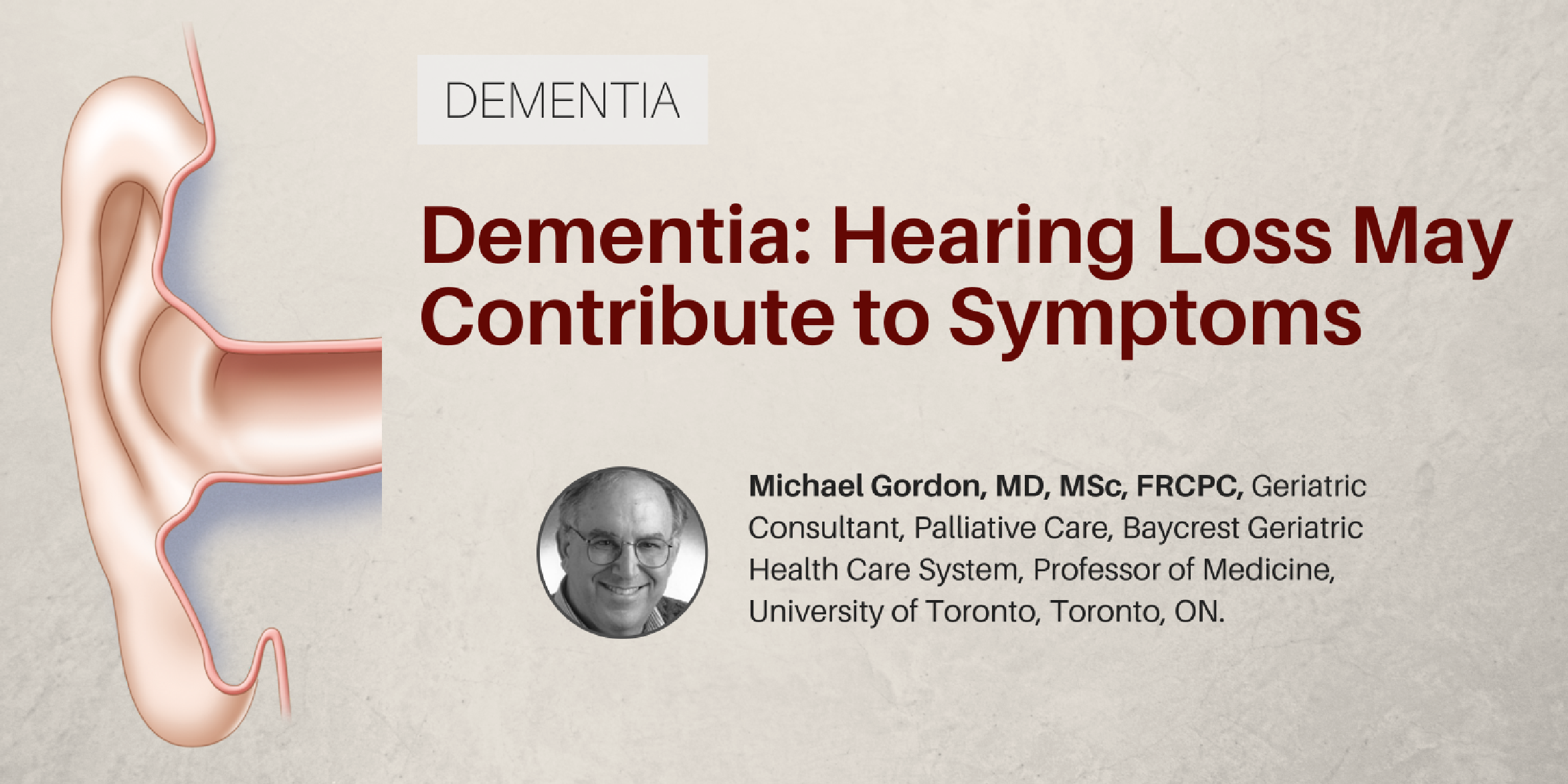
Abstract: Dementia and hearing loss are both prevalent in older people. Until relatively recently there was little appreciation of their possible interconnection in terms of cause, effect and relationship between the two conditions other than perhaps the dictum—”if you can’t hear it you can not remember it”. It has now become apparent that there is a more defined relationship in terms of possible causality or at least partial patho-physiological association which makes it more important to define hearing loss early on and address it as part of the strategy to decrease the risk of dementia.
Key Words: Alzheimer’s disease, hearing loss, symptoms
Do not discount hearing loss as part of assessment of the range of cognitive impairment and dementia.
Look for appropriate strategies to address hearing loss in elders with early cognitive impairment who may shun standard hearings aids—use the simpler Pocketalker (R) which may fulfil the important goal of enhancing hearing and communication.
To have access to full article that these tools were developed for, please subscribe. The cost to subscribe is $80 USD per year and you will gain full access to all the premium content on www.healthplexus.net, an educational portal, that hosts 1000s of clinical reviews, case studies, educational visual aids and more as well as within the mobile app.

Dealing with Family Strife

Author(s)
Deck
Physicians usually become adept at choosing medications for the complaints and illnesses that patients bring to their attention.
Thumbnail Image
Teaser

One always hopes that as medical practitioners, we will be able to focus our attention on the medical issues faced by seniors…

One always hopes that as medical practitioners, we will be able to focus our attention on the medical issues faced by seniors and help families cope with the fears, disappointments and tragedies that are faced by loved ones in the midst of what are often life-altering illnesses.

Section

Beyond Medications for Dementia

Author(s)
Deck
Physicians usually become adept at choosing medications for the complaints and illnesses that patients bring to their attention.
Thumbnail Image
Teaser

Dementia is the umbrella term used commonly to describe the cognitive decline that affects…

Physicians usually become adept at choosing medications for the complaints and illnesses that patients bring to their attention.

Topic
Section

Digoxin for the Control of Congestive Heart Failure Symptoms in Palliative Care

Author(s)
Deck
One of the great things about the history of medicine is how new ideas and approaches to care replace those that were previously the "gold standard" fall by the wayside and are replaced with newer and more effective treatments.
Thumbnail Image
Teaser

One of the great things about the history of medicine is how new ideas and approaches to care replace those that were previously the "gold standard"…

One of the great things about the history of medicine is how new ideas and approaches to care replace those that were previously the "gold standard" fall by the wayside and are replaced with newer and more effective treatments. Sometimes what becomes the new "gold standard" appears so counter-intuitive or "off-the-wall" that it takes time until the evidence grows that demonstrates its new role in the hierarchy of medical treatments.

Section

Anticipatory Conversations: Is there a connection to Ice Cream?

Michael Gordon, MD, MSc, FRCPC,

Medical Program Director, Palliative Care, Baycrest Geriatric Health Care System, Professor of Medicine, University of Toronto, Toronto, ON.

CLINICAL TOOLS

Abstract: Advance care planning has become a much touted and potentially very important addition to the new operative structure of meeting the many challenges of an ever increasingly older population. From what used to be discussions about CPR and DNR the process has evolved into what many expect might become the basis of end-of-life decision-making that may assist family members and health care providers to meet the needs, wishes and priorities of the elderly population, particularly when they are nearing that last trajectory of life.
Key Words: Artificial nutrition and hydration, advance care planning, living wills, end-of-life planning.
1. Planning before there is a medical crises can help avoid medical decisions that may not be in keeping with your wishes and values.
2. Artificial nutrition and hydration may not be what you really want, even though in its simplest form it may seem desirable as a way of avoiding death.
Communication with those who will be responsible for decision-making when you are no longer able to do so is key to having your end-of-life wishes fulfilled and should not be left to crises situations.
If you have favorite foods, make sure your substitute decision-makers know about them so that when the time comes you will not be deprived of your most enjoyed foods, because some health care provider deems them to be "unhealthy" or not in keeping with an "optimal diet".
To have access to full article that these tools were developed for, please subscribe. The cost to subscribe is $80 USD per year and you will gain full access to all the premium content on www.healthplexus.net, an educational portal, that hosts 1000s of clinical reviews, case studies, educational visual aids and more as well as within the mobile app.

Lessons to be Learned from History and the Perspective of Grandparents and Vaccination of Children

Michael Gordon, MD, MSc, FRCPC,

Medical Program Director, Palliative Care, Baycrest Geriatric Health Care System, Professor of Medicine, University of Toronto, Toronto, ON.

CLINICAL TOOLS

Abstract: The progress of medicine over previous decades includes benefits in the world of vaccination against especially childhood disease. It is therefore surprising to witness the growing and vociferous opposition to childhood vaccination, especially for measles. This poses substantial personal and public health risks. It is important to understand the reasons that anti-vaccination sentiment has taken hold among many often highly educated parents.
Key Words: Vaccination, anti-vaxxers, polio, measles vaccine.
The public are not always convinced by the best of medical evidence.
Medicine is always evolving—the public does not always understand the process.
The history of vaccination is long with many great heroes some of whom were not medical or scientific professionals.
Trying to convince people who believe vaccination causes childhood diseases may not respond to more and more evidence as their belief is almost religious in nature.
Sometimes it is the perspective of those old enough to remember the scourge of childhood infectious illnesses who can play a role in helping their children who may oppose vaccination come to their parental senses.
To have access to full article that these tools were developed for, please subscribe. The cost to subscribe is $80 USD per year and you will gain full access to all the premium content on www.healthplexus.net, an educational portal, that hosts 1000s of clinical reviews, case studies, educational visual aids and more as well as within the mobile app.

Lecture in Dundee Scotland—Reviving Old Wonderful Memories

Author(s)
Deck
When I graduated from medical school in 1966, geriatrics was already one of the medical subspecialties in Scotland...
Thumbnail Image
Teaser

I was the honoured speaker for this lecture series endowed in the Name of Miriam Friedman ben-David...

First Inaugural Miriam Friedman Lecturer: Dundee Scotland May 5, 2015

Section