
Editor's Note, Volume 5 Issue 2

D’Arcy Little, MD, CCFP, FRCPC
Medical Director, JCCC and HealthPlexus.NET

D’Arcy Little, MD, CCFP, FRCPC
Medical Director, JCCC and HealthPlexus.NET
Ian PUN, MD,
Family Physician, Scarborough, Ontario. OSCAR McMaster EMR user since 2010.
| Abstract: The leading-edge generation of EMR usage comprises extended interconnectivity to other healthcare databases, expanded communication between providers and their patients and integration of medical diagnostic and support devices ready for remote monitoring. These features are being developed and will become widely adopted in the near future. |
| Key Words: EMR, OSCAR McMaster EMR, OLIS, HRM, Cancer Care registry, vaccine cold chain. |
| Have your EMR connect to government websites so information is directly pushed into your EMR. |
| Health Card databases (HCV), OHIP billing database (MCEDT), Cancer database (CCO SAR), lab database (OLIS), Hospital databases (HRM) and outpatient lab databases (HL7). |
| Connect medical devices to your EMR. |
| Communicate with your colleagues electronically through secure means. |
| Set up your EMR to have working functionality with the CCO SAR, HRM, OLIS and lab databases. |
| Communicate online with your referring and consulting colleagues. |
| To have access to full article that these tools were developed for, please subscribe. The cost to subscribe is $80 USD per year and you will gain full access to all the premium content on www.healthplexus.net, an educational portal, that hosts 1000s of clinical reviews, case studies, educational visual aids and more as well as within the mobile app. |

Sean Christie, MD, MSc, FRCSC,1 Aaron S. Robichaud, MD,2
1Associate Professor, Department of Surgery (Neurosurgery), Department of Medical Neurosciences, Dalhousie University, Halifax, Nova Scotia.
2Clinical Fellow, Department of Surgery (Neurosurgery), Department of Medical Neurosciences, Dalhousie University, Halifax, Nova Scotia.
| Abstract: Cervical myelopathy is a degenerative disease that occurs secondary to direct spinal cord compression and compromise of spinal vasculature through a process of gradual spinal canal narrowing. Patients generally present with signs and symptoms of long tract compromise. Once myelopathy is suspected on clinical grounds, MRI is the test of choice to confirm canal stenosis and cord injury. Treatment involves surgical decompression, anteriorly and/or posteriorly of the spinal. Despite optimal management in this patient population, outcomes may be poor and are usually limited to halting progression of the disease rather than relieving deficits already present. |
| Key Words: Cervical myelopathy, cervical stenosis, degenerative spine disease, spondylosis. |
Members of the College of Family Physicians of Canada may claim MAINPRO-M2 Credits for this unaccredited educational program.
www.cfpc.ca/Mainpro_M2You can take quizzes without subscribing; however, your results will not be stored. Subscribers will have access to their quiz results for future reference.
| Cervical spondylotic myelopathy is a degenerative disease that results from compression of the spinal cord with subsequent cord injury and impaired conduction along the tracts contained within it. |
| Myelopathy is a clinical diagnosis based on signs and symptoms of spinal cord dysfunction and should not be used to refer to isolated imaging findings of spinal cord degeneration or stenosis. |
| MRI is the most sensitive test to identify cervical canal stenosis and injury to the cord and should be arranged when myelopathy is found on clinical evaluation to identify a specific diagnosis and guide management. |
| Surgical decompression can prevent progression of cervical spondylotic myelopathy, and in some patients improve gait and hand function. |
| Cervical myelopathy can be differentiated from radiculopathy on clinical exam by the presence of upper motor neuron signs as a result of injury to the spinal cord, which will be absent in radiculopathy. |
| MRI is helpful in working up cervical spondylotic myelopathy as it allows visualization of the elements causing compression, provides an estimate of the extent of stenosis through loss of CSF space surrounding the cord, and allows identification of cord injury manifest as hyperintense signal change in the cord on T2 weighted imaging. |
| Patients with symptomatic cervical myelopathy should be referred to a spine surgeon for evaluation and management. |
| To have access to full article that these tools were developed for, please subscribe. The cost to subscribe is $80 USD per year and you will gain full access to all the premium content on www.healthplexus.net, an educational portal, that hosts 1000s of clinical reviews, case studies, educational visual aids and more as well as within the mobile app. |
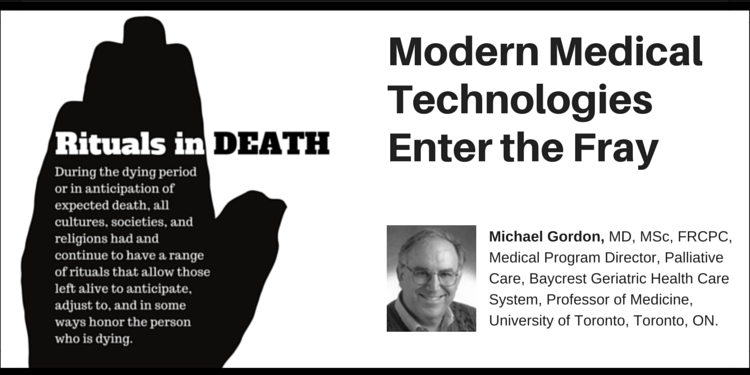
Michael Gordon, MD, MSc, FRCPC, Medical Program Director, Palliative Care, Baycrest Geriatric Health Care System, Professor of Medicine, University of Toronto, Toronto, ON.
Abstract
In the absence of immortality, the human species has over the millennia developed rites and rituals to help in the passing of life to honor the person who is dying or has died or in some way demonstrate their "courage" and perseverance as well as duty even in the face of almost certain death. The centuries old traditions of the gathering of loved ones, the chanting of prayers, the ritual religious blessings are in the process of being replaced by the "miracles" of modern medical technology.
Key Words: Cross-cultural death, death, dying, rituals.
Shannon Humphrey, MD, FRCPC, FAAD,
Director of Continuing Medical Education, Clinical Instructor, Department of Dermatology and Skin Science, University of British Columbia, Vancouver, BC, Canada.
| Abstract: While topical therapy remains a key therapeutic approach in the clinical management of AV, it can be associated with side effects that may compromise the stratum corneum and impair patient adherence. The use of adjunctive cleansers and moisturizers can help mitigate treatment side effects and subsequently enhance therapeutic efficacy. Providing patient-specific skin care recommendations, including product selection and proper use, is an important part of the clinical management of AV and may adjunctively augment the efficacy of topical medications in reducing acne lesions. |
| Key Words: acne vulgaris, adherence, cleansers, moisturizers. |
| Irritation resulting from topical medications and the emergence of bacterial resistance to both topical and oral antibiotics remain significant barriers to good treatment adherence. |
| Providing patient-specific skin care recommendations, including product selection and proper use, is an important part of the clinical management of AV and may adjunctively augment the efficacy of topical medications in reducing acne lesions. |
| Alleviating dryness and improving skin comfort by using a moisturizer concomitantly with retinoid therapy could enhance treatment efficacy. |
| The adjunctive use of appropriate gentle soap-free cleansers and non-comedogenic moisturizers that also restore SC barrier function, provide SPF protection, and reduce side effects of topical acne therapy is recommended and is preferred by patients and will likely improve treatment adherence. |
| Topical dapsone gel is antimicrobial and antineutrophilic and new fixed-dose retinoid-based combination therapies are available and this allows us to improve adherence with therapy and target multiple pathogenic mechanisms with one treatment. |
| Oleosome technology enables the delivery of broad-spectrum UVA/UVB sun protection (SPF 30). This technology effectively reduces the concentration of filters being applied to the skin, reducing the potential for skin sensitivity reactions. |
| To have access to full article that these tools were developed for, please subscribe. The cost to subscribe is $80 USD per year and you will gain full access to all the premium content on www.healthplexus.net, an educational portal, that hosts 1000s of clinical reviews, case studies, educational visual aids and more as well as within the mobile app. |


