
Editor's Note, Volume 7 Issue 1

D’Arcy Little, MD, CCFP, FRCPC
Medical Director, JCCC and HealthPlexus.NET

D’Arcy Little, MD, CCFP, FRCPC
Medical Director, JCCC and HealthPlexus.NET
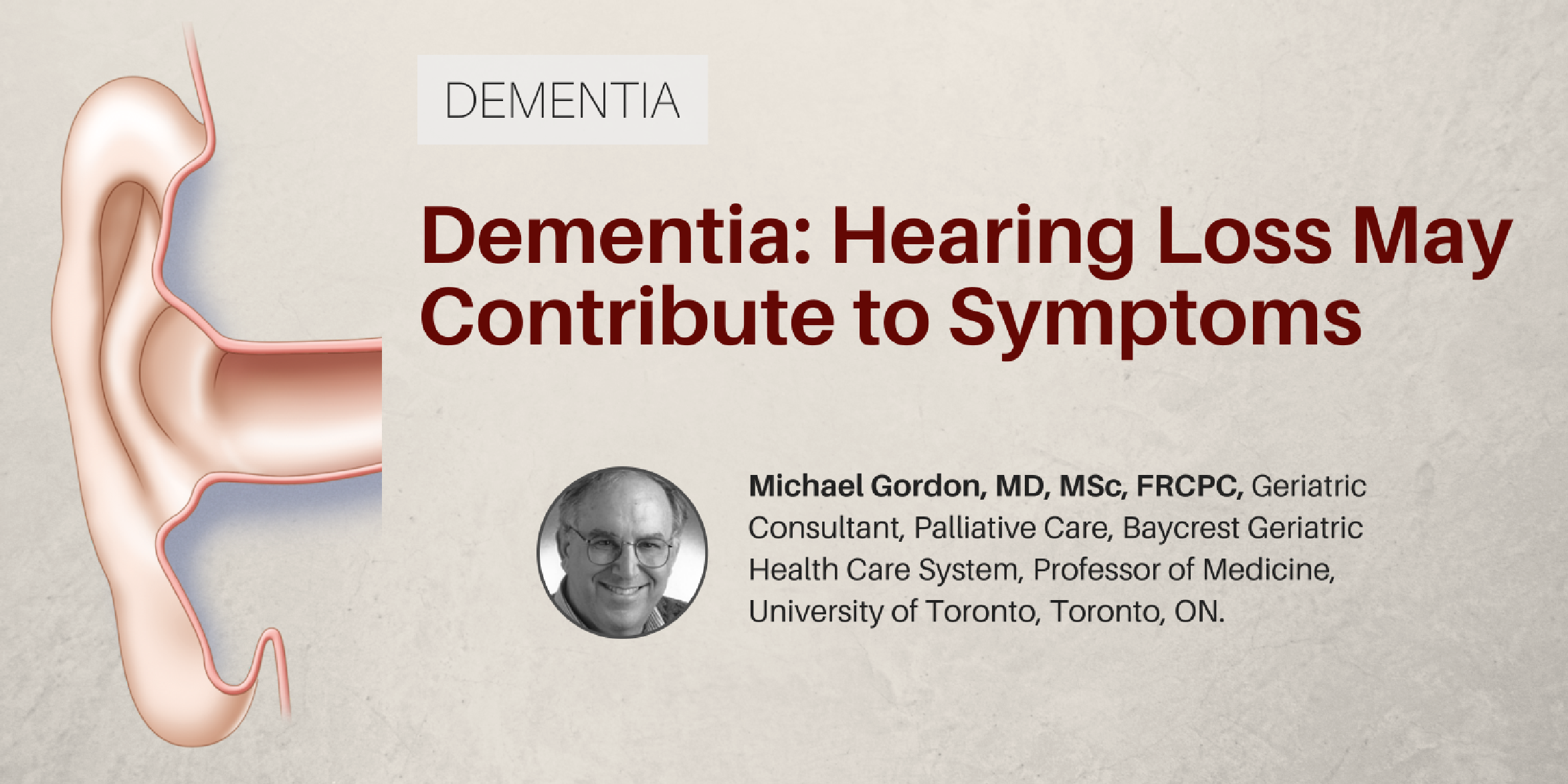
Michael Gordon, MD, MSc, FRCPC,
Medical Program Director, Palliative Care, Baycrest Geriatric Health Care System, Professor of Medicine, University of Toronto, Toronto, ON.
| Abstract: Dementia and hearing loss are both prevalent in older people. Until relatively recently there was little appreciation of their possible interconnection in terms of cause, effect and relationship between the two conditions other than perhaps the dictum—”if you can’t hear it you can not remember it”. It has now become apparent that there is a more defined relationship in terms of possible causality or at least partial patho-physiological association which makes it more important to define hearing loss early on and address it as part of the strategy to decrease the risk of dementia. |
| Key Words: Alzheimer’s disease, hearing loss, symptoms |
| Do not discount hearing loss as part of assessment of the range of cognitive impairment and dementia. |
| Look for appropriate strategies to address hearing loss in elders with early cognitive impairment who may shun standard hearings aids—use the simpler Pocketalker (R) which may fulfil the important goal of enhancing hearing and communication. |
| To have access to full article that these tools were developed for, please subscribe. The cost to subscribe is $80 USD per year and you will gain full access to all the premium content on www.healthplexus.net, an educational portal, that hosts 1000s of clinical reviews, case studies, educational visual aids and more as well as within the mobile app. |
Parham Rasoulinejad, MD, FRCSC, MSc, 1 Jennifer C. Urquhart, PhD,2 Christopher S. Bailey, MD, FRCSC, MSc, 2
1Orthopaedic Surgeon, Division of Orthopaedic Surgery, London Health Sciences Center, and Assistant Professor, Dept. of Surgery, University of Western Ontario, London, ON.
2Research Associate, Division of Orthopaedic Surgery, London Health Sciences Center, and Lawson Health Research Institute, London, ON.
3Orthopaedic Surgeon, Division of Orthopaedic Surgery, London Health Sciences Center, and Associate Professor, Dept. of Surgery, University of Western Ontario, London, ON.
| Abstract: Lumbar disc herniation is a common cause of low back pain and radiculopathy (sciatica). Diagnosis is initially made based on history and physical examination and ruling out red flags, particularly surgical emergencies such as Cauda Equina Syndrome. A trial of conservative treatment consisting of physical rehabilitation and oral medication is usually successful for back dominant pain. When persistent radiculopathy indicates lumbar discectomy the diagnosis must be confirmed by imaging but, due to very high rates of asymptomatic disc herniation, imaging cannot replace clinical diagnosis. For disabling leg dominant pain discectomy results in faster recovery but has a similar long-term outcomes compared to conservative treatment. |
| Key Words: lumbar disc herniation, lower back pain, sciatica, radiculopathy. |
Members of the College of Family Physicians of Canada may claim MAINPRO-M2 Credits for this unaccredited educational program.
www.cfpc.ca/Mainpro_M2You can take quizzes without subscribing; however, your results will not be stored. Subscribers will have access to their quiz results for future reference.
| Lumbar disc herniation is common and frequently asymptomatic. |
| Lumbar disc herniation may result in back pain. Much less frequently, when the adjacent nerve root is involved it can cause radiculopathy (sciatica). |
| Under most circumstances, the symptoms of lumbar disc herniation can be managed conservatively with physical rehabilitation and oral medications. |
| Red flags and surgical emergencies such as Cauda Equina Syndrome must be considered and should lead to urgent imaging and surgical referral. |
| Imaging, particularly MRI, has high rates of false positives and should only be used to confirm a diagnosis made based on history and physical examination. |
| For disabling persistent radiculopathy with good radiological correlation, surgical intervention in the form of a discectomy can be considered. |
| Lumbar disc herniation (LDH) is common and in most cases asymptomatic. Findings on MRI of lumbar disc herniation are not predictive of future back related disability. MRI findings should be interpreted along with history and physical exam findings to determine the appropriate diagnosis. |
| LDH can result in back pain and, when the adjacent nerve root is involved, radicular leg pain. The first line of treatment for back dominant pain should be education, lifestyle modification, mechanical therapy and oral medications in the form of acetaminophen, non-steroidal anti-inflammatories. |
| Radicular leg dominant pain may require opioids and/or epidural corticosteroid injections. The majority of patients will improve without further intervention. |
| For persistent symptoms of sciatica, surgical intervention can be considered. Lumbar discectomy is the most common procedure performed and has good to excellent outcomes. |
| To have access to full article that these tools were developed for, please subscribe. The cost to subscribe is $80 USD per year and you will gain full access to all the premium content on www.healthplexus.net, an educational portal, that hosts 1000s of clinical reviews, case studies, educational visual aids and more as well as within the mobile app. |
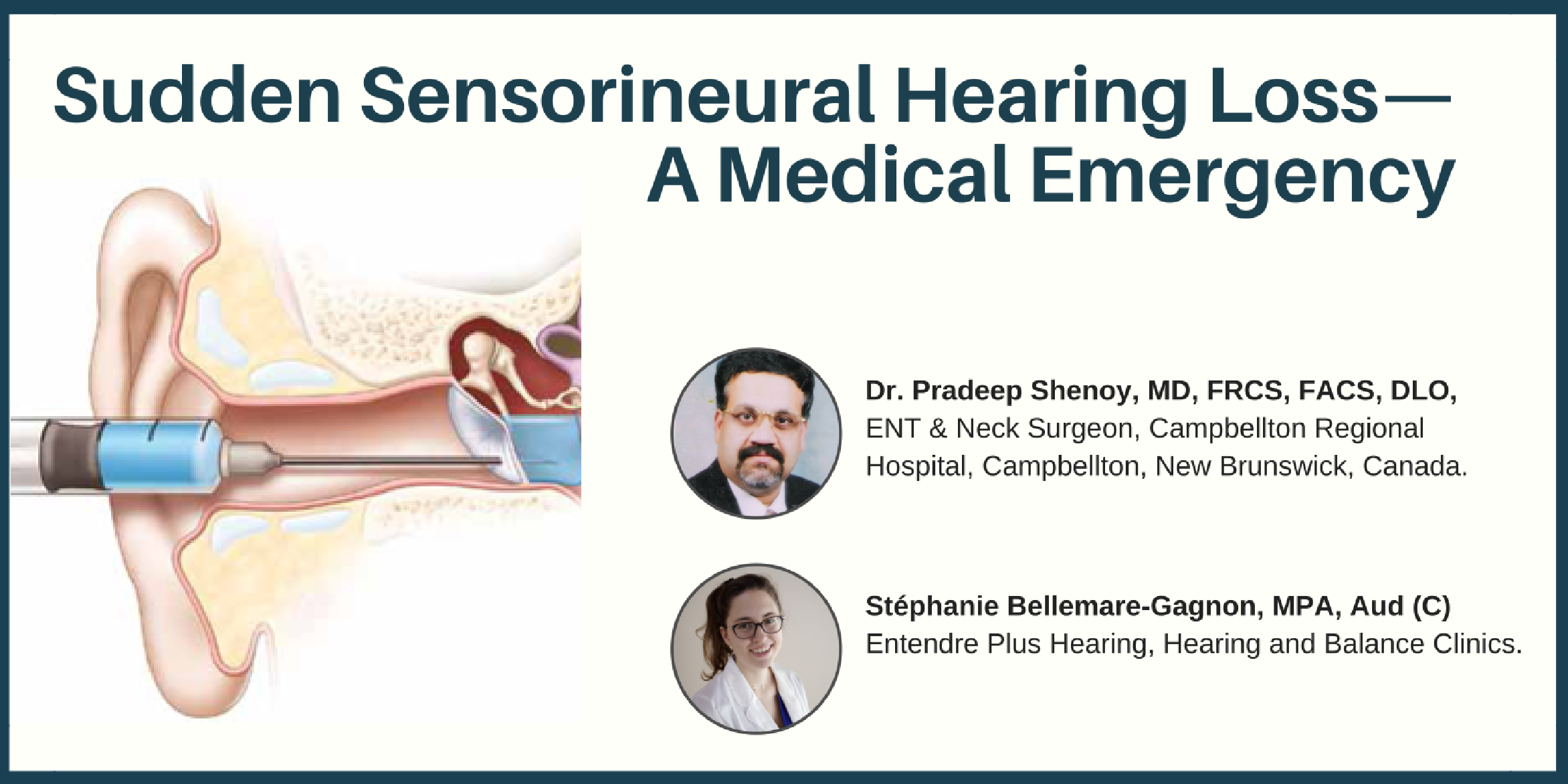
Dr. Pradeep Shenoy, MD, FRCS, FACS, DLO,1 Stéphanie Bellemare-Gagnon, MPA, Aud (C)2
1ENT & Neck Surgeon, Campbellton Regional Hospital, Campbellton, New Brunswick, Canada.
2Entendre Plus Hearing, Hearing and Balance Clinics.
| Abstract: Sudden hearing loss—usually unilateral and rarely bilateral—can be associated with tinnitus and vertigo. In most cases it is idiopathic, although various explanations such as infective, vascular, and immune causes have been postulated. We have reviewed the literature and what follows is a survey of current research and suggested treatments for sudden hearing loss. |
| Key Words: sudden sensorineural hearing loss (SSNHL), tinnitus, pure tone audiogram (PTA), acoustic brainstem response audiometry (ABRA), viral neuritis, vascular insufficiency, oral steroids, intratympanic steroids, antiviral treatment, hyperbaric oxygen therapy (HBOT), MRI brain, acoustic neuroma. |
| All patients with SSNHL should be assessed by taking a thorough history and performing a complete examination to identify any specific disease. |
| PTA should be performed in all patients. |
| Targeted laboratory investigations should be performed after the initial assessment. |
| All patients should have an MRI of the brain if a CT SCAN of the brain is contraindicated; ABR testing should also be considered. |
| If a specific cause for SSNHL is found, the patient should be managed accordingly. |
| If SSNHL is idiopathic in nature, patients may be offered a course of oral steroids. |
| If oral steroids are contraindicated, IT steroid therapy could be considered as a primary or salvage therapy. |
| Use of antivirals, HBOT, vasodilators, and vasoactive agents are not currently supported by the research. |
| To have access to full article that these tools were developed for, please subscribe. The cost to subscribe is $80 USD per year and you will gain full access to all the premium content on www.healthplexus.net, an educational portal, that hosts 1000s of clinical reviews, case studies, educational visual aids and more as well as within the mobile app. |


It happens a few times a month: I get a request for a meeting with a family struggling whether or not to provide a do not resuscitate (DNR) order for a frail and aged family member. Often the patient has dementia, and, therefore, the decision falls to the formal substitute decision maker (SDM), in keeping with the Health Care Consent Act in Ontario (and comparable legislation elsewhere).


