Sports Medicine
Disclaimer: While every attempt is made to ensure that drug dosages provided within the text of this journal and the website are accurate, readers are urged to check drug package inserts before prescribing. Views and opinions in this publication and the website are not necessarily endorsed by or reflective of those of the publisher.
Dr. Aly Abdulla1 Adil Abdulla2 Neelam Charania3
1 is a family doctor with specialties in sports medicine, palliative care, and cosmetic medicine. He can be found on Twitter, LinkedIn and https://ihopeyoufindthishumerusblog.wordpress.com/
2 is a law student at the University of Toronto that has suffered 13 concussions.
3 is a Masters in Occupational Therapy from Boston University and involved in managing and rehabilitating patients with chronic concussion syndrome.
CLINICAL TOOLS
| Abstract: Concussion or minimal traumatic brain injury is a confusing medical condition that is more common than previously appreciated. At the Berlin congress in 2016, 3 key tools and 11 key processes have been developed to clarify this condition and ensure good outcomes. This article summarizes those recommendations in an easy to use format. |
| Key Words: Concussion, minimal traumatic brain injury (mTBI), symptoms, protocol. |


| Do the SCAT5 or cSCAT5 on everyone with a mTBI. |
| When thinking of concussion also consider cervical spine or neck injury and vestibular injury. Learn to differentiate them. Treat accordingly. |
| The patient should rest for 24–48 hours after the injury, then can be encouraged to become gradually and progressively more active while staying below their cognitive and physical symptom-ex-acerbation thresholds |
| Any patients having persistent concussive symptoms (> 14 days for an adult or > 30 days in a child) should be referred to a specialist in mTBI and prescribed active rehabilitation. |
| Have a high rate of suspicion for mTBI |
| Most mTBI are managed well with Remove from play, Re-evaluate in office using SCAT5, and Rest |
| Repeat clinical testing is de rigeur for Return to Play |
| Learn to manage symptoms like poor sleep, mood changes, and deconditioning while patients recover. |
| To have access to full article that these tools were developed for, please subscribe. The cost to subscribe is $80 USD per year and you will gain full access to all the premium content on www.healthplexus.net, an educational portal, that hosts 1000s of clinical reviews, case studies, educational visual aids and more as well as within the mobile app. |
Disclaimer at the end of each page
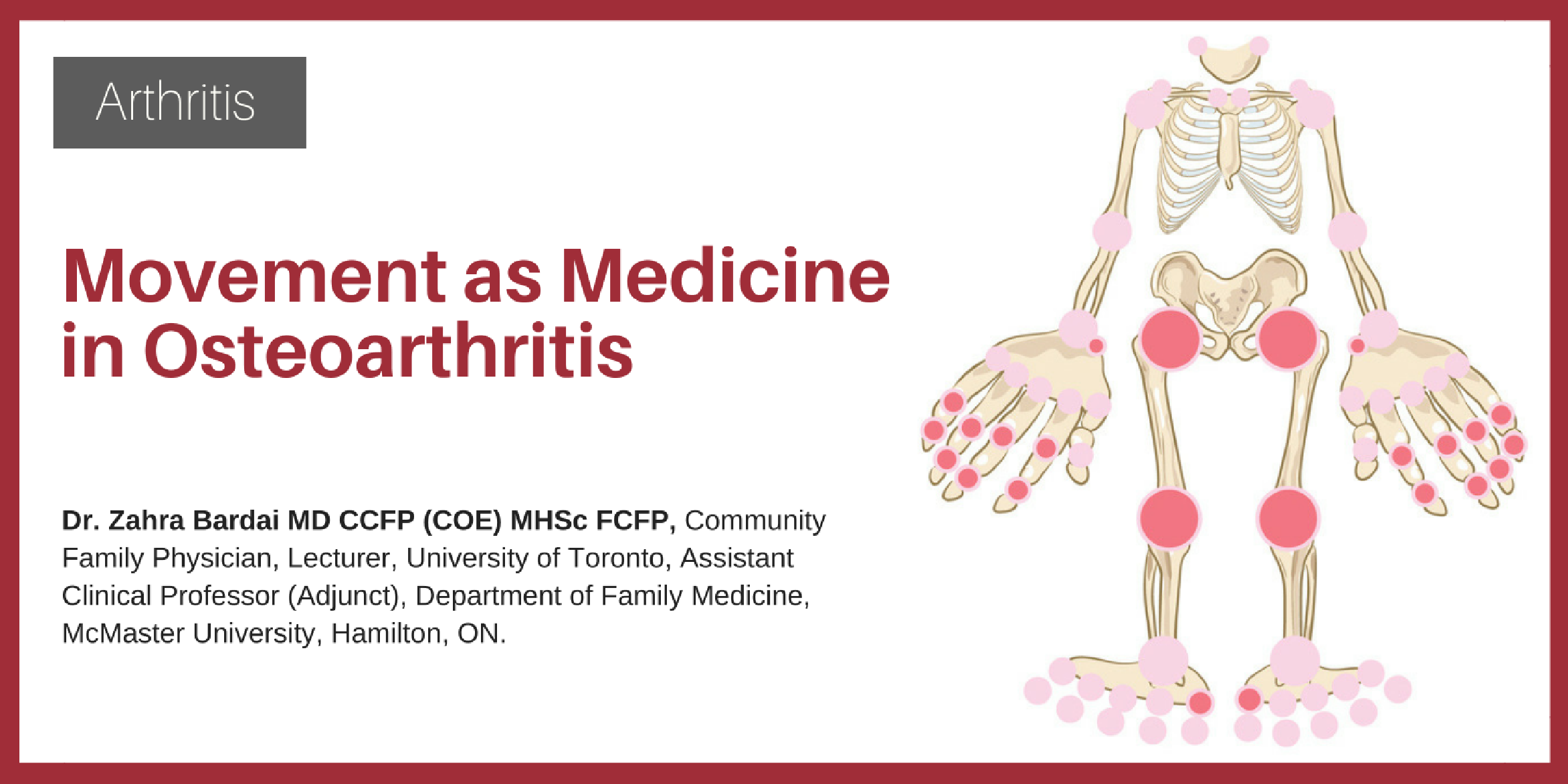
Dr. Zahra Bardai MD CCFP (COE) MHSc FCFP,
Community Family Physician, Lecturer, University of Toronto, Assistant Clinical Professor (Adjunct), Department of Family Medicine, McMaster University, Hamilton, ON.
CLINICAL TOOLS
| Abstract: Osteoarthritis is a prevalent health condition that affects millions of people worldwide. Increasingly, there has been a growing body of international recommendations emphasizing non-pharmacologic interventions using physical activity to modify joint mechanics. Discussion will focus on pathophysiology of joint mechanics as it relates to physical activity as well as the use of specific clinical strategies that can be incorporated into physical activity counseling in osteoarthritis management. |
| Key Words: Osteoarthritis, Physical Activity, Exercise Vital Sign, Exercise Prescription. |


| Osteoarthritis is a leading source of nonfatal health burden |
| Non-pharmacologic treatments of osteoarthritis focus on modifiable factors in joint mechanics |
| Osteoarthritis is a structural and functional failure of joints |
| Movement and physical activity have protective effects on osteoarthritic joints |
| The Exercise Vital Sign should become incorporated into assessments for preventative health and chronic disease including osteoarthritis. |
| The Exercise Prescription tool can help clinicians formally prescribe exercise as a treatment for their patients. |
| To have access to full article that these tools were developed for, please subscribe. The cost to subscribe is $80 USD per year and you will gain full access to all the premium content on www.healthplexus.net, an educational portal, that hosts 1000s of clinical reviews, case studies, educational visual aids and more as well as within the mobile app. |
Spine and Sport: Are Athlete's Back Injuries Different?
Dr. Julia Alleyne, BHSc(PT), MD, CCFP, Dip. Sport Med MScCH,
Family Physician practising Sport and Exercise Medicine at the Toronto Rehabilitation Institute, University Health Network. She is appointed at the University of Toronto, Department of Family and Community Medicine as an Associate Clinical Professor.
CLINICAL TOOLS
| Abstract: Athletes participating in training and competition for an average of 8 hours a week have a one year prevalence for spine injuries as high as 68%; an average increase of 18-31% compared to non-athletes. Except for young growing athletes at risk for structural deformity, most spine injuries are soft tissue and self-limiting. Risk factors include a sudden increase in training hours, transition in strength and coordination related to growth, sustained back flexion, reduced dynamic core stability and repetitive trunk rotation and hyper extension. Decreased training levels following back injury lead to deconditioning and muscle imbalance increasing the risk of recurrence and prolonging recovery. Core stability testing can identify patients for targeted exercise. |
| Key Words: Sport-related, spine, hypermobility, core stability, overuse. |
Members of the College of Family Physicians of Canada may claim MAINPRO-M2 Credits for this unaccredited educational program.
www.cfpc.ca/Mainpro_M2
You can take quizzes without subscribing; however, your results will not be stored. Subscribers will have access to their quiz results for future reference.


| Frequent repetition and sustained postures in rotation, hyperextension and full flexion require advanced levels of strength and flexibility for the athlete to remain injury-free. |
| The two most common risk factors for low back pain in training athletes is overuse strain and excessive spinal movements. |
| Treatment consists of both reducing the demands on the paraspinal muscles and increasing the amount of core stability. |
| It is important to screen for generalized joint hypermobility syndrome (JHS) affecting all joints using the Beighton Score, as this condition may require investigation and can be an indication of other medical syndromes. |
| The most specific test with high inter-rater reliability to determine core stability is the single leg standing balance stork test. The patient stands on one leg and raises the other knee to 90 degrees then maintains balance for a minimum of 25 seconds. |
| To have access to full article that these tools were developed for, please subscribe. The cost to subscribe is $80 USD per year and you will gain full access to all the premium content on www.healthplexus.net, an educational portal, that hosts 1000s of clinical reviews, case studies, educational visual aids and more as well as within the mobile app. |
Prescribing Exercise
Exercise offers significant health benefits to older people, but may also carry risks of injury and cardiovascular events. These can be minimized with appropriate screening, prescription, and monitoring of an exercise program. Tailored exercise prescription is developed in consultation with the participant, taking into account identified risks, functional limitations, and individual goals. Exercise professionals can provide valuable assistance with screening, prescription, and supervision of an exercise program, but limited access to experienced staff and supervised programs remains a significant barrier to exercise participation. Innovative models of care are required to investigate optimal participant targeting, long-term exercise adherence, and cost-effectiveness.
Key words: exercise therapy, physical fitness health services for older adults, risk assessment, patient compliance.
The Impact of Exercise Rehabilitation and Physical Activity on the Management of Parkinson’s Disease
Although medication therapy is generally effective in the clinical management of Parkinson’s disease (PD), additional improvement of some gross motor symptoms may be achieved through the use of nonpharmacological treatments, such as physical therapy and exercise rehabilitation. Despite the fact that PD is a neurological disorder, successful rehabilitation has been demonstrated with treatments that combine cognitive and physical approaches. While the exact mechanism through which these therapies obtain successful outcomes is still largely unknown, it is worthwhile to explore these adjunctive approaches to treating the motor output symptoms of PD.
Key words: Parkinson’s disease, movement disorders, exercise rehabilitation, physical therapy, motor control.
Yoga as a Complementary Therapy
By broadening yoga’s application beyond stress-related ailments to include preventative and curative therapies, physicians today have an advantage in treating patients’ illnesses and disorders. Specifically, yoga therapy complements patients’ traditional medical treatment of osteoarthritis and other bone and joint disorders. Following anatomical guidelines, yoga teachers can adapt postures (asanas) to ensure patients’ organs, joints, and bones are aligned to achieve physiologic changes. Recent studies performed by this author assessing the effect of yoga therapy on rheumatic diseases, such as osteoarthritis, and repetitive strain injuries, such as carpal tunnel syndrome, showed that yoga therapy caused physiologic changes, relieved pain, and improved motion.
Key words: osteoarthritis, yoga, Iyengar, exercise, repetitive strain injuries.
Screening for and Prescribing Exercise for Older Adults
Physical activity helps to maintain function, health, and overall quality of life for older adults. It is challenging, however, for health care providers and others who work with older adults to know what type of activity to encourage older adults to engage in, and how to motivate them to initiate and adhere to physical activity and exercise over time. The purpose of this piece is to provide an overview of physical activity for older adults and provide the resources needed to evaluate older adults and help them establish safe and appropriate physical activity programs, as well as providing motivational interventions that will eliminate the barriers to exercise and optimize the benefits.
Key words: exercise, screening, motivation, self-efficacy, outcome expectations.
Promotion of Exercise Prescriptions in General Practice for Older Populations
Boyd Swinburn, MB, ChB, FRACP, MD, Professor, Centre for Physical Activity and Nutrition, Deakin University, Melbourne, Victoria, Australia.
Richard Sager, BHlthSc (N&D), APD, Public Health Research Fellow, Greater Green Triangle University, Department of Rural Health, Deakin University, Warrnambool, Victoria, Australia.
Regular physical activity in older populations reduces the risks of cardiovascular diseases, diabetes, osteoporosis and falls and also improves mental health. Some programs of written exercise prescriptions by general practitioners have been shown to significantly increase physical activity levels over the medium-term (six to 12 months). Increasing the confidence and skills of general practitioners to prescribe and monitor exercise programs is important. However, the more challenging barriers to the widespread uptake of exercise prescription programs are the structural and economic constraints within general practice, as well as the competing promotion of prescribing pharmaceutical products. Implementation research on overcoming these barriers is urgently needed.
Key words: exercise prescriptions, general practitioner, health gains, training, barriers, health promotion.