
Editor's Note, Volume 5 Issue 3

D’Arcy Little, MD, CCFP, FRCPC
Medical Director, JCCC and HealthPlexus.NET

D’Arcy Little, MD, CCFP, FRCPC
Medical Director, JCCC and HealthPlexus.NET
Julie Man, MD,1 Joseph M. Lam, MD, FRCPC,2
1Department of Family Medicine, University of Alberta, Edmonton, AB.
2Assistant Clinical Professor, Department of Paediatrics, Associate Member, Department of Dermatology, University of British Columbia, BC.
Abstract: A 13-year-old girl presented with a 3-month history of a reticulate hyperpigmented patch over the lower abdomen. Her past medical history was significant for recurrent abdominal pain, Ehlers-Danlos syndrome, a mild learning disability, and multiple allergies. On physical examination, she had a reticulate, hyperpigmented patch distributed diffusely over the lower abdomen (Figure 1). The remainder of her exam was unremarkable. Upon questioning, it was revealed that the patient had been applying a hot water bottle to the lower abdomen for the last 4 months to help relieve the discomfort associated with the abdominal pain. This history led to the diagnosis.  |
| Key Words: Erythema ab igne, hyperpigmentation, reticulate, thermal injury. |
| Erythema ab igne may present as a transient erythematous eruption, or as a reticulate hyperpigmentation. |
| Erythema ab igne is a clinical diagnosis which rarely requires biopsy confirmation. |
| Direct questioning about heat sources, such as prolonged laptop computer use, aids the diagnosis. |
| Treatment consists of patient education and removal of the heat source. |
| 1. Erythema ab igne is a recognizable condition associated with chronic exposure to heat sources such as heating pads, hot water bottles, electric blankets, space heaters and laptop computers. |
| 2. The differential diagnosis for erythema ab igne includes livedo reticularis, livedoid vasculitis, cutis marmorata telangiectatica congenita, a reticulate port-wine stain and poikiloderma. |
| 3. The most important treatment for erythema ab igne is recognition and removal of the source of infrared radiation. |
| To have access to full article that these tools were developed for, please subscribe. The cost to subscribe is $80 USD per year and you will gain full access to all the premium content on www.healthplexus.net, an educational portal, that hosts 1000s of clinical reviews, case studies, educational visual aids and more as well as within the mobile app. |
Dr. Ted Findlay, D.O., CCFP,1 Amar Suchak, MD, FRCP(C),2
1Clinical Assistant Professor, Department of Medicine, University of Calgary, Private Family Medicine practice, Medical Staff, Alberta Health Services, Calgary Zone, Calgary, Alberta.
2Clinical Assistant Professor Department of Radiology, Department of Nuclear Medicine, University of Calgary, Calgary, Alberta.
| Abstract: Many clinicians believe that imaging is necessary to accurately diagnose and manage low back pain. However, there is good evidence that in the absence of "Red Flags", there is an overuse of both routine X-rays and advanced diagnostic imaging such as MRI. When imaging is used without appropriate clinical indications, it is rare for the results to lead to a change in a treatment plan. Management is based on adequate history and confirmatory physical examination. This article uses three actual cases as the basis for exploring the place of diagnostic imaging in treating low back pain. |
| Key Words: low back pain, diagnosis, radiology, indications, appropriate. |
Members of the College of Family Physicians of Canada may claim MAINPRO-M2 Credits for this unaccredited educational program.
www.cfpc.ca/Mainpro_M2You can take quizzes without subscribing; however, your results will not be stored. Subscribers will have access to their quiz results for future reference.


| 1. While imaging may be required in the management of specific cases of low back pain particularly when "Red Flags" are present, it is rare that unexpected findings will result in a change of the treatment plan. |
| 2. Be very cautious about the terminology used to describe the results of imaging studies and whenever possible normalize the results for the patient. Many abnormal findings may be "normal" for patients in older age groups. Many may be present in patients who are pain free. |
| 3. Ensure that the patient understands that the results of the images are not necessarily a barrier to recovery. |
| 4. Except to establish the boney contours of the spine, when advanced imaging is required an MRI examination is often the preferred option. |
| 5. Be very cautious about attributing the cause of a patient's pain to the results found on imaging. Careful correlation with the clinical presentation is required before deciding on any change in treatment. |
| In the absence of clinical "Red Flags", there is no indication to image the spine before initiating treatment. |
| It is never appropriate to delay treatment for mechanical low back pain to wait for an imaging procedure. |
| Prepare the patient, before advanced imaging is performed, that there is a very high likelihood that the investigation will find "abnormalities" but that these changes are usually the result of natural aging and no cause for concern. |
| To have access to full article that these tools were developed for, please subscribe. The cost to subscribe is $80 USD per year and you will gain full access to all the premium content on www.healthplexus.net, an educational portal, that hosts 1000s of clinical reviews, case studies, educational visual aids and more as well as within the mobile app. |
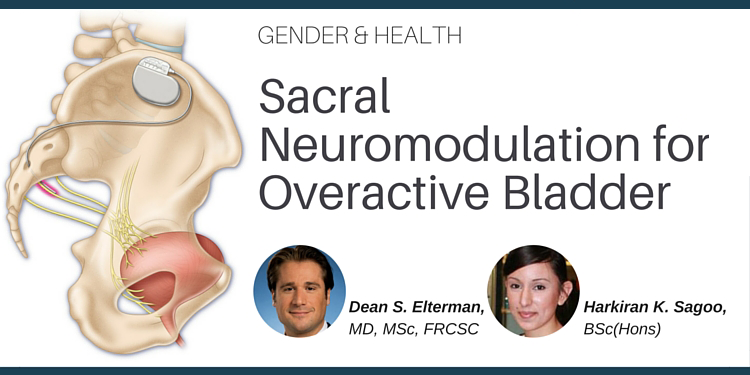
Dr. Dean S. Elterman, MD, MSc, FRCSC,1 Harkiran K. Sagoo, BSc(Hons),2
1Attending Urologic Surgeon, Toronto Western Hospital, University Health Network, Assistant Professor, Division of Urology, Department of Surgery, University of Toronto, Toronto, ON.
24th Year Medical Student at GKT School of Medicine, King's College London, U.K.
| Abstract: Sacral Neuromodulation (SNM) is a FDA-approved minimally invasive surgical therapy offered as a third-line treatment for refractory overactive bladder (OAB). Studies report improvements in continence, mean number of voids/day, quality of life, depression and sexual function in patients receiving SNM compared to medical therapy, with treatment success sustained long-term and with few adverse events. SNM is recommended by CUA and AUA guidelines in the treatment of OAB in carefully selected patients. |
| Key Words:Neuromodulation, Neurostimulation, Overactive, Bladder, Incontinence. |
Members of the College of Family Physicians of Canada may claim MAINPRO-M2 Credits for this unaccredited educational program.
www.cfpc.ca/Mainpro_M2You can take quizzes without subscribing; however, your results will not be stored. Subscribers will have access to their quiz results for future reference.

| Sacral neuromodulation should be offered as third-line treatment for patients with overactive bladder symptoms refractory to conservative/behavioural and/or pharmacological treatment. |
| Sacral neuromodulation is a minimally invasive procedure that may be offered to carefully selected patients with severe refractory overactive bladder that are willing to undergo a surgical procedure. |
| Sacral neuromodulation activates inhibitory sympathetic neurons using low-amplitude electrical stimulation of S3 afferent nerve roots to prevent detrusor contraction. |
| A prospective, randomized multi-center trial (level 1 evidence) reported improvements in incontinence, mean number of voids/day, quality of life, depression and sexual function in patients receiving sacral neuromodulation compared to standard medical treatment. |
| Adverse events/complications associated with SNM use include: pain at the implantation site, lead migration, wound-related complications, bowel dysfunction, infection, and generator problems. |
| Sacral neuromodulation is a FDA-approved minimally-invasive surgical therapy used as third-line treatment of overactive bladder symptoms/refractory overactive bladder. It is carried out in two stages, the first (evaluation) stage involves insertion of a temporary generator to assess clinical efficacy, and the second stage involves insertion of a permanent neuromodulator implant in patients that have demonstrated >50% improvement in symptoms during the evaluation stage. |
| Evidence from randomized, controlled trials, prospective multicenter, prospective single-center and retrospective studies demonstrates clinical efficacy of SNM in reducing symptoms of overactive bladder in these patients and therefore SNM is recommended by CUA and AUA guidelines in the treatment of overactive bladder in carefully-selected patients, as the risks of the procedure outweigh the burdens of the overactive bladder syndrome. |
| To have access to full article that these tools were developed for, please subscribe. The cost to subscribe is $80 USD per year and you will gain full access to all the premium content on www.healthplexus.net, an educational portal, that hosts 1000s of clinical reviews, case studies, educational visual aids and more as well as within the mobile app. |
Michael Gordon, MD, MSc, FRCPC,
Medical Program Director, Palliative Care, Baycrest Geriatric Health Care System, Professor of Medicine, University of Toronto, Toronto, ON.
| Abstract: The progress of medicine over previous decades includes benefits in the world of vaccination against especially childhood disease. It is therefore surprising to witness the growing and vociferous opposition to childhood vaccination, especially for measles. This poses substantial personal and public health risks. It is important to understand the reasons that anti-vaccination sentiment has taken hold among many often highly educated parents. |
| Key Words: Vaccination, anti-vaxxers, polio, measles vaccine. |
| The public are not always convinced by the best of medical evidence. |
| Medicine is always evolving—the public does not always understand the process. |
| The history of vaccination is long with many great heroes some of whom were not medical or scientific professionals. |
| Trying to convince people who believe vaccination causes childhood diseases may not respond to more and more evidence as their belief is almost religious in nature. |
| Sometimes it is the perspective of those old enough to remember the scourge of childhood infectious illnesses who can play a role in helping their children who may oppose vaccination come to their parental senses. |
| To have access to full article that these tools were developed for, please subscribe. The cost to subscribe is $80 USD per year and you will gain full access to all the premium content on www.healthplexus.net, an educational portal, that hosts 1000s of clinical reviews, case studies, educational visual aids and more as well as within the mobile app. |


