Disclaimer:  While every attempt is made to ensure that drug dosages provided within the text of this journal and the website are accurate, readers are urged to check drug package inserts before prescribing. Views and opinions in this publication and the website are not necessarily endorsed by or reflective of those of the publisher.

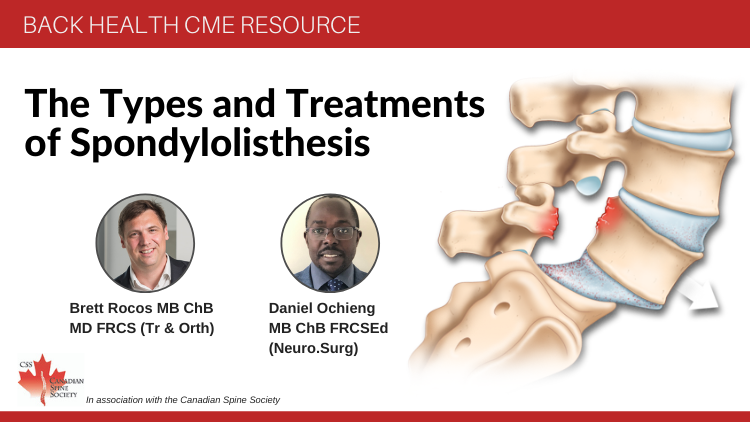
Brett Rocos MB ChB MD FRCS (Tr & Orth),1, Daniel Ochieng MB ChB FRCSEd (Neuro.Surg),2,

1 Consultant Spine Surgeon, Department of Spine Surgery, Barts Health NHS Trust, London, UK.
2Complex Spine Fellow, Department of Spine Surgery, Barts Health NHS Trust, London, UK.

CLINICAL TOOLS

Abstract: Spondylolisthesis is a common finding in the adult patient but seldom requires surgical intervention. Up to 18% of the population show spondylolisthesis on spinal imaging with the vast majority requiring little or no treatment. This review explores the aetiology of spondylolisthesis, alongside key findings in the history and examination that should prompt referral, as well as presenting the evidence supporting surgical treatment. Spondylolisthesis affects patients at nearly every stage of life and understanding why and how to manage this common problem will aid in counselling patients and making the right referrals.
Key Words: Spondylolisthesis, spondylosis, back pain, radicular pain, neurogenic claudication, spinal stenosis.

Members of the College of Family Physicians of Canada may claim MAINPRO-M2 Credits for this unaccredited educational program.

www.cfpc.ca/Mainpro_M2

You can take quizzes without subscribing; however, your results will not be stored. Subscribers will have access to their quiz results for future reference.

• Spondylolisthesis affects 18% of adults.
• Surgical treatment for spondylolisthesis is rarely required.
• Risk factors depend on the patient's age and include specific athletic activities, trauma and degenerative changes to the posterior elements.
• Examination findings can be normal.
• Surgical options include repair, decompression, and stabilisation of affected segments.
• Spondylolisthesis is a common incidental finding.
• Not every spondylolisthesis needs treatment.
• Uncontrolled pain is a valid reason for referral.
• Analgesia, physiotherapy, and injection therapy manage most cases successfully.
To have access to full article that these tools were developed for, please subscribe. The cost to subscribe is $80 USD per year and you will gain full access to all the premium content on www.healthplexus.net, an educational portal, that hosts 1000s of clinical reviews, case studies, educational visual aids and more as well as within the mobile app.

The book was sitting on my secretary's desk for many weeks.

Disclaimer at the end of each page

3P Episode 1: About Pills, Pearls & Patients (3P)

Author(s)
Thumbnail Image
Teaser

Welcome to 3P: pills, pearls, and patients where we will discuss current events in medicine, stories from real patient-physician encounters, and gain insight into what it's like being a physician in today's society.

Please note, that to access ths episode in full instead of the teaser available just below you would need to login.


Hello there and welcome to 3P. Pills, Pearls & Patients. I'm your host Dr. Marina Malik.

So welcome. Today is the first episode of Pills, Pearls & Patients. This is the introductory episode where we'll talk a little bit about myself, my practice and what the point of this podcast is and where it's going.

First just a disclaimer. Anything shared on this podcast is obviously not meant to replace any medical advice. It's the opinions of myself and any guests that we might have and if there are any references, they'll always be provided as well.

Please feel free to share any comments that you might have. Obviously we're aiming for an open discussion here and I look forward to you guys interacting with us for this podcast.

So a little bit about myself. As I mentioned, my name is Dr. Marina Malik. I am a fairly new medical graduate in family medicine. I practice in Mississauga, Ontario. I am a Lecturer and Faculty Member of the University of Toronto, Faculty of Family Medicine and Community Medicine. I'm really interested in teaching and medical education and I don't have any particular interests in medicine and I guess that's why i became a family doctor. I like to do it all from young to old, big, small, mental health, respiratory diseases, endocrine diseases, you name it.

I also do have my own personal blog, Health is Wealth and this is where I talk a little bit about my previous experiences as well as just some day-to-day thoughts. So if you're interested in checking it out it's anorexiarecovery1.blogspot.com

Book CoverI've also written a book which is called Recipe for Recovery, I battled and Overcame an Eating Disorder and You Can, Too! and that's mostly available on the publisher website at burnstownpublishinghouse.com. Again that's burnstownpublishinghouse.com, and eventually you'll be able to find this podcast transcribed so please feel free to read that afterwards if you're interested in any links as well as any information shared in this podcast.
...


Welcome to 3P: pills, pearls, and patients where we will discuss current events in medicine, stories from real patient-physician encounters, and gain insight into what it's like being a physician in today's society.

Section

Michael Gordon, MD, MSc, FRCPC,

Emeritus Professor of Medicine, University of Toronto, Toronto, ON.

CLINICAL TOOLS

Abstract: The evolution of medicine is quite remarkable and astounding. Modern medicine is successfully treating or providing long-term control of conditions which in the not-so-distant past were lethal or resulted in permanent disability. The strong emphasis on evidence-based medicine in today's medical profession has led to a more organized approach toward evaluating the safety and efficacy of new medical treatments. Despite attempts to meet the complex needs of an ever-aging population, an almost cynical or inherent distrust of physicians in general and their medical claims is being increasingly noted. For many physicians this has led to an uncomfortable sense of professional frustration as doubt is cast on themselves or the medical profession in general when the expectations and goals of patients or their families are not achieved. The causes of this apparent malady of contemporary medicine are myriad and may be explored from various perspectives, depending on the particular issue. To understand better the issues and challenges involved, today's medical practitioner needs to be aware of the complex mix of organizational, professional, ethical, and at times anthropological perspectives contributing to this dissonance between medical professionals and the public. Improving our insight into the forces at work in this dissonance will help medical professionals improve medical services to the public and contribute to the preservation of medicine's admirable historical legacy.
Key Words: Anti-vaccination movement, conspiracy theories, evidence-based medicine, medical quackery, trust in physicians.
Evidence-based medicine asks questions, finds and appraises the relevant data, and harnesses that information for everyday clinical practice. Evidence-based medicine follows four steps:
• Formulate a clear clinical question from a patient’s problem
• Search the literature for relevant clinical articles
• Evaluate (critically appraise) the evidence for its validity and usefulness
• Implement useful findings in clinical practice.
The growing mistrust undermines the patient-doctor relationship, as well as the public’s perspective of health care professionals and the system in general.
If the medical dissonance is left unresolved, the future of health care will become increasingly onerous for those wishing to enter its professions, ultimately impacting those in need of medical services.
To have access to full article that these tools were developed for, please subscribe. The cost to subscribe is $80 USD per year and you will gain full access to all the premium content on www.healthplexus.net, an educational portal, that hosts 1000s of clinical reviews, case studies, educational visual aids and more as well as within the mobile app.

Conner Joseph Clay1, José M. Orenday-Barraza, MD2, María José Cavagnaro MD2, Leah Hillier MD CCFP (SEM)3, Leeann Qubain1, Eric John Crawford MD MSc(c) FRCSC4, Brandon Hirsch MD5, Ali A. Baaj MD2, Robert A. Ravinsky MDCM MPH FRCSC5

1 University of Arizona College of Medicine – Phoenix, Phoenix, AZ.
2Department of Neurosurgery, University of Arizona College of Medicine – Phoenix, Phoenix, AZ.
3Department of Family Medicine & Community Medicine, Banner University Medical Center Phoenix, University of Arizona College of Medicine – Phoenix, Phoenix, AZ.
4Division of Orthopaedic Surgery, Department of Surgery, University of Toronto, Toronto, ON, Canada.
5Department of Orthopaedic Surgery, University of Arizona College of Medicine – Phoenix, Phoenix, AZ.

CLINICAL TOOLS

Abstract: Low back pain (LBP) is one of the most common presenting complaints in the primary care setting with significant economic implications and impairment of quality of life. Effective treatment of LBP can frequently be delivered in the primary care setting. Knowledge of common pain generators and recognition of pain patterns based on the history and physical exam helps guide the treatment of LBP without the need for excessive resource utilization. The majority of patients presenting with LBP can be confidently managed with targeted conservative management; when this fails further investigation may be warranted. Part 2 of this review focuses on imaging and diagnosis of LBP, as well as a detailed review of treatment modalities.
Key Words: low back pain, imaging, diagnostic interventions, treatment.

Members of the College of Family Physicians of Canada may claim MAINPRO-M2 Credits for this unaccredited educational program.

www.cfpc.ca/Mainpro_M2

You can take quizzes without subscribing; however, your results will not be stored. Subscribers will have access to their quiz results for future reference.

Patients presenting with lumbar-related complaints, in the absence of red flags or neurological deficits, can safely undergo a course of conservative treatment prior to ordering imaging studies.
Nonsurgical treatment modalities that can be attempted in patients with LBP include oral medications, topical medications, passive modalities, active physical therapy and cognitive interventions.
Diagnostic interventions such as selective nerve root blocks, diagnostic facet joint injections, medial branch blocks and provocative discography can be useful in confirming that a particular anatomical structure is a clinically relevant pain generator.
Surgery, in the absence of red flags or neurological deficits, should only be considered after the patient fails a thorough course of conservative treatment.
Images of the spine are not necessary to initiate management of mechanical low back pain; they may even be counterproductive.
When required, initial radiological evaluation of the lumbar spine involves upright plain radiographs. Further investigation may include use of MRI or CT myelography.
Diagnostic interventions can aid in establishing the dominant pain-generating anatomical structure but are not required if the patient is improving as anticipated.
To have access to full article that these tools were developed for, please subscribe. The cost to subscribe is $80 USD per year and you will gain full access to all the premium content on www.healthplexus.net, an educational portal, that hosts 1000s of clinical reviews, case studies, educational visual aids and more as well as within the mobile app.

Dr. Marina Abdel Malak, MD, CCFP, BSc.N,

is a Family Physician in Mississauga, Ontario. She has served on several committees and groups, including The Primary Care Network and Collaborative Mental Health Network. She has a passion for medical education, patient empowerment, and increasing awareness about the relationship between mental, emotional, and physical health. Dr. Abdel Malak is highly involved in quality improvement initiatives, and her research interests include strategies to support physician wellness, patient self-management, and optimizing physician education.

CLINICAL TOOLS

Abstract: The worst of the COVID-19 pandemic is finally behind us. Now comes the challenges of learning to 'live with COVID-19'. But what exactly does that mean? This article will provide some answers to such questions as what does living 'with COVID' mean? Who should continue wearing masks? Should we change the way we think about infections? Should we wear personal protective equipment all the time? Does it mean leaving the pandemic life behind and returning to what was 'previously normal?'.
Key Words: COVID-19, pandemic, new normal, living with COVID, masks.
The COVID-19 pandemic has had a major impact on our lives the past two years.
We must learn to 'live with COVID' and open our eyes to the deficiencies and strengths of our current systems and practices.
Officials, physicians and patients should work together to optimize healthcare outcome and promote health systems and practices.
A key role of government and public health is managing misinformation.
To have access to full article that these tools were developed for, please subscribe. The cost to subscribe is $80 USD per year and you will gain full access to all the premium content on www.healthplexus.net, an educational portal, that hosts 1000s of clinical reviews, case studies, educational visual aids and more as well as within the mobile app.
Disclaimer at the end of each page

It's not a new phenomenon—there are those who don't like or approve of any books…

Disclaimer at the end of each page

On the op-ed page was an article on the risk to Canada of the potential loss of American democracy.

Disclaimer at the end of each page