Arthritis

Disclaimer:  While every attempt is made to ensure that drug dosages provided within the text of this journal and the website are accurate, readers are urged to check drug package inserts before prescribing. Views and opinions in this publication and the website are not necessarily endorsed by or reflective of those of the publisher.

Dr. Zahra Bardai MD CCFP (COE) MHSc FCFP,

Community Family Physician, Lecturer, University of Toronto, Assistant Clinical Professor (Adjunct), Department of Family Medicine, McMaster University, Hamilton, ON.

CLINICAL TOOLS

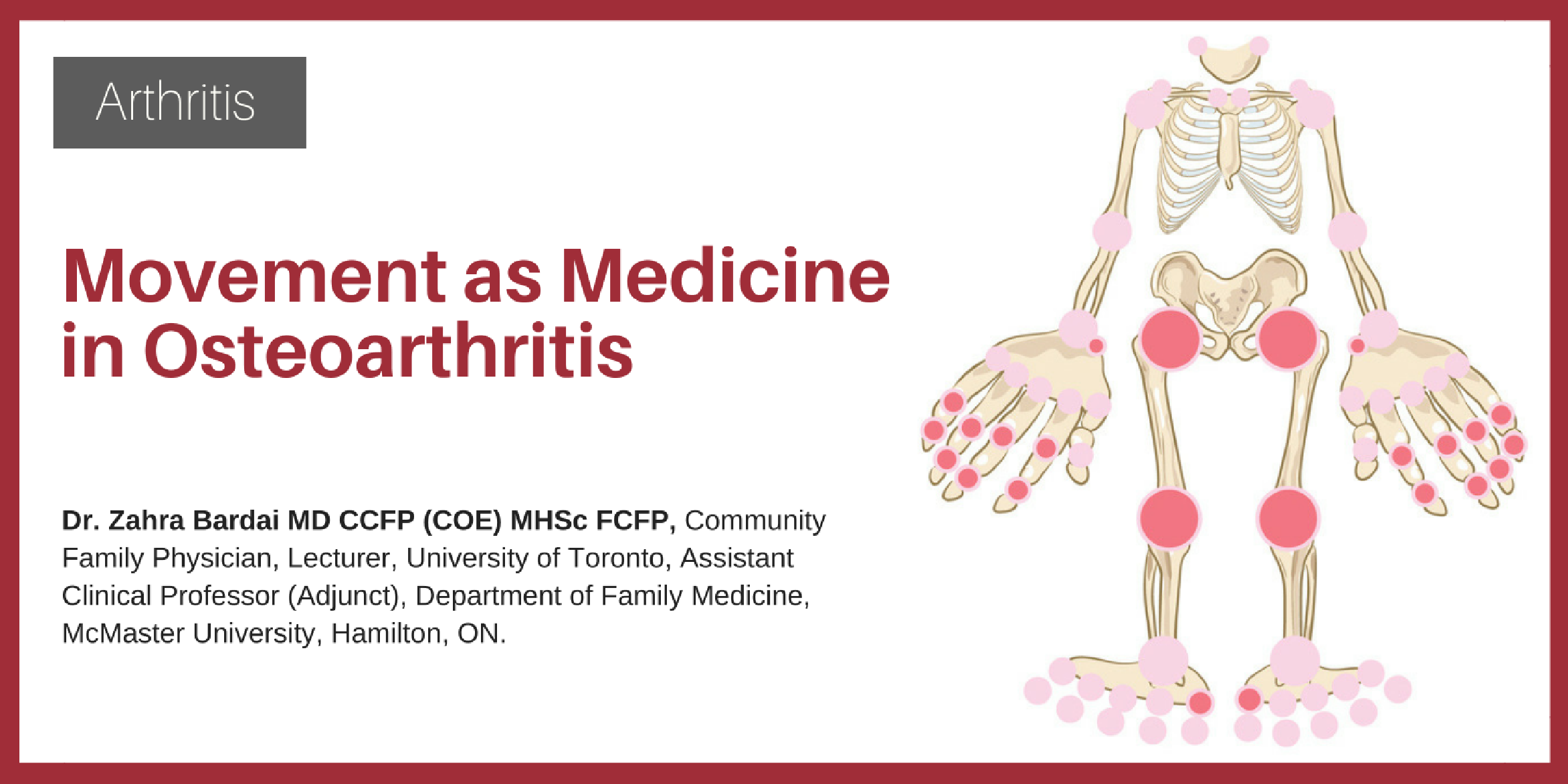
Abstract: Osteoarthritis is a prevalent health condition that affects millions of people worldwide. Increasingly, there has been a growing body of international recommendations emphasizing non-pharmacologic interventions using physical activity to modify joint mechanics. Discussion will focus on pathophysiology of joint mechanics as it relates to physical activity as well as the use of specific clinical strategies that can be incorporated into physical activity counseling in osteoarthritis management.
Key Words: Osteoarthritis, Physical Activity, Exercise Vital Sign, Exercise Prescription.
Osteoarthritis is a leading source of nonfatal health burden
Non-pharmacologic treatments of osteoarthritis focus on modifiable factors in joint mechanics
Osteoarthritis is a structural and functional failure of joints
Movement and physical activity have protective effects on osteoarthritic joints
The Exercise Vital Sign should become incorporated into assessments for preventative health and chronic disease including osteoarthritis.
The Exercise Prescription tool can help clinicians formally prescribe exercise as a treatment for their patients.
To have access to full article that these tools were developed for, please subscribe. The cost to subscribe is $80 USD per year and you will gain full access to all the premium content on www.healthplexus.net, an educational portal, that hosts 1000s of clinical reviews, case studies, educational visual aids and more as well as within the mobile app.

Making Sense of Low Back Pain

Hamilton Hall, MD, FRCSC,1 Julia Alleyne, BHSc(PT), MD, CCFP, Dip. Sport Med MScCH,2 Yoga Raja Rampersaud, MD, FRCSC,3

1Professor, Department of Surgery, University of Toronto; Medical Director, Canadian Back Institute; Executive Director, Canadian Spine Society, Toronto, ON.
2Associate Professor, Department of Family and Community Medicine, University of Toronto, Medical Director, Sport CARE, Women’s College Hospital, Toronto, ON.
3Associate Professor Department of Surgery, University of Toronto, Divisions of Orthopaedic and Neurosurgery, University Health Network Medical Director, Back and Neck Specialty Program, Altum Health, Immediate Past President Canadian Spine Society, Toronto, ON.

CLINICAL TOOLS

Abstract: In 1987, the Quebec Taskforce noted, "Distinct patterns of reliable clinical findings are the only logical basis for back pain categorization and subsequent treatment." Identifying these patterns begins with the patient's history: "Where is your pain the worst?" "Is your pain constant or intermittent?" "Has there been any change in your bowel or bladder function?" This questioning establishes the mechanical nature of the pain, and a physical examination verifies or refutes the pattern established in the history. The examination involves two essential tests to detect upper motor and low sacral root involvement. A failure of the results to fit into one of four syndromes—two back dominant and two leg dominant—suggests a non-mechanical or more complex problem.
Key Words:patterns of back pain, pain location, pain characteristics, history, physical examination.

HealthPlexus is offering an eCME in support of the Back Pain Management Resource

eCME: The Latest in Back Pain Management

This CME activity offers interactive Videos, Animations, Pre- and Post-test Quizzes and you will be able to download a Certificate of Participation upon completion.

90% of Low Back Pain is not related to serious pathology and does not require surgical intervention.
Mechanical Low Back Pain can be categorized to patterns that are identified in history and confirmed in the physical examination.
Findings on radiological imaging including x-ray, CT scan and MRI have not been found to correlate to pain-generating pathology, can increase patient anxiety and detract from successful recovery.
A concise history starts with two questions: "Where is your pain the worst?" and "Is your pain constant or intermittent?"
The goal of physical examination is to verify or refute the diagnostic assumptions made on the basis of the history.
Managing low back pain is not a one-time event. Low back pain is a chronic condition that demands ongoing care and follow-up.
To have access to full article that these tools were developed for, please subscribe. The cost to subscribe is $80 USD per year and you will gain full access to all the premium content on www.healthplexus.net, an educational portal, that hosts 1000s of clinical reviews, case studies, educational visual aids and more as well as within the mobile app.

Managing Back Dominant Pain

Hamilton Hall, MD, FRCSC,1 Julia Alleyne, BHSc(PT), MD, CCFP, Dip. Sport Med MScCH,2 Yoga Raja Rampersaud, MD, FRCSC,3

1Professor, Department of Surgery, University of Toronto; Medical Director, Canadian Back Institute; Executive Director, Canadian Spine Society, Toronto, ON.
2Associate Professor, Department of Family and Community Medicine, University of Toronto, Medical Director, Sport CARE, Women’s College Hospital, Toronto, ON.
3Associate Professor Department of Surgery, University of Toronto, Divisions of Orthopaedic and Neurosurgery, University Health Network Medical Director, Back and Neck Specialty Program, Altum Health, Immediate Past President Canadian Spine Society, Toronto, ON.

CLINICAL TOOLS

Abstract: Back dominant pain is either intensified by flexion or is not aggravated by bending forward. The most common pattern, probably discogenic, subdivides into two groups: one with pain on flexion but relief on extension, the other with pain in both directions. The second pattern has symptoms with extension only. Treatment begins with education about the true benign nature of the problem. Mechanical pain responds to posture adjustment and pattern-specific movement. Medication has a secondary role. Imaging is not required for the responding patient. The inability to detect a pattern or a lack of anticipated response combined with non-mechanical findings indicates the need for appropriate referral.
Key Words:back dominant pain, education, medication, imaging, specialist referral.

HealthPlexus is offering an eCME in support of the Back Pain Management Resource

eCME: The Latest in Back Pain Management

This CME activity offers interactive Videos, Animations, Pre- and Post-test Quizzes and you will be able to download a Certificate of Participation upon completion.

Back Dominant pain can be divided into two presentations: pain that is predominantly reproduced with flexion or pain that is reduced or unaffected by flexion.
The recognition of mechanical low back pain is based on a precise history, a validating physical examination and a positive treatment result.
Referred pain to the leg may occur with back dominant pain but, unlike radicular pain, the neurological examination will be normal.
Facilitating the patient to engage in activity that does not aggravate pain is the key to pain management and recovery.
The goal is control, not cure. Anything that relieves the pain and helps to restore mobility is valuable.
Medication has a limited and secondary role. There is no place for the routine use of narcotics or psychotropic drugs.
To have access to full article that these tools were developed for, please subscribe. The cost to subscribe is $80 USD per year and you will gain full access to all the premium content on www.healthplexus.net, an educational portal, that hosts 1000s of clinical reviews, case studies, educational visual aids and more as well as within the mobile app.

Managing Leg Dominant Pain

Yoga Raja Rampersaud, MD, FRCSC,1 Julia Alleyne, BHSc(PT), MD, CCFP, Dip. Sport Med MScCH,2 Hamilton Hall, MD, FRCSC,3

1Associate Professor Department of Surgery, University of Toronto, Divisions of Orthopaedic and Neurosurgery, University Health Network Medical Director, Back and Neck Specialty Program, Altum Health, Immediate Past President Canadian Spine Society, Toronto, ON.
2Associate Professor, Department of Family and Community Medicine, University of Toronto, Medical Director, Sport CARE, Women’s College Hospital, Toronto, ON.
3Professor, Department of Surgery, University of Toronto; Medical Director, Canadian Back Institute; Executive Director, Canadian Spine Society, Toronto, ON.

CLINICAL TOOLS

Abstract: Leg dominant pain suggests direct nerve root involvement: radicular, not referred symptoms. Constant pain associated with positive neurological findings usually results from an acute disc herniation. Symptoms are the result of mechanical compression but principally reflect an inflammatory response, properly designated sciatica. Intermittent leg dominant pain triggered by activity in extension and relieved by rest in flexion probably represents neurogenic claudication: nerve root ischemia secondary to spinal stenosis. Except for acute cauda equina syndrome, acute sciatica is initially managed with scheduled rest, adequate medication, and time. Non-responsive cases may require surgery. Surgery also shows superior outcomes for disabling neurogenic claudication.
Key Words:leg dominant pain, sciatica, neurogenic claudication, cauda equina syndrome, surgery.

HealthPlexus is offering an eCME in support of the Back Pain Management Resource

eCME: The Latest in Back Pain Management

This CME activity offers interactive Videos, Animations, Pre- and Post-test Quizzes and you will be able to download a Certificate of Participation upon completion.

True spine-generated, leg dominant pain is consistently reproduced by particular spinal movements or positions.
No imaging investigation is required for a patient presenting an unequivocal clinical picture and exhibiting steady predictable improvement.
Of the four back pain syndromes, only neurogenic claudication is consistently best treated by surgery.
In contrast to the back dominant cases, in sciatica there is a definite role for short-acting narcotics or psychotropic drugs for uncontrolled pain.
Criteria for Surgical Referral
Emergency Referral The symptoms of Cauda Equina Syndrome are: - Urinary retention followed by insensible urinary overflow. - Unrecognized fecal incontinence. - Loss or decrease in saddle/perineal sensation. Acute Cauda Equina Syndrome is a surgical emergency.
Consider Elective Referral Failure to respond to a trial of conservative care: - Unbearable constant leg dominant pain. - Worsening nerve irritation tests (SLR or femoral nerve stretch). - Expanding motor, sensory or reflex deficits. - Recurrent disabling sciatica. - Disabling neurogenic claudication.
To have access to full article that these tools were developed for, please subscribe. The cost to subscribe is $80 USD per year and you will gain full access to all the premium content on www.healthplexus.net, an educational portal, that hosts 1000s of clinical reviews, case studies, educational visual aids and more as well as within the mobile app.

An Active Approach to the Treatment of Frozen Shoulder

R.N. Martinez-Gallino, MD, Department of Orthopaedic Surgery, University of British Columbia, Vancouver, BC.
L.K. Burke, BScN, BHSc, Department of Orthopaedic Surgery, University of British Columbia, Vancouver, BC.
R.G. McCormack, MD, FRCSC, Department of Orthopaedic Surgery, University of British Columbia, Vancouver, BC.

Frozen shoulder, or adhesive capsulitis, is a frustrating condition for both patients and physicians. The protracted course of frozen shoulder in combination with the pain and limited range of motion significantly impacts patients’ quality of life. Controversy over the best course of treatment for this chronic condition has proved to be a major challenge for physicians. The goal of this article is to present an organized review of the assessment and management of a frozen shoulder. The emphasis is placed on treatment options. Special considerations for the older adult are highlighted.
Key words: frozen shoulder, adhesive capsulitis, diabetes, glenohumeral joint, pain.

How to Make Sure Your Patient with Osteoarthritis Gets the Best Care

Cornelia M. Borkhoff, PhD, Postdoctoral Research Fellow, Centre for Global Health, University of Ottawa, Ottawa, ON; Canadian Osteoarthritis Research Program, Women’s College Hospital, Toronto, ON.
Gillian A. Hawker, MD, MSc, FRCPC, Chief of Medicine, Women’s College Hospital;
F.M. Hill Chair in Academic Women’s Medicine, University of Toronto; Arthritis Society of Canada Senior Distinguished Rheumatology Investigator, Toronto, ON.

Although total joint arthroplasty (TJA) is a highly effective treatment for individuals with moderate to severe osteoarthritis who have not responded to medical therapy, disparities in TJA utilization based on gender, race/ethnicity, and socioeconomic status are well documented. These disparities may be due in part to patient-level factors such as perceptions of, and willingness to consider, TJA. Another possible explanation is that subtle or overt biases may inappropriately influence physicians’ treatment recommendations regarding this procedure. Because of the potential for an increased quality of life among TJA recipients, disparity in rates of use of TJA among individuals with an identified need represents inadequate care. In this article, we make recommendations about how to make sure your patient gets the best care.
Key words: quality of care, osteoarthritis, joint arthroplasty, disparities.

Crystal-Induced Arthritis

Simon H.K. Huang, MD, FRCPC, Clinical Associate Professor, Division of Rheumatology, Faculty of Medicine, University of British Columbia, Vancouver, BC.
Ian K. Tsang, MB, FRCPC, Clinical Professor Emeritus, Division of Rheumatology, Faculty of Medicine, University of British Columbia, Vancouver, BC.

The two most common forms of crystal-induced arthritis among older adults are gout and calcium pyrophosphate dihydrate (CPPD) deposition disease. Gout in older adults has unique clinical features. The new case incidence is the same in males and females over age 60. Upper limb and polyarticular involvement are not unusual. CPPD deposition disease may present as asymptomatic chondrocalcinosis on radiographs and symptomatically as pseudogout, pseudo–rheumatoid arthritis, or pseudo-osteoarthritis. Other crystals may cause periarthritis or arthritis. Management of crystal-induced arthritis among older adults requires special considerations due to comorbid conditions and concomitant medications. Nonsteroidal anti-inflammatory drugs may be contraindicated. Steroids taken either orally or intra-articularly are often an alternative.
Key words: gout, chondrocalcinosis, pseudogout, pseudo–rheumatoid arthritis, pseudo-osteoarthritis.