
Disclaimer: While every attempt is made to ensure that drug dosages provided within the text of this journal and the website are accurate, readers are urged to check drug package inserts before prescribing. Views and opinions in this publication and the website are not necessarily endorsed by or reflective of those of the publisher.

Dr. Pradeep Shenoy, MD, FRCS, FACS, DLO,1
Dr. Farah Tabassum, MD, FRCPC, FABP2
1ENT & Neck Surgeon, Campbellton Regional Hospital, Campbellton, New Brunswick, Canada.
2Pathologist, Campbellton Regional Hospital, Campbellton, New Brunswick, Canada.
CLINICAL TOOLS
| Abstract:Sublingual dermoid cysts are rare lesions in the oral cavity. Common oral lesions include: ranula; benign mucosal swelling; and sublingual salivary gland tumours. Uncommon types of lesions include: thyroglossal cysts, pilomatrixomas,12 pilomatrix carcinomas, and arteriovenous malformations. The etiology, diagnostic problems, radiological findings, various treatment approaches, and histopathological findings are described in the following case study, which includes a literature review. |
| Key Words: epidermoid cyst, submental swelling, sublingual swelling, sialo adenitis, thyroglossal cyst, pilomatrixoma. |


| Sublingual dermoid cysts are asymptomatic unless they are big causing pressure symptoms causing sialoadnitis, difficulty in swallowing, choking or pain while moving the tongue. |
| Good examination and CT scan of the neck helps to plan for the surgery. |
| Once removed completely the recurrence is very rare. |
| Dermoid cyst in the oral cavity are rare entity depending on the histological picutres that are classified into dermoid, epidermoid, and teratomas. |
| Complete excision through intra oral and external approach is done, depending on its site in relation with geniohyoid muscles. |
| To have access to full article that these tools were developed for, please subscribe. The cost to subscribe is $80 USD per year and you will gain full access to all the premium content on www.healthplexus.net, an educational portal, that hosts 1000s of clinical reviews, case studies, educational visual aids and more as well as within the mobile app. |
Should We Keep Meeting Like This?—The Place for Reunions
Deck
Reunions are unusual and sometimes bizarre phenomena.
Thumbnail Image


Reunions are unusual and sometimes bizarre phenomena. It is curious that people seem to be drawn to meeting over periods of many years or even decades with people that they may or may not have been close to during some period of their formative years of education. Think about the likelihood that at a high school reunion, you might meet more than a few people of significance in your life or with whom you have even the remotest interest in knowing what they have done during the intervening years.
Topic
Section
Editor's Note, Volume 6 Issue 5

D’Arcy Little, MD, CCFP, FRCPC
Medical Director, JCCC and HealthPlexus.NET

Justin J. Badal, MD,1 Genevieve Sweet, MD, 2Shelley Godley, MD,3Stanley A. Yap, MD,4Dana Nanigian, MD, 5
1Department of Urology, University of
California Davis, Sacramento, California.
2Department of Urology, Sutter Medical Group,
Roseville, California.
3Department of Urology, Veterans Affairs
Northern California Health Care System, Sacramento,
California.
4Department of Urology, University of California
Davis, Sacramento, California and Department of Urology,
Veterans Affairs Northern California Health Care System,
Sacramento, California.
5Chief of Urology, Department of Urology,
Veterans Affairs Northern California Health Care System,
Sacramento, California.
CLINICAL TOOLS
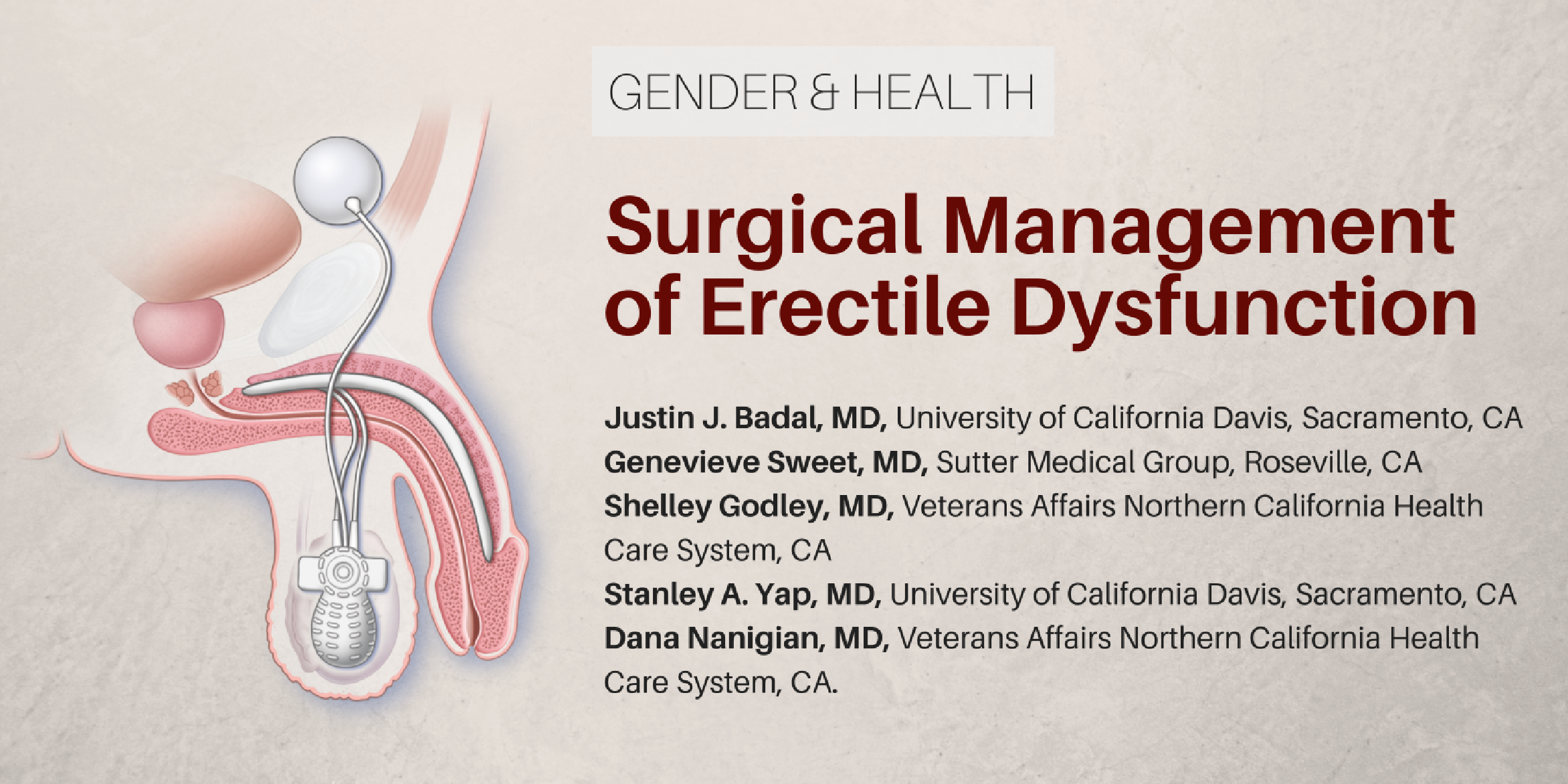
| Abstract: Erectile dysfunction (ED) is one of the most common sexual disorders affecting men. Discussion regarding erectile function, diagnosis, and management of the disease typically begins at the primary care level. A broad understanding of the basic causative factors and initial treatment regimens gives primary care physicians the ability to treat ED. An enhanced understanding of surgical options allows for referrals to be made to urologists for advanced surgical treatment of ED in patients who have failed medical therapies. Initial diagnosis and continued workup can be performed prior to consultation with a surgical specialist. Detailed here are different causes of ED as well as their respective studies to enhance initial surgical evaluation. |
| Key Words:erectile dysfunction, diagnosis, management, treatment. |
Members of the College of Family Physicians of Canada may claim MAINPRO-M2 Credits for this unaccredited educational program.
www.cfpc.ca/Mainpro_M2You can take quizzes without subscribing; however, your results will not be stored. Subscribers will have access to their quiz results for future reference.


| A thorough discussion regarding the irreversibility of penile implants is strongly recommended with the patient before proceeding. |
| Inflatable penile prosthetics avoid the effect of the constant erection created by malleable implants. |
| Partner satisfaction is highest with the inflatable penile prosthesis. |
| The inflatable penile prosthesis is the most preferred among men. |
| Adverse events/complications associated with SNM use include: pain at the implantation site, lead migration, wound-related complications, bowel dysfunction, infection, and generator problems. |
| Postoperative outcomes can be improved with detailed counseling in regards to modifiable risk factors, such as achieving appropriate glycemic control. |
| Candidates for revascularization therapy should be carefully selected, with those who are younger and have sustained pelvic trauma having the best outcomes. |
| To have access to full article that these tools were developed for, please subscribe. The cost to subscribe is $80 USD per year and you will gain full access to all the premium content on www.healthplexus.net, an educational portal, that hosts 1000s of clinical reviews, case studies, educational visual aids and more as well as within the mobile app. |
Lisa M. Flegel,1 Joseph M. Lam, MD, FRCSC,2
1Medical Degree Undergraduate Program, Northern Medical Program, University of British Columbia, BC.
2Clinical Assistant Professor, Department of Pediatrics and Dermatology, University of British Columbia, BC.
CLINICAL TOOLS
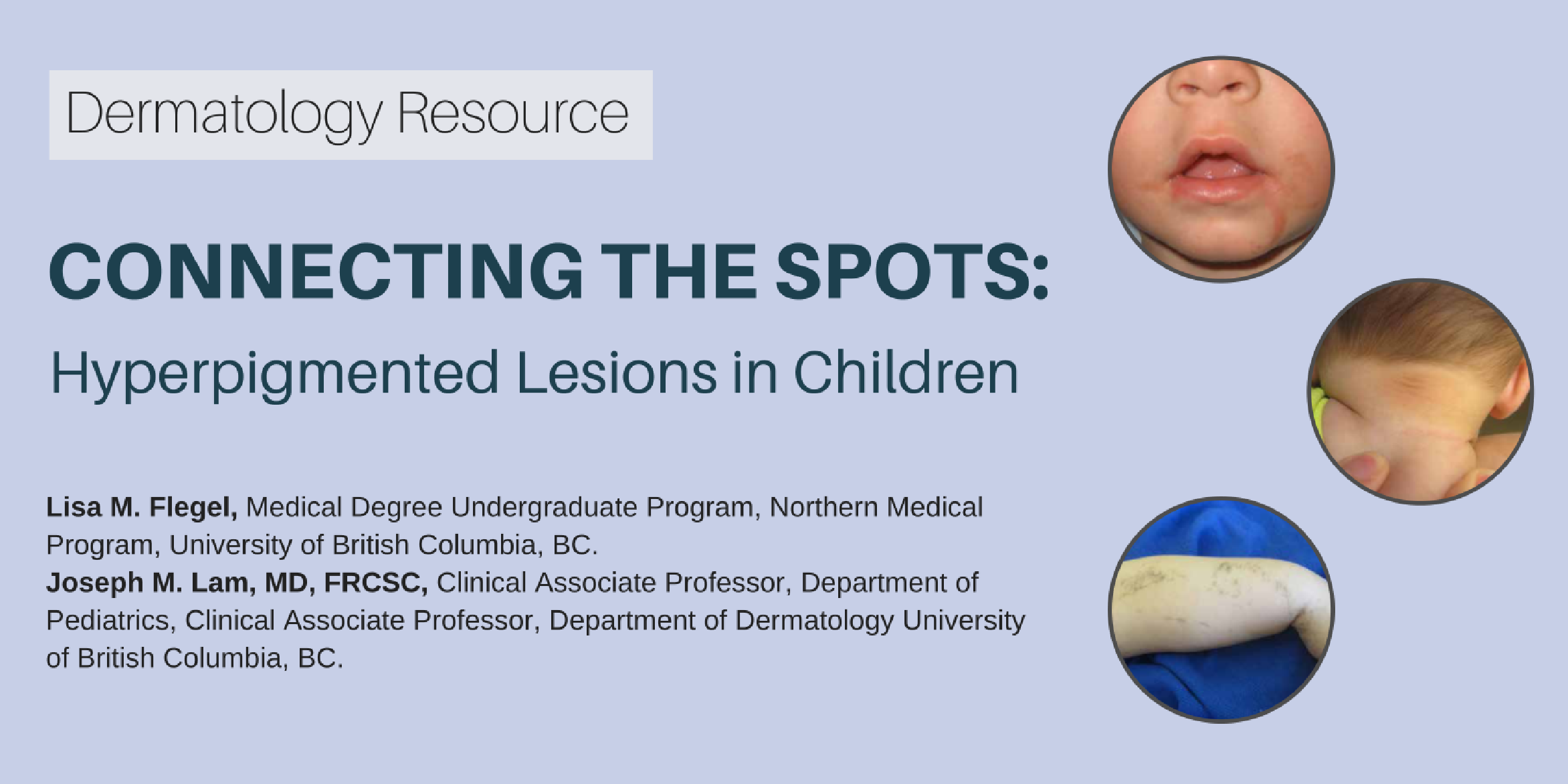
| Abstract: Hyperpigmented lesions are common in the pediatric population and identifying their etiologies can be challenging for physicians. Patients and caregivers may worry that hyperpigmented lesions are dangerous, associated with an internal illness or that they may lead to skin cancers. Having a better understanding of the causes and natural histories of these lesions may help to guide management and alleviate worry. This review article will provide an overview of select common and uncommon causes of hyperpigmented skin lesions in children. |
| Key Words: hyperpigmentation, pediatric. |

| 1. Most hyperpigmented lesions in children do not require treatment aside from for cosmesis. |
| 2. Features of malignant melanoma in children include: non-pigmented, uniform color, variable diameter, nodular lesions, and occurring de novo. |
| 3. Parents and children should be warned that melanocytic nevi will grow as their child grows, but growth should be proportionate. |
| 4. The risk of melanocytic nevi becoming malignant melanoma in children is very small. |
| In children with numerous melanocytic nevi, a good rule of thumb is to look for the 'ugly duckling' mole. |
| To track lesions over time, parents can develop a routine of taking a picture each year on the child's birthday. |
| To have access to full article that these tools were developed for, please subscribe. The cost to subscribe is $80 USD per year and you will gain full access to all the premium content on www.healthplexus.net, an educational portal, that hosts 1000s of clinical reviews, case studies, educational visual aids and more as well as within the mobile app. |